
Hello,
I would like to soundproof an open wooden beam ceiling. My plan is to lay a wooden layer of 20-25mm (around 1 inch) over the beams, then put a protective foil on top as a dust barrier. After that, I want to add another layer of beams with impact sound insulation attached underneath. I would like to size these beams according to recommendations to achieve good soundproofing. For the 4cm (1.5 inch) spaces between them, I’m considering filling them with sand. On top of the whole assembly, I plan to install a chipboard or OSB panel, followed by another soundproofing layer, and then floorboards, all decoupled from the walls.
Do you have any experience with this? Which materials would you recommend for soundproofing? How would you suggest transporting the sand? Is it possible to blow it in, like in sandblasting? Carrying all those bags upstairs would be quite a lot of work...!
Would it help to nail the first layer of floorboards instead of screwing them? Would it also make sense to put strips of impact sound insulation underneath? Probably best to avoid a rigid connection, since the sand should already add enough weight. Maybe someone has experience with this.
Best regards,
Bampa
I would like to soundproof an open wooden beam ceiling. My plan is to lay a wooden layer of 20-25mm (around 1 inch) over the beams, then put a protective foil on top as a dust barrier. After that, I want to add another layer of beams with impact sound insulation attached underneath. I would like to size these beams according to recommendations to achieve good soundproofing. For the 4cm (1.5 inch) spaces between them, I’m considering filling them with sand. On top of the whole assembly, I plan to install a chipboard or OSB panel, followed by another soundproofing layer, and then floorboards, all decoupled from the walls.
Do you have any experience with this? Which materials would you recommend for soundproofing? How would you suggest transporting the sand? Is it possible to blow it in, like in sandblasting? Carrying all those bags upstairs would be quite a lot of work...!
Would it help to nail the first layer of floorboards instead of screwing them? Would it also make sense to put strips of impact sound insulation underneath? Probably best to avoid a rigid connection, since the sand should already add enough weight. Maybe someone has experience with this.
Best regards,
Bampa
 Winniefred11 Apr 2023 15:10
You’ll need to explain more clearly what you’re planning. An old basement, a timber beam ceiling, and then a new building on top??
A
Audiobampa11 Apr 2023 15:44We have purchased an old holiday cottage with a solid basement built on a rock. Currently, there is a wooden beam ceiling on top of this basement, and a timber frame house has been constructed above it. This will now be demolished, and the basement gutted.
Our plan is to pour a concrete wall around the basement, then renew the basement ceiling, build up one storey with masonry, install the intermediate floor, and then build up another storey, followed by a mono-pitch roof with sarking insulation.
Why not use a heavy timber frame on an old basement? Because then basically only the load-bearing elements would remain...
Our plan is to pour a concrete wall around the basement, then renew the basement ceiling, build up one storey with masonry, install the intermediate floor, and then build up another storey, followed by a mono-pitch roof with sarking insulation.
Why not use a heavy timber frame on an old basement? Because then basically only the load-bearing elements would remain...
A
Audiobampa11 Apr 2023 20:43Here is the floor plan; maybe it will be helpful.
In the two upper floors, the ceilings rest only on the exterior walls.
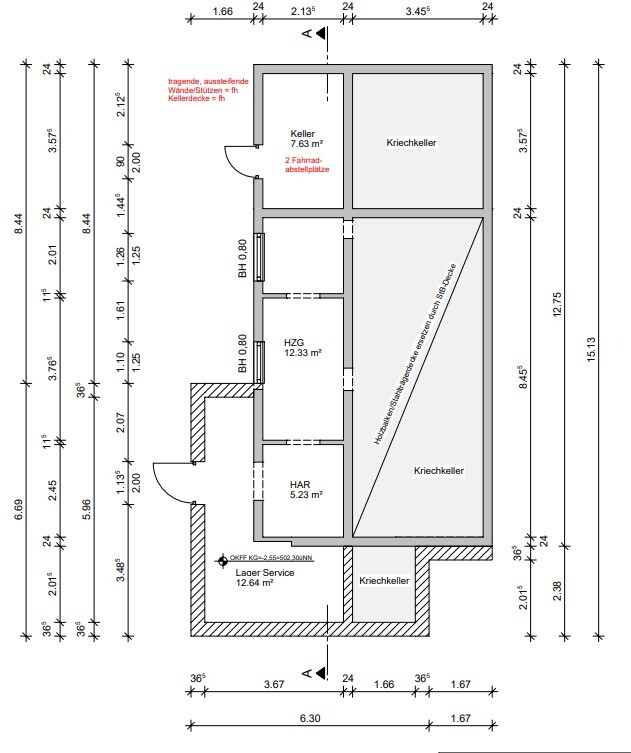
In the two upper floors, the ceilings rest only on the exterior walls.
Winniefred11 Apr 2023 21:52Interesting project. To be honest, I would be cautious about giving advice here, as it is quite a specialized situation. If it were my project, I would definitely consult the structural engineer again—regardless of which option is ultimately chosen. This is quite different from simply applying a bit of dry screed over a wooden beam ceiling in an ordinary intermediate floor of an old building.
However, I can recommend checking with Fermacell; they have good customer service and detailed product information, including specific examples on improving sound insulation with their products in wooden beam ceilings. Personally, I would avoid using wood-based dry screed (WBD) altogether and always opt for concrete. We have WBD in our older building, and it's fine, but if you are building new...?
However, I can recommend checking with Fermacell; they have good customer service and detailed product information, including specific examples on improving sound insulation with their products in wooden beam ceilings. Personally, I would avoid using wood-based dry screed (WBD) altogether and always opt for concrete. We have WBD in our older building, and it's fine, but if you are building new...?
A
Audiobampa12 Apr 2023 03:24Yes, concrete was the original plan, but on the one hand, the concrete work in that location made up about 70% of the shell construction costs, and the company insisted on using a crane. Since the crane operator then said they couldn’t access the site, the only option left is the HBD, which also looks nice. Well, the impact sound insulation isn’t great, but I also hope the construction costs will decrease significantly. I’m still waiting for quotes...
Similar topics