
Hello everyone,
I want to undertake the insulation of the top floor ceiling myself.
[Facts]:
- Semi-detached house built in 1972, two floors with heated basement rooms
- Upper floor ceiling made of reinforced concrete - B225, thickness according to plan 16cm (6.3 inches)
- Roof pitch is 18 degrees and cannot be converted into living space
- The purlins rest directly on the concrete ceiling
- The roof will not be insulated; instead, the floor will be insulated
- The attic space should be partially usable as storage and walkable
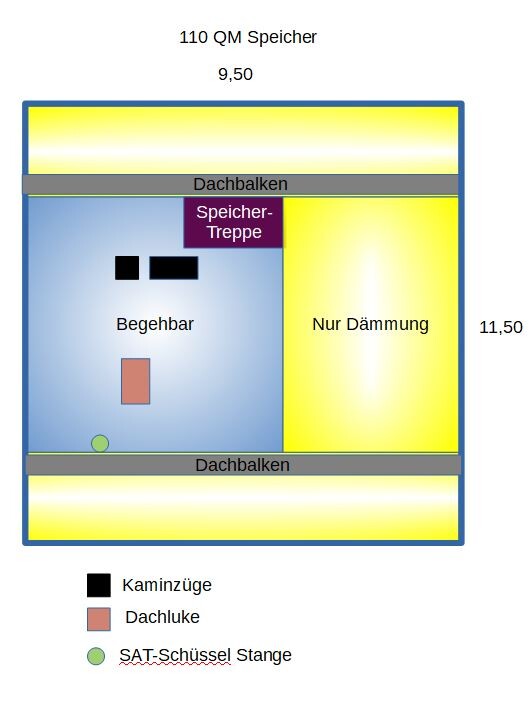
See sketch top view attic 110 sqm (1184 sq ft) area, approx. 40 sqm (430 sq ft) walkable
[Questions]:
1) Preparations:
What preparations do I need to make on the concrete before starting work? Thorough cleaning?
2) Vapor barrier:
Do I also need to install a vapor barrier foil on the reinforced concrete B225 at the upper floor?
3) Insulation material:
I plan to lay EPS 040 WI/DI/DZ 50mm (2 inch) polystyrene boards (width 500mm (20 inches) x length 1000mm (39 inches)) double-layered and staggered (without cross joints) everywhere.
This means about 9-10cm (3.5-4 inches) of insulation thickness. What U-value would I achieve with this?
Material cost comes to around 800 EUR including VAT.
Which affordable insulation boards would you recommend for my project? Has anyone had experience using polystyrene boards?
4) OSB boards (thickness - no idea - any recommendations)?
For the walkable area I would additionally install OSB-3 tongue and groove boards, 12mm (0.5 inch) thick, 205cm (80 inches) x 62.5cm (25 inches).
Material cost is approximately 200 EUR including VAT.
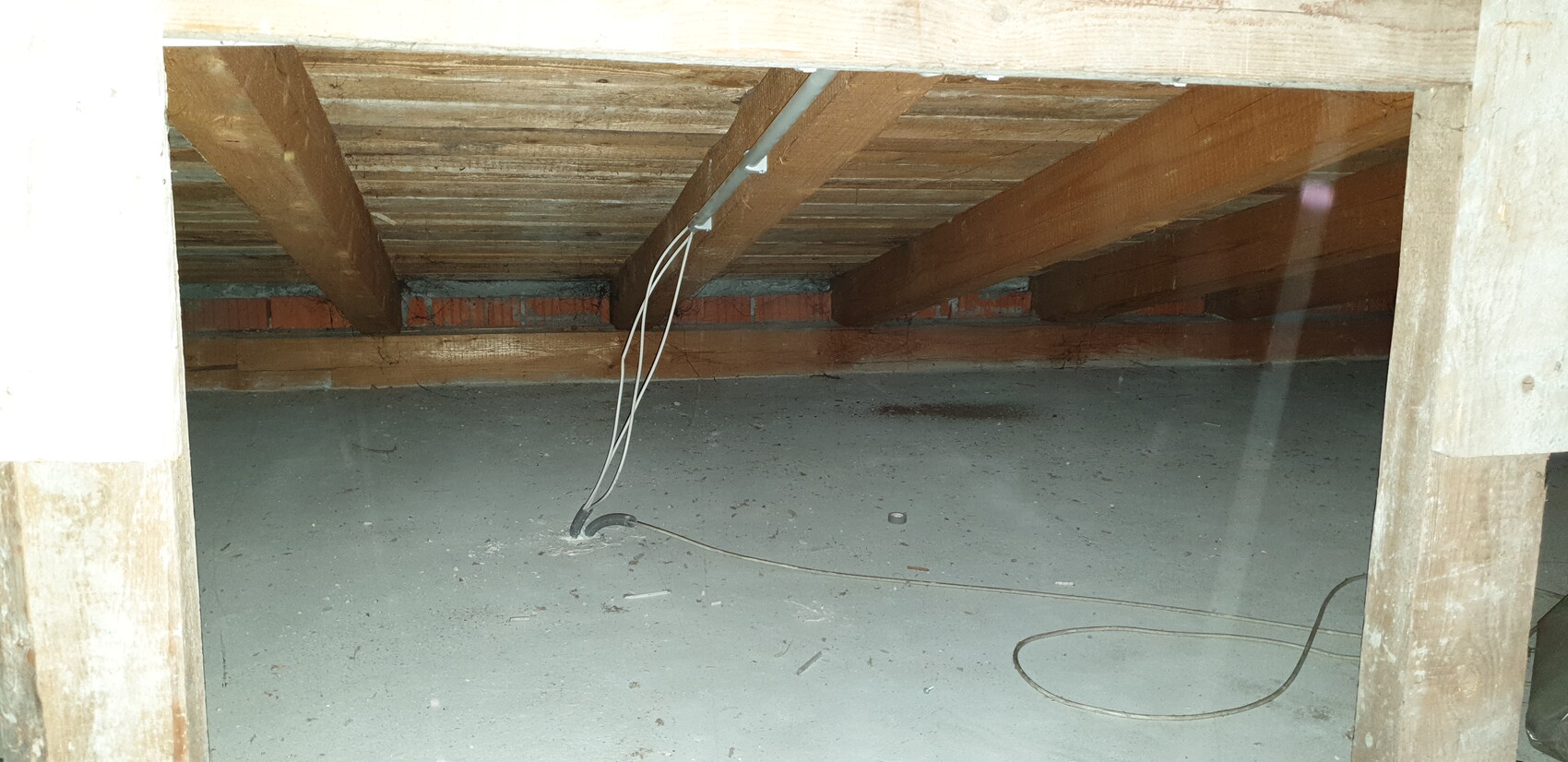
5) How should I deal with cables embedded in the concrete ceiling and around the purlins when insulating?
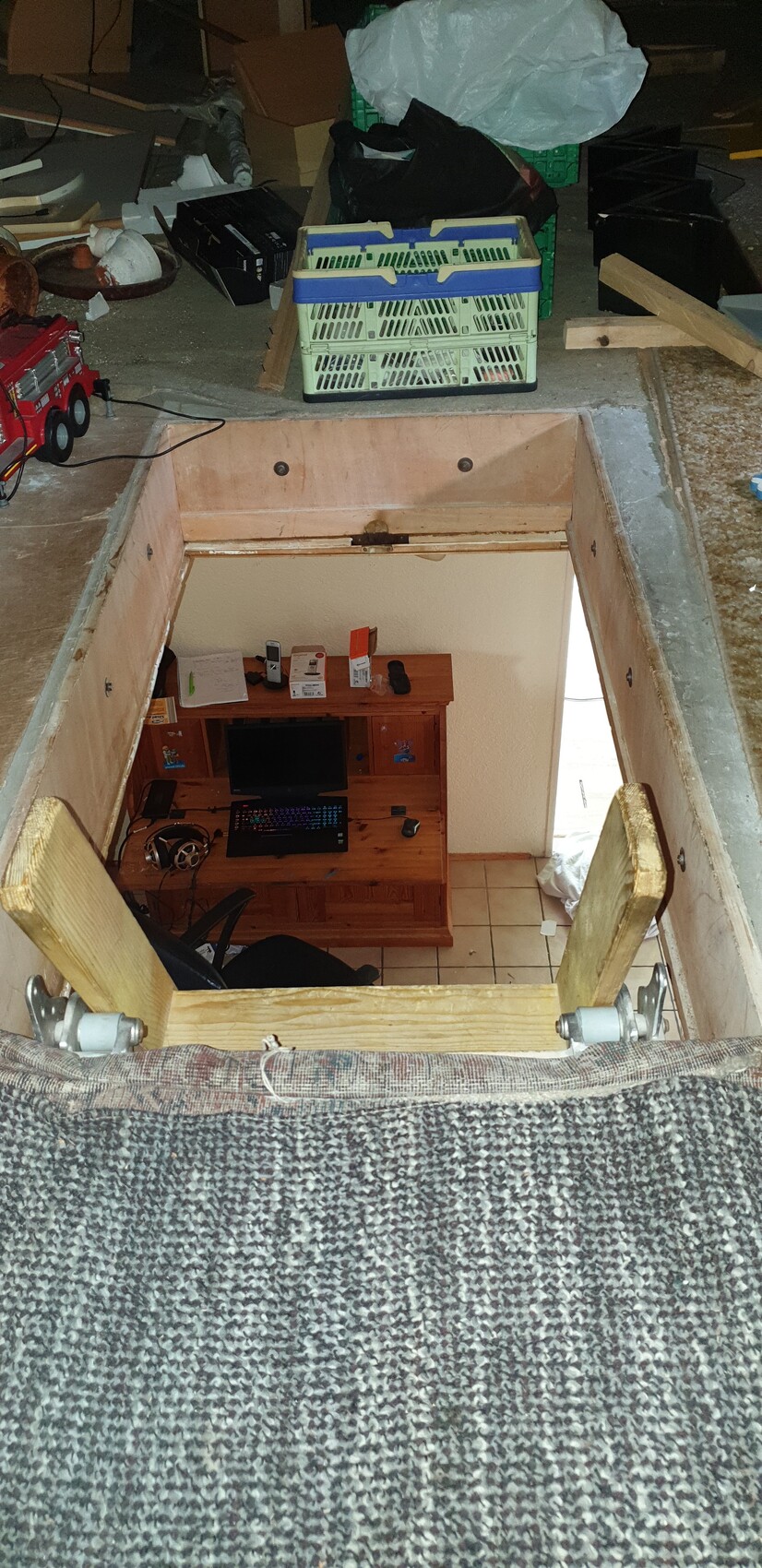
6) How should/could I insulate the attic stairs?
7) Are there any special considerations I might have overlooked?
Looking forward to your opinions/ideas/tips and tricks,
Chippy
I want to undertake the insulation of the top floor ceiling myself.
[Facts]:
- Semi-detached house built in 1972, two floors with heated basement rooms
- Upper floor ceiling made of reinforced concrete - B225, thickness according to plan 16cm (6.3 inches)
- Roof pitch is 18 degrees and cannot be converted into living space
- The purlins rest directly on the concrete ceiling
- The roof will not be insulated; instead, the floor will be insulated
- The attic space should be partially usable as storage and walkable
See sketch top view attic 110 sqm (1184 sq ft) area, approx. 40 sqm (430 sq ft) walkable
[Questions]:
1) Preparations:
What preparations do I need to make on the concrete before starting work? Thorough cleaning?
2) Vapor barrier:
Do I also need to install a vapor barrier foil on the reinforced concrete B225 at the upper floor?
3) Insulation material:
I plan to lay EPS 040 WI/DI/DZ 50mm (2 inch) polystyrene boards (width 500mm (20 inches) x length 1000mm (39 inches)) double-layered and staggered (without cross joints) everywhere.
This means about 9-10cm (3.5-4 inches) of insulation thickness. What U-value would I achieve with this?
Material cost comes to around 800 EUR including VAT.
Which affordable insulation boards would you recommend for my project? Has anyone had experience using polystyrene boards?
4) OSB boards (thickness - no idea - any recommendations)?
For the walkable area I would additionally install OSB-3 tongue and groove boards, 12mm (0.5 inch) thick, 205cm (80 inches) x 62.5cm (25 inches).
Material cost is approximately 200 EUR including VAT.
5) How should I deal with cables embedded in the concrete ceiling and around the purlins when insulating?
6) How should/could I insulate the attic stairs?
7) Are there any special considerations I might have overlooked?
Looking forward to your opinions/ideas/tips and tricks,
Chippy
I have now been able to convince the energy consultant (after a call to KfW) that materials are also eligible for funding when they are properly installed by oneself.
However, I understood that with the 160mm (6 inch) PUR insulation boards, I could avoid the effort of installing a vapor barrier. I will now request a quote.
Even if I were to use the cheaper 160mm (6 inch) EPS polystyrene with a thermal conductivity of WLG 040, the material cost would still be around 10 EUR per m², and it wouldn’t achieve the same U-value. In that case, I would still need a vapor barrier, right?
However, I understood that with the 160mm (6 inch) PUR insulation boards, I could avoid the effort of installing a vapor barrier. I will now request a quote.
Even if I were to use the cheaper 160mm (6 inch) EPS polystyrene with a thermal conductivity of WLG 040, the material cost would still be around 10 EUR per m², and it wouldn’t achieve the same U-value. In that case, I would still need a vapor barrier, right?
N
nordanney30 Oct 2020 07:53parcus schrieb:
It’s just unfortunate if it’s not the final layer, and even more problematic if OSB boards are installed on top, which are then glued, and the vapor retarder ends up on the outside,... Why are you so skeptical? What factual reason do you have for that?
Please explain your comment regarding the Bauder system assemblies or building physics. I am just an amateur with 20 years of real estate experience and am eager to learn. From DIN 4108-3, I only understood that a vapor retarder or vapor barrier is not necessary.
parcus schrieb:
It’s just unfortunate if it’s not the final layer, and really unfortunate if OSB panels are going to be installed on top, which will then be glued, with the vapor retarder on the outside... You’ve already read my initial post, right? I am planning a) to create a walkable area only partially (using OSB or chipboard) and b) I could use a vapor-permeable tape on the upper side. Furthermore, I will select OSB or chipboard panels that are vapor-permeable. From my understanding, the moisture should then be able to escape.
Additionally, my concrete floor, built in 1972, has certainly no residual moisture left. I agree with you regarding new buildings – in that case, it is advisable to install a vapor barrier on a concrete slab, since there is still residual moisture within the concrete that needs to escape.
Is that correct so far? Otherwise, please clarify the matter factually and WITHOUT sarcasm. Thank you for your input.
Best regards
@nordanney
You can still learn new things even after many years. Bauder follows the DIN standard and therefore includes a vapor retarder in the system.
Factually: The water vapor diffusion-equivalent air layer thickness must decrease from the inside to the outside.
@chippy79
In the walkable area, this applies; b) is nonsense anyway because the joint is not large enough as a surface.
I am not referring to residual moisture but to water vapor, assuming the house is occupied.
You can still learn new things even after many years. Bauder follows the DIN standard and therefore includes a vapor retarder in the system.
Factually: The water vapor diffusion-equivalent air layer thickness must decrease from the inside to the outside.
@chippy79
In the walkable area, this applies; b) is nonsense anyway because the joint is not large enough as a surface.
I am not referring to residual moisture but to water vapor, assuming the house is occupied.
Similar topics