
Hello everyone,
I want to undertake the insulation of the top floor ceiling myself.
[Facts]:
- Semi-detached house built in 1972, two floors with heated basement rooms
- Upper floor ceiling made of reinforced concrete - B225, thickness according to plan 16cm (6.3 inches)
- Roof pitch is 18 degrees and cannot be converted into living space
- The purlins rest directly on the concrete ceiling
- The roof will not be insulated; instead, the floor will be insulated
- The attic space should be partially usable as storage and walkable
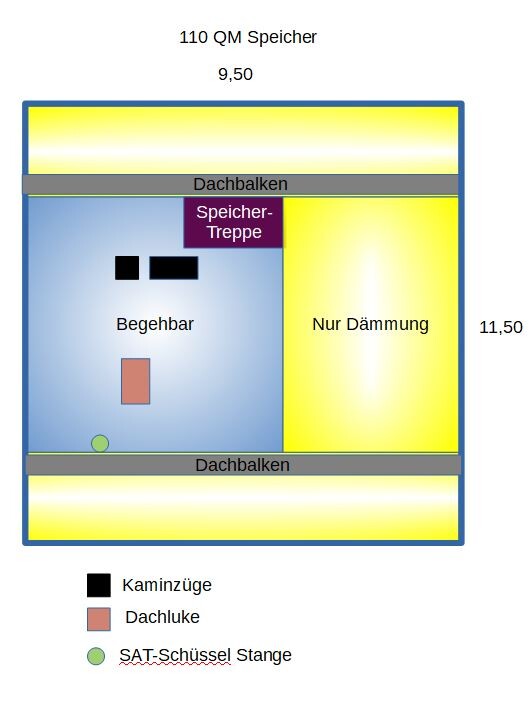
See sketch top view attic 110 sqm (1184 sq ft) area, approx. 40 sqm (430 sq ft) walkable
[Questions]:
1) Preparations:
What preparations do I need to make on the concrete before starting work? Thorough cleaning?
2) Vapor barrier:
Do I also need to install a vapor barrier foil on the reinforced concrete B225 at the upper floor?
3) Insulation material:
I plan to lay EPS 040 WI/DI/DZ 50mm (2 inch) polystyrene boards (width 500mm (20 inches) x length 1000mm (39 inches)) double-layered and staggered (without cross joints) everywhere.
This means about 9-10cm (3.5-4 inches) of insulation thickness. What U-value would I achieve with this?
Material cost comes to around 800 EUR including VAT.
Which affordable insulation boards would you recommend for my project? Has anyone had experience using polystyrene boards?
4) OSB boards (thickness - no idea - any recommendations)?
For the walkable area I would additionally install OSB-3 tongue and groove boards, 12mm (0.5 inch) thick, 205cm (80 inches) x 62.5cm (25 inches).
Material cost is approximately 200 EUR including VAT.
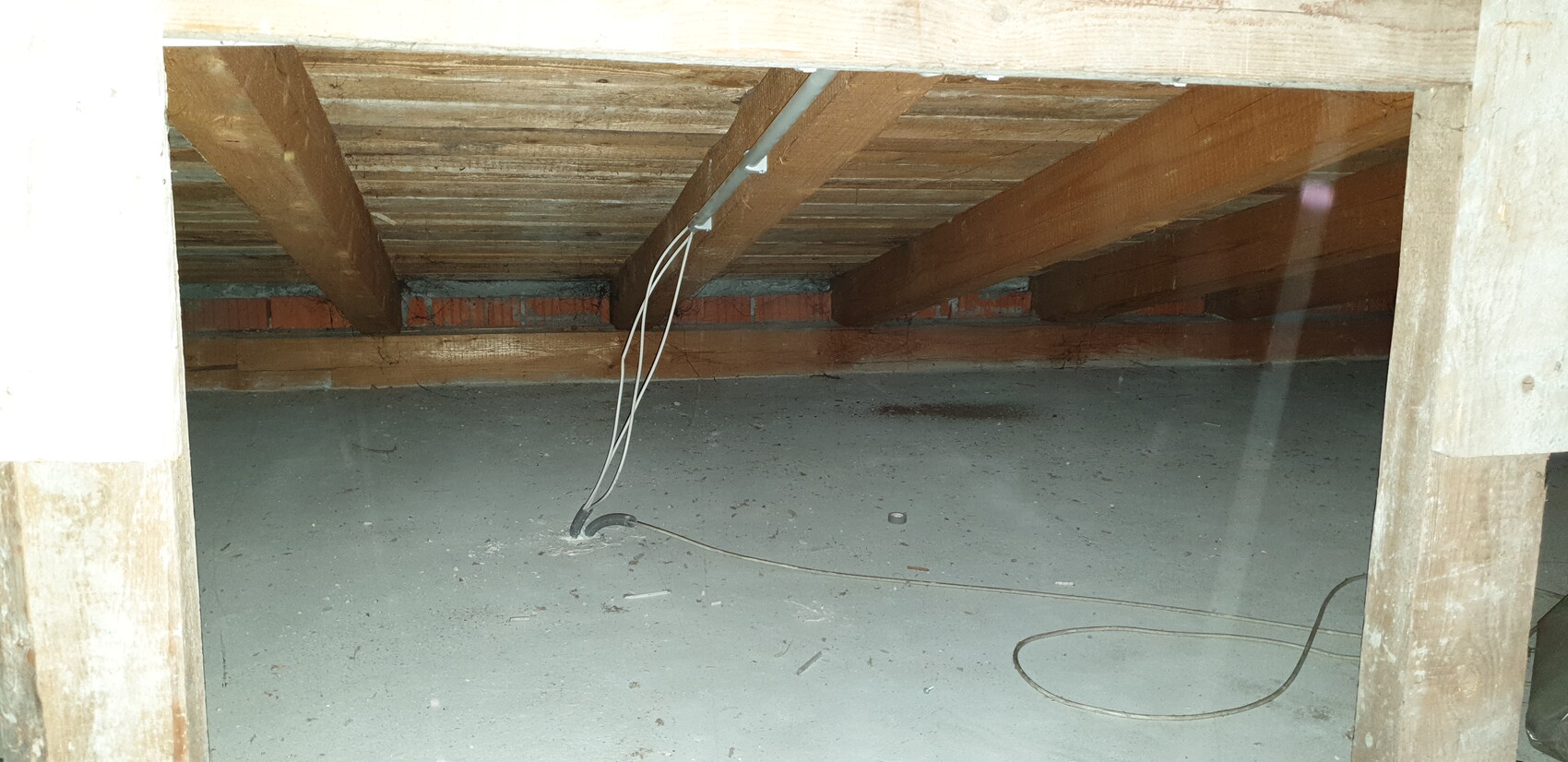
5) How should I deal with cables embedded in the concrete ceiling and around the purlins when insulating?
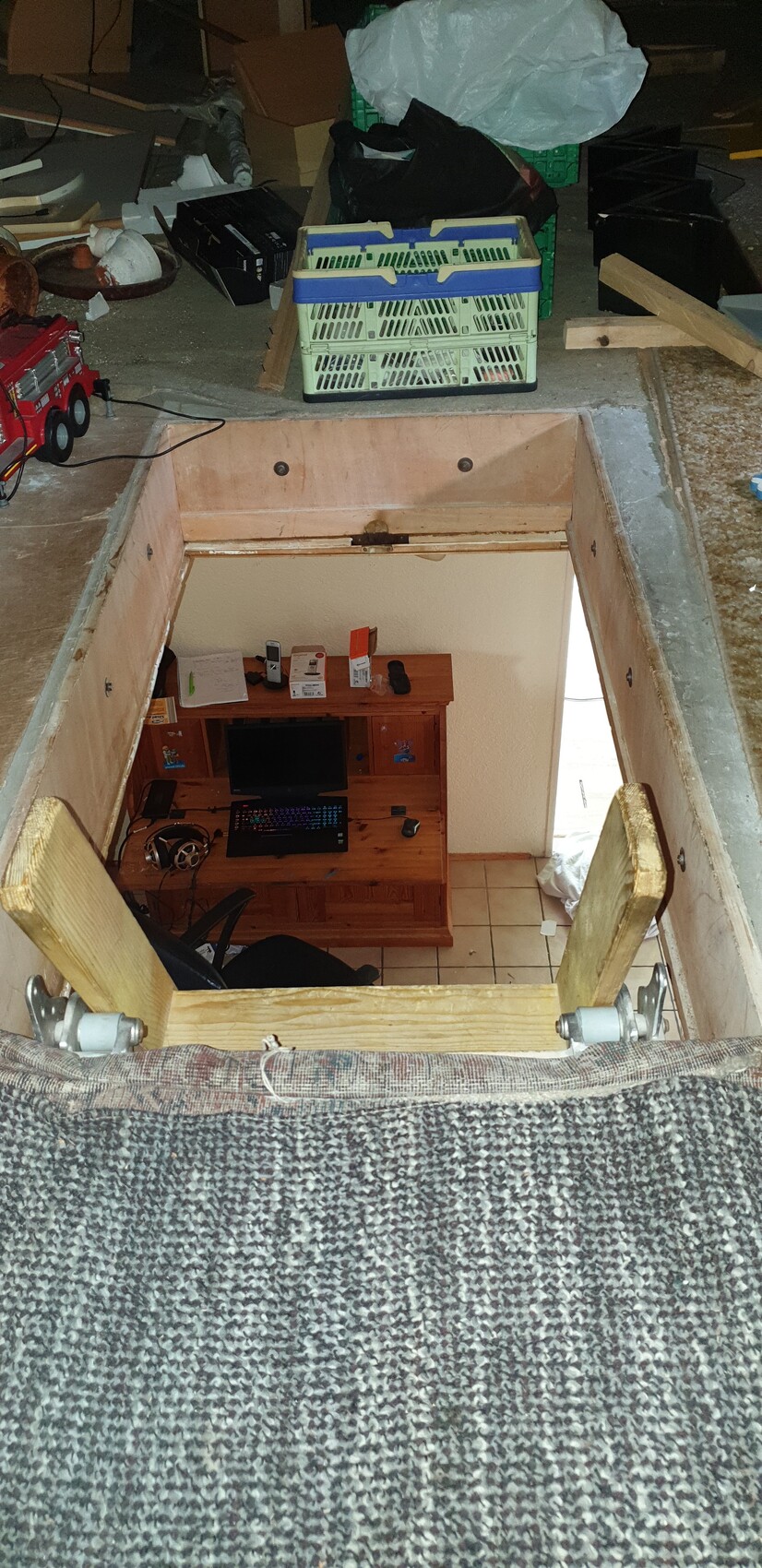
6) How should/could I insulate the attic stairs?
7) Are there any special considerations I might have overlooked?
Looking forward to your opinions/ideas/tips and tricks,
Chippy
I want to undertake the insulation of the top floor ceiling myself.
[Facts]:
- Semi-detached house built in 1972, two floors with heated basement rooms
- Upper floor ceiling made of reinforced concrete - B225, thickness according to plan 16cm (6.3 inches)
- Roof pitch is 18 degrees and cannot be converted into living space
- The purlins rest directly on the concrete ceiling
- The roof will not be insulated; instead, the floor will be insulated
- The attic space should be partially usable as storage and walkable
See sketch top view attic 110 sqm (1184 sq ft) area, approx. 40 sqm (430 sq ft) walkable
[Questions]:
1) Preparations:
What preparations do I need to make on the concrete before starting work? Thorough cleaning?
2) Vapor barrier:
Do I also need to install a vapor barrier foil on the reinforced concrete B225 at the upper floor?
3) Insulation material:
I plan to lay EPS 040 WI/DI/DZ 50mm (2 inch) polystyrene boards (width 500mm (20 inches) x length 1000mm (39 inches)) double-layered and staggered (without cross joints) everywhere.
This means about 9-10cm (3.5-4 inches) of insulation thickness. What U-value would I achieve with this?
Material cost comes to around 800 EUR including VAT.
Which affordable insulation boards would you recommend for my project? Has anyone had experience using polystyrene boards?
4) OSB boards (thickness - no idea - any recommendations)?
For the walkable area I would additionally install OSB-3 tongue and groove boards, 12mm (0.5 inch) thick, 205cm (80 inches) x 62.5cm (25 inches).
Material cost is approximately 200 EUR including VAT.
5) How should I deal with cables embedded in the concrete ceiling and around the purlins when insulating?
6) How should/could I insulate the attic stairs?
7) Are there any special considerations I might have overlooked?
Looking forward to your opinions/ideas/tips and tricks,
Chippy
N
nordanney29 Oct 2020 12:27chippy79 schrieb:
Then the moisture can escape more easily.There shouldn’t be any moisture present that needs to escape. Adhesion mainly helps to keep the panels from shifting too easily.N
nordanney29 Oct 2020 13:08parcus schrieb:
If anything, the vapor retarder goes on the concrete slab, for example, when using mineral wool. Nothing needs to be applied to the concrete slab. No retarder, no barrier, or anything else. What moisture would it be stopping? I agree with you on timber beam ceilings, but not on concrete.
N
nordanney29 Oct 2020 14:46parcus schrieb:
Even stupidity produces water vapor,...LOL@ TE: Don’t let it unsettle you.
P
Peter Silie29 Oct 2020 15:47nordanney schrieb:
Nothing needs to be added to the concrete ceiling. No vapor barrier, no membrane, or anything else. What moisture exactly should be stopped? I agree with you for wooden beam ceilings, but not for concrete. And even if someone installs them, it’s not the end of the world. Just sweep everything clean, install the edge insulation strips, lay overlapping sheets of foil and tape the seams, then put the polystyrene on. Lay one sheet horizontally and one vertically, OSB boards on top, glue the tongue and groove joints, and you’re good to go. I can already feel the cozy atmosphere at home.
Similar topics