
Hello everyone,
I want to undertake the insulation of the top floor ceiling myself.
[Facts]:
- Semi-detached house built in 1972, two floors with heated basement rooms
- Upper floor ceiling made of reinforced concrete - B225, thickness according to plan 16cm (6.3 inches)
- Roof pitch is 18 degrees and cannot be converted into living space
- The purlins rest directly on the concrete ceiling
- The roof will not be insulated; instead, the floor will be insulated
- The attic space should be partially usable as storage and walkable
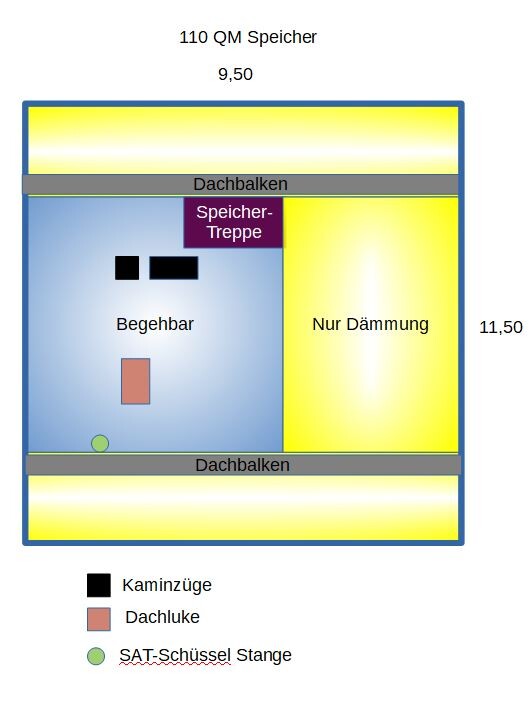
See sketch top view attic 110 sqm (1184 sq ft) area, approx. 40 sqm (430 sq ft) walkable
[Questions]:
1) Preparations:
What preparations do I need to make on the concrete before starting work? Thorough cleaning?
2) Vapor barrier:
Do I also need to install a vapor barrier foil on the reinforced concrete B225 at the upper floor?
3) Insulation material:
I plan to lay EPS 040 WI/DI/DZ 50mm (2 inch) polystyrene boards (width 500mm (20 inches) x length 1000mm (39 inches)) double-layered and staggered (without cross joints) everywhere.
This means about 9-10cm (3.5-4 inches) of insulation thickness. What U-value would I achieve with this?
Material cost comes to around 800 EUR including VAT.
Which affordable insulation boards would you recommend for my project? Has anyone had experience using polystyrene boards?
4) OSB boards (thickness - no idea - any recommendations)?
For the walkable area I would additionally install OSB-3 tongue and groove boards, 12mm (0.5 inch) thick, 205cm (80 inches) x 62.5cm (25 inches).
Material cost is approximately 200 EUR including VAT.
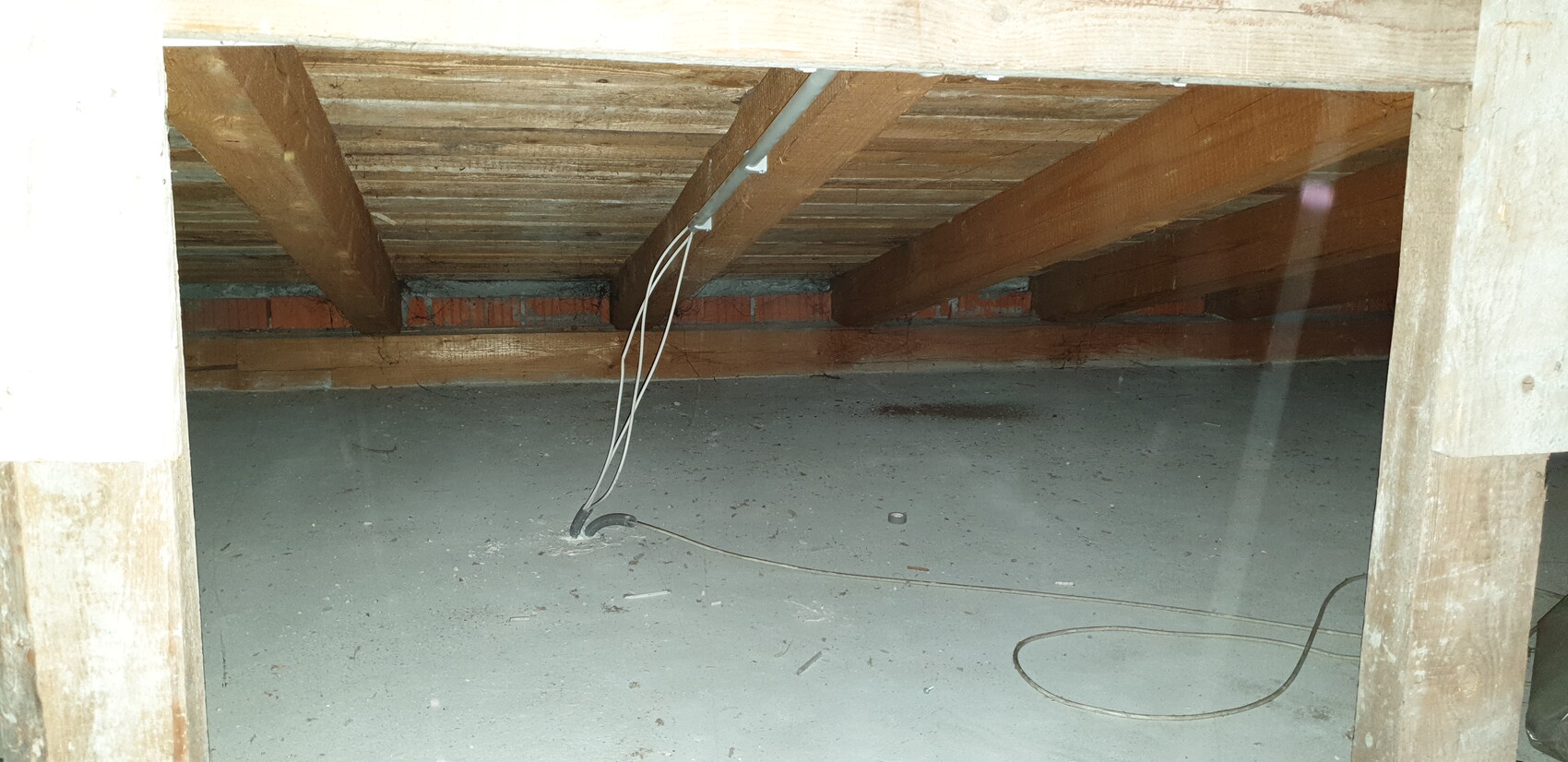
5) How should I deal with cables embedded in the concrete ceiling and around the purlins when insulating?
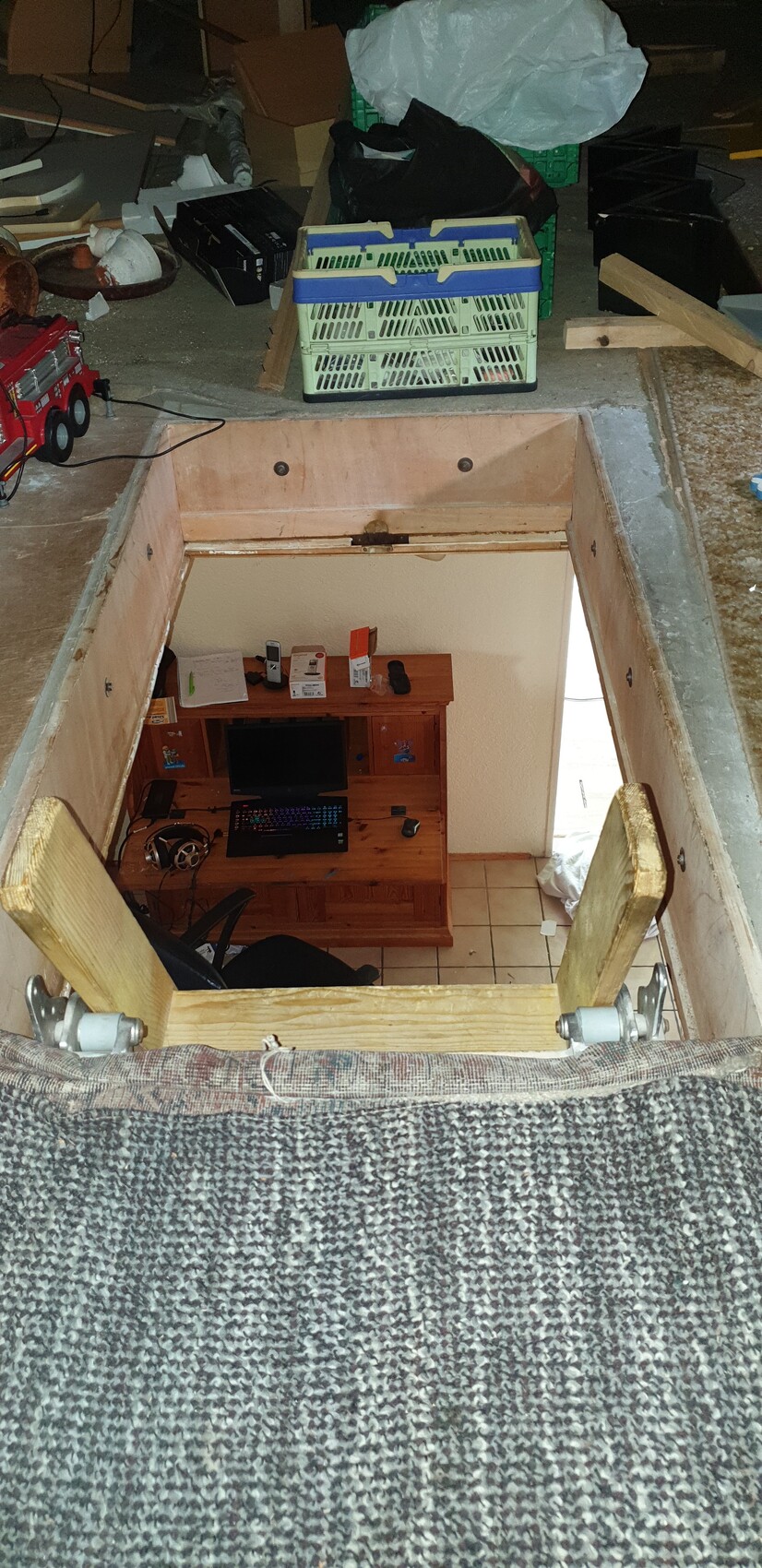
6) How should/could I insulate the attic stairs?
7) Are there any special considerations I might have overlooked?
Looking forward to your opinions/ideas/tips and tricks,
Chippy
I want to undertake the insulation of the top floor ceiling myself.
[Facts]:
- Semi-detached house built in 1972, two floors with heated basement rooms
- Upper floor ceiling made of reinforced concrete - B225, thickness according to plan 16cm (6.3 inches)
- Roof pitch is 18 degrees and cannot be converted into living space
- The purlins rest directly on the concrete ceiling
- The roof will not be insulated; instead, the floor will be insulated
- The attic space should be partially usable as storage and walkable
See sketch top view attic 110 sqm (1184 sq ft) area, approx. 40 sqm (430 sq ft) walkable
[Questions]:
1) Preparations:
What preparations do I need to make on the concrete before starting work? Thorough cleaning?
2) Vapor barrier:
Do I also need to install a vapor barrier foil on the reinforced concrete B225 at the upper floor?
3) Insulation material:
I plan to lay EPS 040 WI/DI/DZ 50mm (2 inch) polystyrene boards (width 500mm (20 inches) x length 1000mm (39 inches)) double-layered and staggered (without cross joints) everywhere.
This means about 9-10cm (3.5-4 inches) of insulation thickness. What U-value would I achieve with this?
Material cost comes to around 800 EUR including VAT.
Which affordable insulation boards would you recommend for my project? Has anyone had experience using polystyrene boards?
4) OSB boards (thickness - no idea - any recommendations)?
For the walkable area I would additionally install OSB-3 tongue and groove boards, 12mm (0.5 inch) thick, 205cm (80 inches) x 62.5cm (25 inches).
Material cost is approximately 200 EUR including VAT.
5) How should I deal with cables embedded in the concrete ceiling and around the purlins when insulating?
6) How should/could I insulate the attic stairs?
7) Are there any special considerations I might have overlooked?
Looking forward to your opinions/ideas/tips and tricks,
Chippy
N
nordanney27 Oct 2020 22:52chippy79 schrieb:
Is it possible to simply lay EPS loose on a concrete floor without any screed over it? What if the top floor slab consists of concrete with a 3 cm (1.2 inches) screed? Is it allowed to place EPS on top of the screed as well? Just place it on top.
What I would do, and will actually do soon, is use glass wool insulation batts. A 36 cm (14 inch) thickness (two layers) with a thermal conductivity of 0.035 W/mK costs only €10 per sqm (I have a cold roof – no walkable attic necessary – and have it installed professionally).
Otherwise, I would choose the 160 mm (6.3 inch) PIR boards from the offer at €15 per sqm (thermal conductivity about 0.023 W/mK).
N
nordanney28 Oct 2020 06:52parcus schrieb:
For your reference to make guessing easier,
the energy saving ordinance currently stands at 0.24 W/(m²·K) .... Are you threatening the original poster with the energy saving ordinance police?
With both proposals, by the way, the ceiling then reaches 0.10–0.15.
nordanney schrieb:
Just go for it
What I would do, and will actually do soon, is use glass wool insulation batts. 36cm (14 inches) thickness (two layers) with a thermal conductivity rating of 0.035 W/(m·K) only costs €10 per square meter (I’m having it installed by a company; I have a cold roof – no need for an accessible attic).
Otherwise, I would choose the 160mm (6.3 inches) PIR boards from the offer for €15 per square meter (thermal conductivity rating around 0.023 W/(m·K)?).Do you mean the rigid PUR foam boards with aluminum foil facing on both sides, thermal conductivity rating 0.023 W/(m·K), 160mm (6.3 inches) thick?
And then install them in two layers, so 320mm (12.6 inches) of insulation in total?
Would I need to cover the foam boards with OSB or chipboard panels if I want to walk on them and store boxes?
I had also considered glass wool, but I want to be able to access the attic and use it as storage space. What about exposed glass wool and the fine dust it generates? Does any of this dust enter the lungs (seriously asking)? Otherwise, I could insulate the non-accessible part with glass wool. So you used 180mm (7 inches) glass wool in two layers?
One advantage of glass wool would probably be that cables and such underneath do not create thermal bridges, right?
Best regards
N
nordanney28 Oct 2020 10:27chippy79 schrieb:
Do you mean the rigid PUR foam boards laminated with aluminum on both sides, with a thermal conductivity of 0.023 W/(m·K), 160mm (6.3 inches)?
And then installing them in double layers, so 320mm (12.6 inches) of insulation? Yes, exactly.
But only a single layer, please! That already achieves insulation values suitable for good new builds (see my U-value information). I would still put some boards on top of that (OSB or similar).
chippy79 schrieb:
I had also considered glass wool, but I want to be able to walk in the attic and use it as storage space. Then glass wool is out of the question.
chippy79 schrieb:
So you used 180mm (7 inches) glass wool in double layers? I at least hired a tradesman to do that as part of my house renovation. But it’s an attic that will never be walked on again (or only if, for example, the multiswitch for the satellite system located there breaks).
chippy79 schrieb:
One advantage of glass wool would surely be that cables and the like underneath do not cause thermal bridges, right? Cut a small channel into the PUR foam for the cables to lie in. That way, there are no thermal bridges either. Anything is better than no insulation.
Similar topics