
Hello everyone,
I want to undertake the insulation of the top floor ceiling myself.
[Facts]:
- Semi-detached house built in 1972, two floors with heated basement rooms
- Upper floor ceiling made of reinforced concrete - B225, thickness according to plan 16cm (6.3 inches)
- Roof pitch is 18 degrees and cannot be converted into living space
- The purlins rest directly on the concrete ceiling
- The roof will not be insulated; instead, the floor will be insulated
- The attic space should be partially usable as storage and walkable
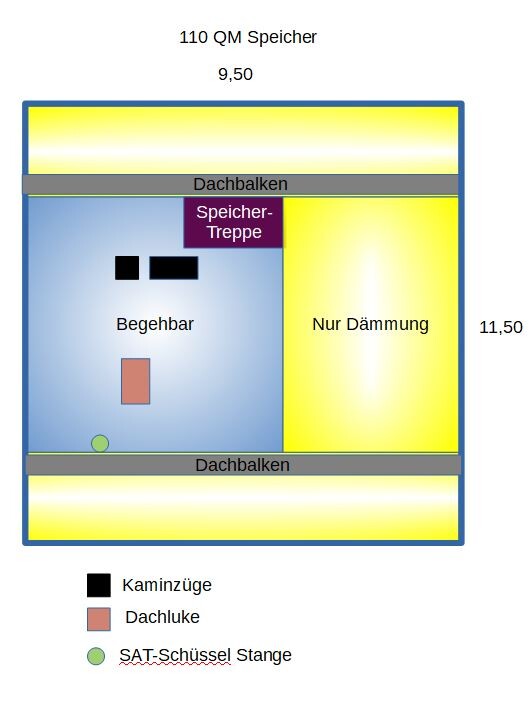
See sketch top view attic 110 sqm (1184 sq ft) area, approx. 40 sqm (430 sq ft) walkable
[Questions]:
1) Preparations:
What preparations do I need to make on the concrete before starting work? Thorough cleaning?
2) Vapor barrier:
Do I also need to install a vapor barrier foil on the reinforced concrete B225 at the upper floor?
3) Insulation material:
I plan to lay EPS 040 WI/DI/DZ 50mm (2 inch) polystyrene boards (width 500mm (20 inches) x length 1000mm (39 inches)) double-layered and staggered (without cross joints) everywhere.
This means about 9-10cm (3.5-4 inches) of insulation thickness. What U-value would I achieve with this?
Material cost comes to around 800 EUR including VAT.
Which affordable insulation boards would you recommend for my project? Has anyone had experience using polystyrene boards?
4) OSB boards (thickness - no idea - any recommendations)?
For the walkable area I would additionally install OSB-3 tongue and groove boards, 12mm (0.5 inch) thick, 205cm (80 inches) x 62.5cm (25 inches).
Material cost is approximately 200 EUR including VAT.
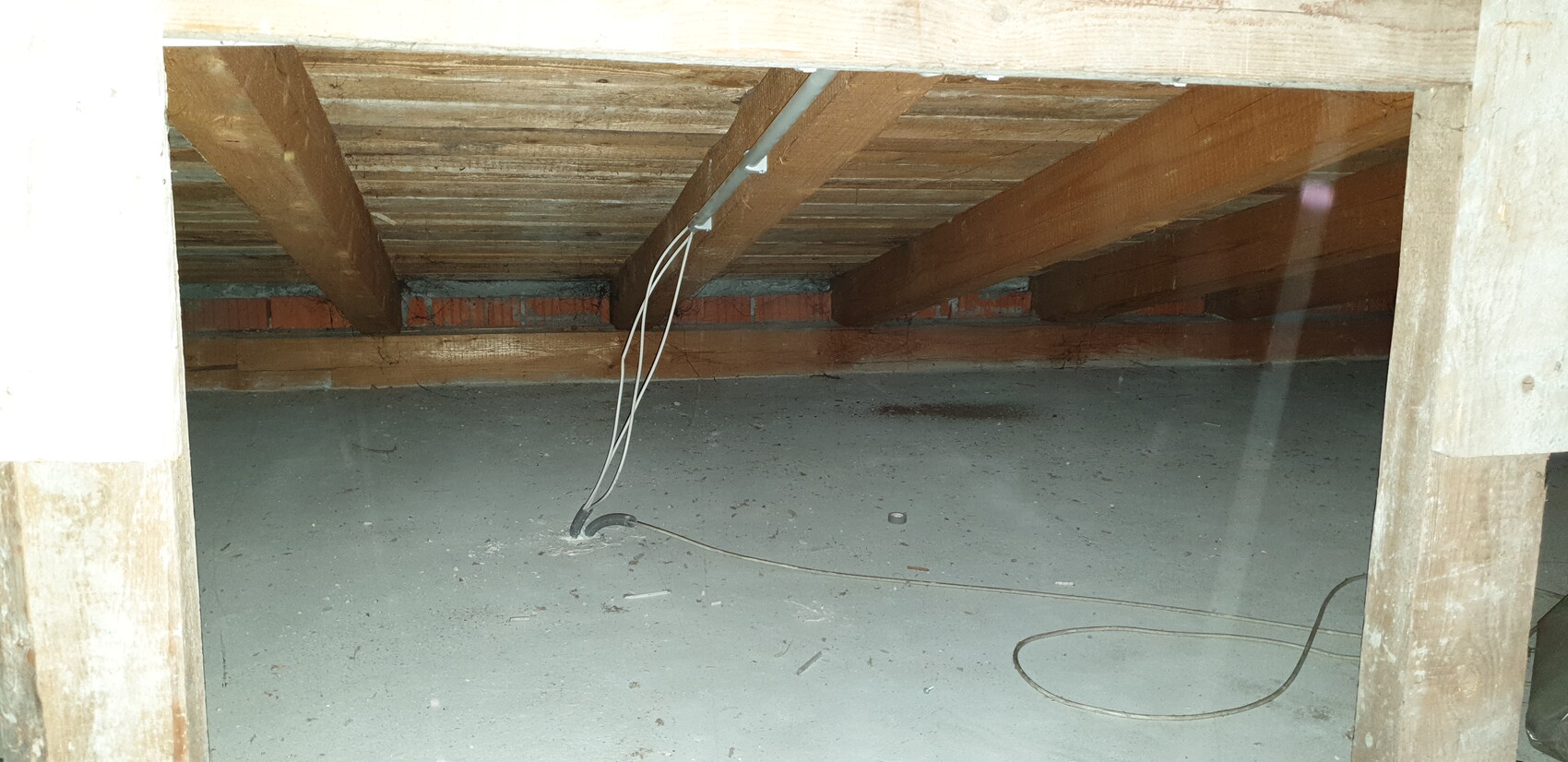
5) How should I deal with cables embedded in the concrete ceiling and around the purlins when insulating?
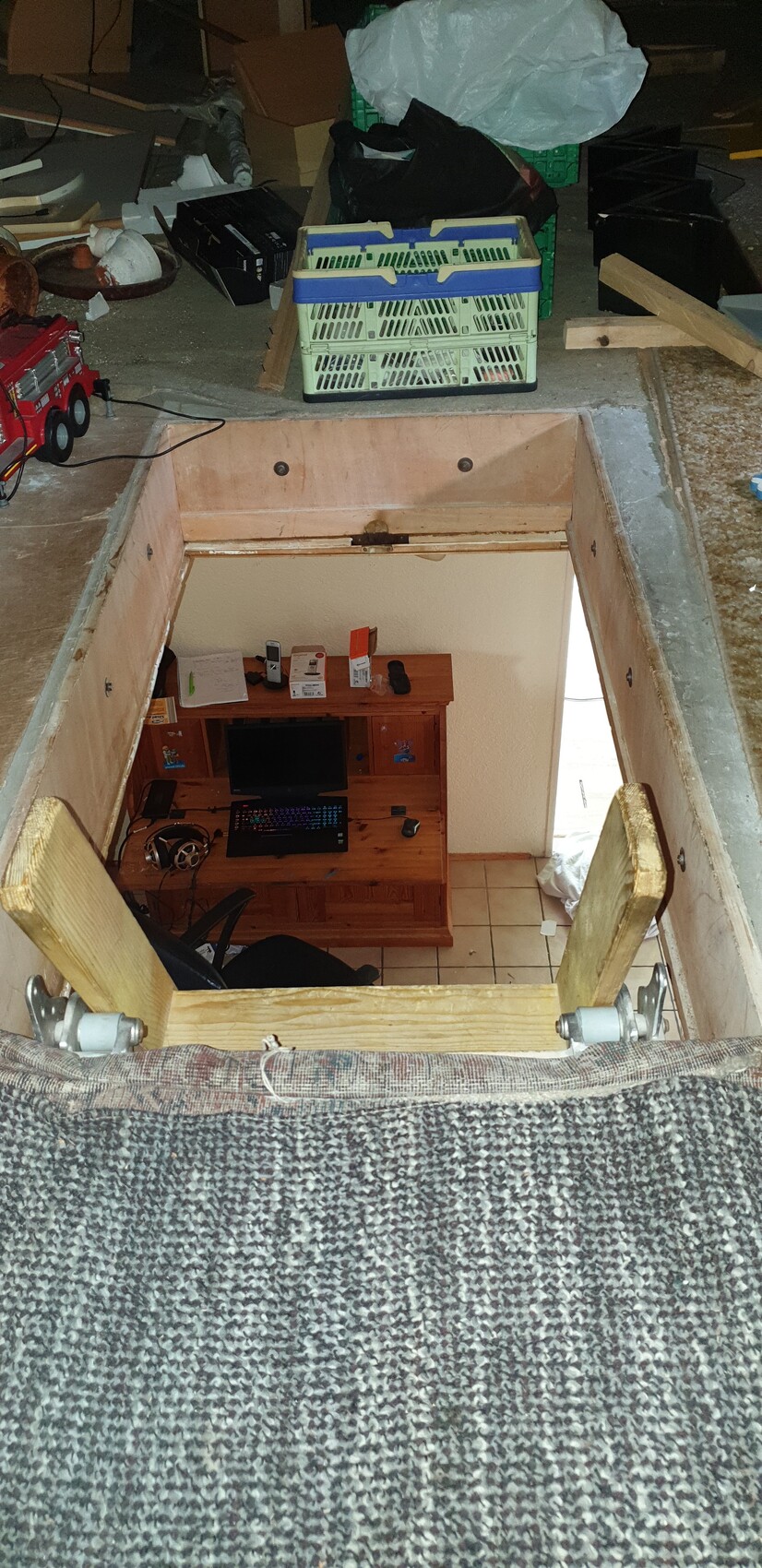
6) How should/could I insulate the attic stairs?
7) Are there any special considerations I might have overlooked?
Looking forward to your opinions/ideas/tips and tricks,
Chippy
I want to undertake the insulation of the top floor ceiling myself.
[Facts]:
- Semi-detached house built in 1972, two floors with heated basement rooms
- Upper floor ceiling made of reinforced concrete - B225, thickness according to plan 16cm (6.3 inches)
- Roof pitch is 18 degrees and cannot be converted into living space
- The purlins rest directly on the concrete ceiling
- The roof will not be insulated; instead, the floor will be insulated
- The attic space should be partially usable as storage and walkable
See sketch top view attic 110 sqm (1184 sq ft) area, approx. 40 sqm (430 sq ft) walkable
[Questions]:
1) Preparations:
What preparations do I need to make on the concrete before starting work? Thorough cleaning?
2) Vapor barrier:
Do I also need to install a vapor barrier foil on the reinforced concrete B225 at the upper floor?
3) Insulation material:
I plan to lay EPS 040 WI/DI/DZ 50mm (2 inch) polystyrene boards (width 500mm (20 inches) x length 1000mm (39 inches)) double-layered and staggered (without cross joints) everywhere.
This means about 9-10cm (3.5-4 inches) of insulation thickness. What U-value would I achieve with this?
Material cost comes to around 800 EUR including VAT.
Which affordable insulation boards would you recommend for my project? Has anyone had experience using polystyrene boards?
4) OSB boards (thickness - no idea - any recommendations)?
For the walkable area I would additionally install OSB-3 tongue and groove boards, 12mm (0.5 inch) thick, 205cm (80 inches) x 62.5cm (25 inches).
Material cost is approximately 200 EUR including VAT.
5) How should I deal with cables embedded in the concrete ceiling and around the purlins when insulating?
6) How should/could I insulate the attic stairs?
7) Are there any special considerations I might have overlooked?
Looking forward to your opinions/ideas/tips and tricks,
Chippy
parcus schrieb:
I think it’s more about the condensation on the pipe, the metal roof tiles, and where the exhaust air no longer vents through the roof.So, if the pipe were now open in the attic space, would that be considered a construction defect? Or could it potentially cause one? Oh dear, I’ll have a look up there tonight and report back.
That said, I should add that I’m still planning to have a cold roof and will only insulate the top floor ceiling.
So I checked again. The removed roof tiles with openings were apparently just ventilation tiles for the attic. The pipes are still exiting through the roof.
Regarding insulation of the pipes: Does this mean I still need to insulate the pipes with material here? What material should I use?
How large should the gap between insulation boards and chimney, timber frame, pipes be at minimum? I’m not supposed to compress the glass wool, right? About 10cm (5 inches) around?
And can I lay old solid wood flooring on top of the insulation boards as a walkable surface? Only in the areas where I want to walk. Or is that unnecessary with these insulation boards? They seem quite firm. I want to store boxes and move around on all fours, crawling basically. So purely a storage space.
Thanks
Regarding insulation of the pipes: Does this mean I still need to insulate the pipes with material here? What material should I use?
How large should the gap between insulation boards and chimney, timber frame, pipes be at minimum? I’m not supposed to compress the glass wool, right? About 10cm (5 inches) around?
And can I lay old solid wood flooring on top of the insulation boards as a walkable surface? Only in the areas where I want to walk. Or is that unnecessary with these insulation boards? They seem quite firm. I want to store boxes and move around on all fours, crawling basically. So purely a storage space.
Thanks
Simply wrap one layer around the pipe and that’s sufficient. You can optionally secure it with wire. Make sure not to compress it. You can basically cover it with anything you want, including hardwood flooring. What’s important is to have few overlapping joints and to ensure the insulation is not "ventilated" underneath.
Joedreck schrieb:
Just wrap one layer around the pipe and that’s it. Possibly fix it with wire. Make sure not to compress it.
You can basically put anything you want on top, even parquet flooring.
The important thing is to have few overlapping joints and to prevent the insulation from being "ventilated" underneath. One layer of what? Pipe insulation from the hardware store?
By preventing the insulation from being ventilated underneath, you mean I have to ensure that the insulation boards always lie fully flat on the concrete floor, right? So if there are cables or other conduits on the floor, I would need to cut a V-shaped notch on the bottom?
Thanks
Similar topics