
Hello everyone,
I want to undertake the insulation of the top floor ceiling myself.
[Facts]:
- Semi-detached house built in 1972, two floors with heated basement rooms
- Upper floor ceiling made of reinforced concrete - B225, thickness according to plan 16cm (6.3 inches)
- Roof pitch is 18 degrees and cannot be converted into living space
- The purlins rest directly on the concrete ceiling
- The roof will not be insulated; instead, the floor will be insulated
- The attic space should be partially usable as storage and walkable
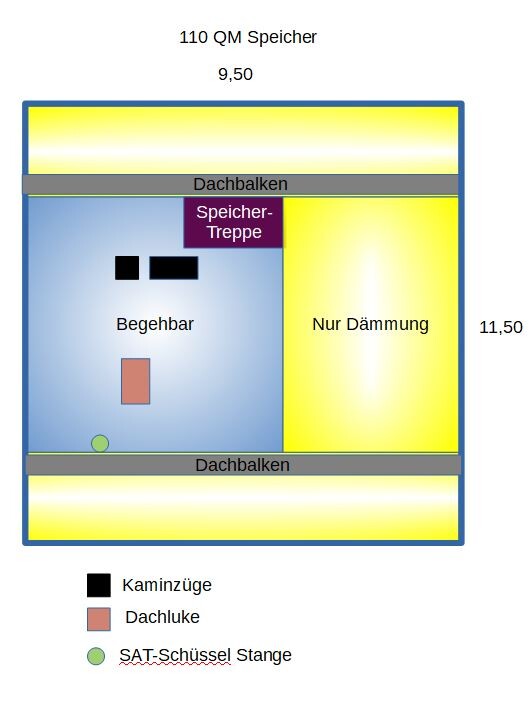
See sketch top view attic 110 sqm (1184 sq ft) area, approx. 40 sqm (430 sq ft) walkable
[Questions]:
1) Preparations:
What preparations do I need to make on the concrete before starting work? Thorough cleaning?
2) Vapor barrier:
Do I also need to install a vapor barrier foil on the reinforced concrete B225 at the upper floor?
3) Insulation material:
I plan to lay EPS 040 WI/DI/DZ 50mm (2 inch) polystyrene boards (width 500mm (20 inches) x length 1000mm (39 inches)) double-layered and staggered (without cross joints) everywhere.
This means about 9-10cm (3.5-4 inches) of insulation thickness. What U-value would I achieve with this?
Material cost comes to around 800 EUR including VAT.
Which affordable insulation boards would you recommend for my project? Has anyone had experience using polystyrene boards?
4) OSB boards (thickness - no idea - any recommendations)?
For the walkable area I would additionally install OSB-3 tongue and groove boards, 12mm (0.5 inch) thick, 205cm (80 inches) x 62.5cm (25 inches).
Material cost is approximately 200 EUR including VAT.
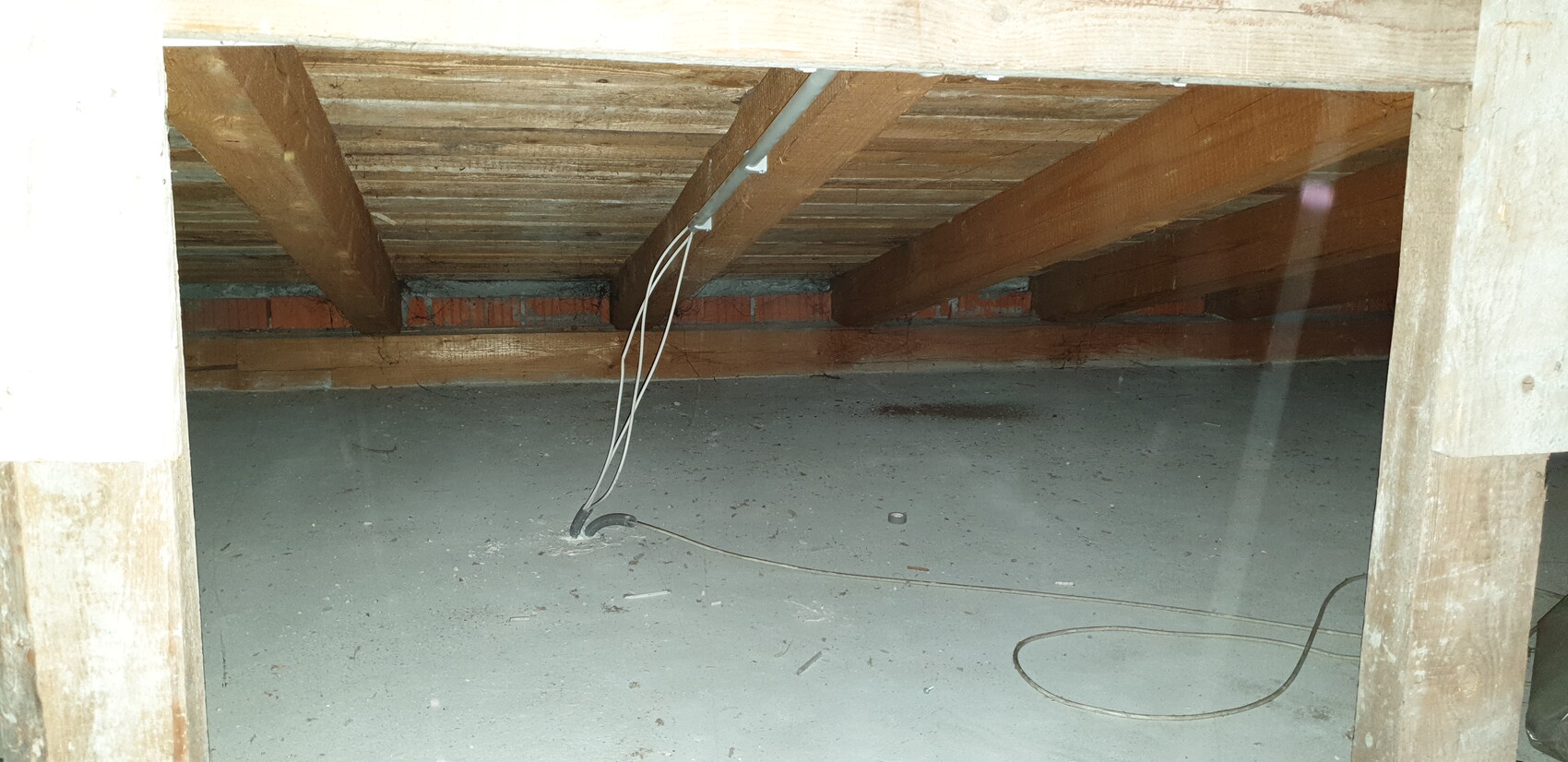
5) How should I deal with cables embedded in the concrete ceiling and around the purlins when insulating?
6) How should/could I insulate the attic stairs?
7) Are there any special considerations I might have overlooked?
Looking forward to your opinions/ideas/tips and tricks,
Chippy
I want to undertake the insulation of the top floor ceiling myself.
[Facts]:
- Semi-detached house built in 1972, two floors with heated basement rooms
- Upper floor ceiling made of reinforced concrete - B225, thickness according to plan 16cm (6.3 inches)
- Roof pitch is 18 degrees and cannot be converted into living space
- The purlins rest directly on the concrete ceiling
- The roof will not be insulated; instead, the floor will be insulated
- The attic space should be partially usable as storage and walkable
See sketch top view attic 110 sqm (1184 sq ft) area, approx. 40 sqm (430 sq ft) walkable
[Questions]:
1) Preparations:
What preparations do I need to make on the concrete before starting work? Thorough cleaning?
2) Vapor barrier:
Do I also need to install a vapor barrier foil on the reinforced concrete B225 at the upper floor?
3) Insulation material:
I plan to lay EPS 040 WI/DI/DZ 50mm (2 inch) polystyrene boards (width 500mm (20 inches) x length 1000mm (39 inches)) double-layered and staggered (without cross joints) everywhere.
This means about 9-10cm (3.5-4 inches) of insulation thickness. What U-value would I achieve with this?
Material cost comes to around 800 EUR including VAT.
Which affordable insulation boards would you recommend for my project? Has anyone had experience using polystyrene boards?
4) OSB boards (thickness - no idea - any recommendations)?
For the walkable area I would additionally install OSB-3 tongue and groove boards, 12mm (0.5 inch) thick, 205cm (80 inches) x 62.5cm (25 inches).
Material cost is approximately 200 EUR including VAT.
5) How should I deal with cables embedded in the concrete ceiling and around the purlins when insulating?
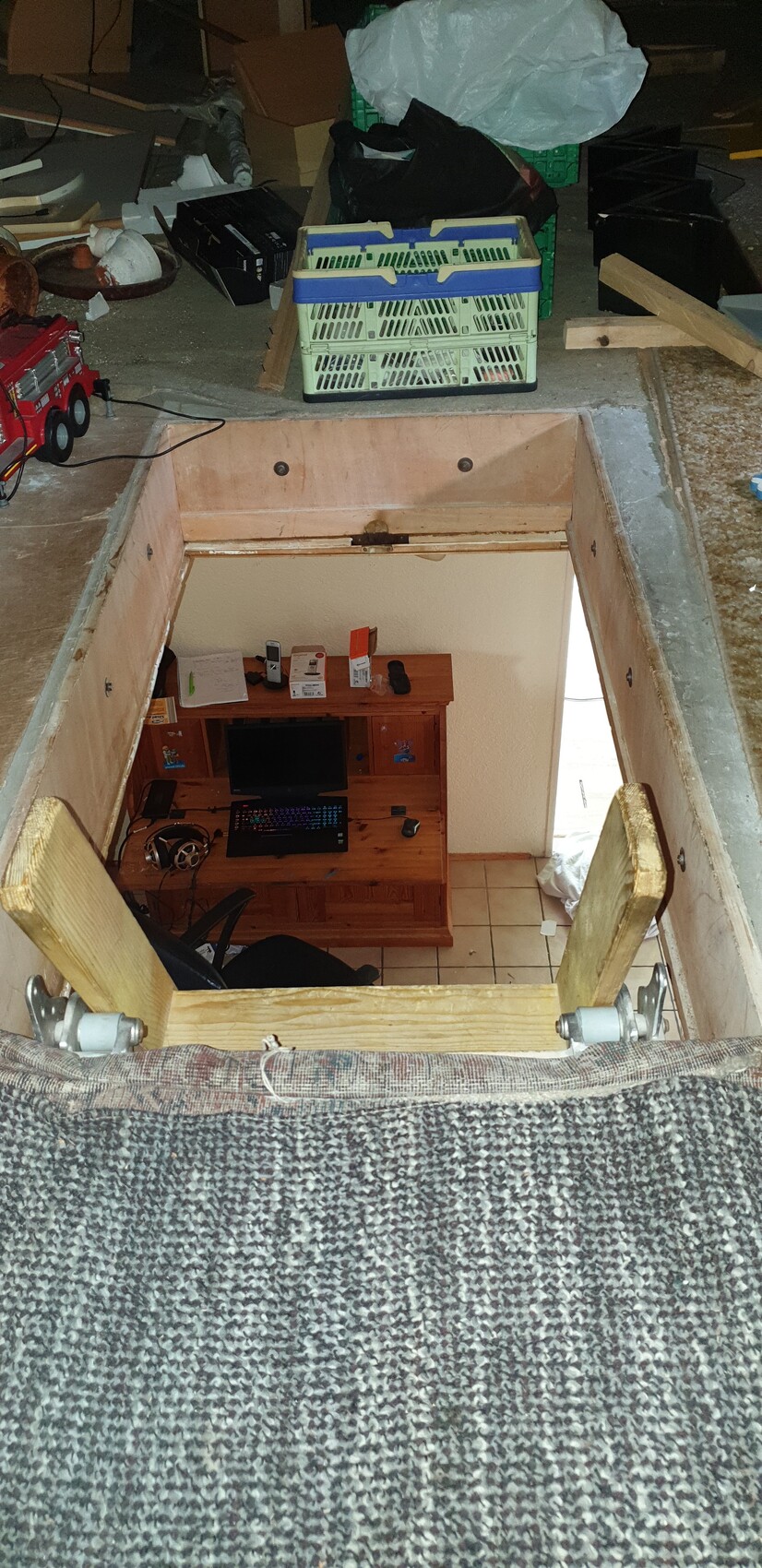
6) How should/could I insulate the attic stairs?
7) Are there any special considerations I might have overlooked?
Looking forward to your opinions/ideas/tips and tricks,
Chippy
P
Piotr198130 Nov 2020 11:16chippy79 schrieb:
I’m currently facing the issue that the panels are 120cm x 50cm (47 inches x 20 inches) and 16cm (6 inches) thick, with a stepped tongue-and-groove joint. They can’t be split in the middle, so they can only be installed as a single layer with 16cm (6 inches) thickness.
But basically, because of the stepped tongue-and-groove, the joints are already staggered, right?
For the batt insulation, should I use fiberglass insulation? How much of a gap in cm should I leave around it? For example, should I leave 10cm (4 inches) clearance around the chimney to the concrete floor? Then just use 16cm (6 inches) of glass wool? Wouldn’t that reduce the thermal insulation effectiveness there?
Looks nice how you installed it 🙂 In my opinion, that’s not a problem, but I assume you’ll need to saw or cut the panels lengthwise at some point. Then you’d start with the shorter piece at the other end.
Yes, fiberglass insulation with a thermal conductivity value of 0.035 W/(m·K) is recommended, and possibly 16mm (0.6 inches) thick to ensure the glass fibers align flush with the wood and your panels.
Basically: cover as much as possible—any gaps will create thermal bridges.
Regarding cutting: So first measure the length and then cut one board accordingly so that it fits exactly, resulting in shortened boards on both sides? Or did I misunderstand? I place the long edge of the board against the roof’s gable end, right? And when installing the boards, do I need to stagger the joints so that no long seam runs “downward”?
How large should the gap be between the insulation boards and the chimney, wooden studs, or pipes at minimum? I’m not allowed to compress the glass wool insulation, correct? Around 10cm (4 inches) clearance?
What should I do with the horizontally installed pipes? See the third photo. Should I not use insulation boards there, but instead push 16cm (6 inches) of glass wool underneath and lay it over?
Can you also briefly tell me something about the removed vent pipes?
Thanks
How large should the gap be between the insulation boards and the chimney, wooden studs, or pipes at minimum? I’m not allowed to compress the glass wool insulation, correct? Around 10cm (4 inches) clearance?
What should I do with the horizontally installed pipes? See the third photo. Should I not use insulation boards there, but instead push 16cm (6 inches) of glass wool underneath and lay it over?
Can you also briefly tell me something about the removed vent pipes?
Thanks
P
Piotr198130 Nov 2020 11:42chippy79 schrieb:
About cutting. So, first measure the length and then cut one board so it fits exactly, making sure you have cut boards on both ends? Or did I misunderstand? Should I place the long edge of the board against the gable end of the roof? And when installing the boards, do I need to stagger them so there isn’t a long joint running downward?
How big should the gap between the insulation boards and chimney, timber studs, or pipes be at minimum? I’m not allowed to compress the glass wool, right? About 10cm (5 inches) around?
How should I handle the horizontally installed pipes? See the third photo. Should I avoid putting insulation boards there and instead push 16cm (6 inches) of glass wool underneath and lay it on top?
Could you also briefly advise me about the removed vent pipes?
Thanks You start with the first board, place others along it, and in the end you’ll see that no whole board fits exactly. Then cut to size and close the gap. The leftover piece becomes the starting piece for the next row, followed by a full board, and so on. This way you avoid joints running vertically downward.
Yes, basically cover everything that’s exposed. If you can’t use boards there, then use wool. 16cm (6 inches) should also be sufficient for the pipes.
parcus schrieb:
If the work has already been done, there should be puddles around the pipes by now,...But the solar company replaced the old tiles with metal tiles everywhere they had to install the mounts for the photovoltaic panels. I assume they did the same in the areas where the ventilation tiles were located. Thanks for the tip. I’ll take another close look in the attic today.
Similar topics