
Hello everyone,
we live in a house from the 1970s with a half-height, uninsulated attic. The floor below gets unbearably hot in the summer, so I’m considering insulating the roof myself.
I’m planning to install insulation between the rafters. I’ve already found a lot of information about this and think it shouldn’t be a problem to do it myself.
One question still concerns me: If I’m not using the attic as a living space and the insulation won’t be covered by drywall, do I still need a vapor barrier? Or can I save the cost and effort by simply fitting the batt insulation between the rafters and securing it lightly with battens?
I hope someone can help me so I can start this project as soon as possible and be able to tolerate the heat in the living room during the summer.
Thanks in advance for your help
Ben
we live in a house from the 1970s with a half-height, uninsulated attic. The floor below gets unbearably hot in the summer, so I’m considering insulating the roof myself.
I’m planning to install insulation between the rafters. I’ve already found a lot of information about this and think it shouldn’t be a problem to do it myself.
One question still concerns me: If I’m not using the attic as a living space and the insulation won’t be covered by drywall, do I still need a vapor barrier? Or can I save the cost and effort by simply fitting the batt insulation between the rafters and securing it lightly with battens?
I hope someone can help me so I can start this project as soon as possible and be able to tolerate the heat in the living room during the summer.
Thanks in advance for your help
Ben
I would definitely install a vapor barrier in any case. I don’t see why not, since the effort required is quite minimal. Especially with insulation installed between the rafters, simply tack a suitable foil as the final step and seal the joints, edges, and penetrations with approved tape—done.
Even if the attic is not currently planned for use, who knows what the future holds? Moisture from inside the house can reach the attic and condense in the insulation without a vapor barrier during cold weather. This causes the insulation to get damp and reduces its thermal performance.
When installing friction-fitted insulation batts properly, there is no need for battens underneath to hold them in place. However, if desired, battens can also be installed after the vapor barrier is in place.
Even if the attic is not currently planned for use, who knows what the future holds? Moisture from inside the house can reach the attic and condense in the insulation without a vapor barrier during cold weather. This causes the insulation to get damp and reduces its thermal performance.
When installing friction-fitted insulation batts properly, there is no need for battens underneath to hold them in place. However, if desired, battens can also be installed after the vapor barrier is in place.
S
Sebastian7920 Feb 2016 08:40Do you not have collar beam insulation in the top floor ceiling?

Such a roof insulation must be carefully planned to ensure you gain more benefits than cause medium-term damage. The required effort and the construction method depend on the existing structure and cannot be specified in general terms. The installation situation needs to be assessed on site.
Typically, roof trusses from the 1950s to 1970s lack the ventilation layer (counter battens) that allows moisture from indoor air to be carried away from the insulated roof area. Without this layer and a functional, vapor-permeable secondary drainage layer (roofing underlay/membrane), installing insulation between rafters will not be damage-free in the medium term. Additionally, the insulated structure must be airtight against convection, meaning it must not be permeated by warm, humid indoor air. Therefore, you will need an interior material that acts as a vapor retarder. Unfortunately, the conversion you have in mind will not work as planned.
I would recommend having a building survey carried out by a professional planner who can calculate a suitable construction assembly (considering the 2016 energy-saving regulations), point out any relevant structural connections and additional work, and accompany the entire construction project by providing at least consultation if you plan to carry out the work yourself.
In principle, I would also suggest considering insulation of the collar beam layer, since otherwise you will be heating the unused attic space.
Typically, roof trusses from the 1950s to 1970s lack the ventilation layer (counter battens) that allows moisture from indoor air to be carried away from the insulated roof area. Without this layer and a functional, vapor-permeable secondary drainage layer (roofing underlay/membrane), installing insulation between rafters will not be damage-free in the medium term. Additionally, the insulated structure must be airtight against convection, meaning it must not be permeated by warm, humid indoor air. Therefore, you will need an interior material that acts as a vapor retarder. Unfortunately, the conversion you have in mind will not work as planned.
I would recommend having a building survey carried out by a professional planner who can calculate a suitable construction assembly (considering the 2016 energy-saving regulations), point out any relevant structural connections and additional work, and accompany the entire construction project by providing at least consultation if you plan to carry out the work yourself.
In principle, I would also suggest considering insulation of the collar beam layer, since otherwise you will be heating the unused attic space.
Thank you for your answers.
I will probably install the vapor barrier as well. I just thought I might save some work and a bit of money.
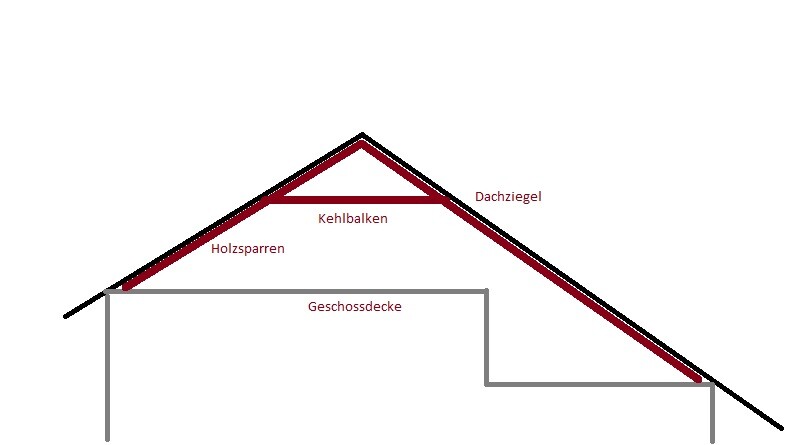
I am also considering installing insulation at the collar beams. But maybe I’m misunderstanding something. Collar beams and the floor structure above, they aren’t the same, right?
I sketched a picture of how it looks in my case.
So I would simply place the insulation batts between the wooden rafters and the collar beam, then install the vapor barrier in front of that (completely airtight, of course), and if necessary, add counter battens.
I will probably install the vapor barrier as well. I just thought I might save some work and a bit of money.
I am also considering installing insulation at the collar beams. But maybe I’m misunderstanding something. Collar beams and the floor structure above, they aren’t the same, right?
I sketched a picture of how it looks in my case.
So I would simply place the insulation batts between the wooden rafters and the collar beam, then install the vapor barrier in front of that (completely airtight, of course), and if necessary, add counter battens.
Similar topics