
Hello everyone,
My partner and I moved into our own home about six months ago. We bought the house as a newly built property, ready for first occupancy. It was designed and constructed by the seller.
Over these six months, we have noticed that the house is very noisy. The two rooms directly next to the bathroom/water closet are most affected. The level of privacy you would expect in a bathroom (toilet) is completely missing here. When someone uses the toilet, if you are in one of the neighboring rooms, you feel like you are right there instead of being separate.
Especially at night, when my (pregnant) partner makes one of her many trips to the bathroom, it becomes really exhausting. I could easily describe the consistency and quantity of what she flushes (exaggerated). And when she flushes, it feels like you might get flushed away too.
I understand that 100% soundproofing is impossible, but this seems abnormal to me.
Today, I measured the wall thickness myself (I couldn’t make sense of the structural engineer’s documents). The walls are approximately between 14 and 18 cm (5.5 and 7 inches) thick and, according to the building description, are made of aerated concrete (porous concrete) or calcium silicate bricks.
Can anyone tell me if this is normal? Are there any regulations concerning sound transmission or insulation of interior walls? Could this be a construction defect? If so, how can it be proven?
I hope someone here might be able to help me a bit.
Thank you in advance.
My partner and I moved into our own home about six months ago. We bought the house as a newly built property, ready for first occupancy. It was designed and constructed by the seller.
Over these six months, we have noticed that the house is very noisy. The two rooms directly next to the bathroom/water closet are most affected. The level of privacy you would expect in a bathroom (toilet) is completely missing here. When someone uses the toilet, if you are in one of the neighboring rooms, you feel like you are right there instead of being separate.
Especially at night, when my (pregnant) partner makes one of her many trips to the bathroom, it becomes really exhausting. I could easily describe the consistency and quantity of what she flushes (exaggerated). And when she flushes, it feels like you might get flushed away too.
I understand that 100% soundproofing is impossible, but this seems abnormal to me.
Today, I measured the wall thickness myself (I couldn’t make sense of the structural engineer’s documents). The walls are approximately between 14 and 18 cm (5.5 and 7 inches) thick and, according to the building description, are made of aerated concrete (porous concrete) or calcium silicate bricks.
Can anyone tell me if this is normal? Are there any regulations concerning sound transmission or insulation of interior walls? Could this be a construction defect? If so, how can it be proven?
I hope someone here might be able to help me a bit.
Thank you in advance.
Hello everyone,
First of all, thank you very much for the previous answers and sorry for the delayed reply. The reason is my daughter, who decided to arrive a bit earlier than expected.
But now back to the topic.
My main goal is to identify the cause of this (in my opinion) increased noise level and then find a solution. Of course, I could also tear down the walls and install drywall partitions, but honestly, I bought a new house to avoid having to do something like that right away.
According to the company that did the plumbing installation, the pipes were insulated. Is there a difference between insulation and soundproofing? How can I check whether the pipes were really insulated without having to tear down the walls completely?
I can’t say exactly how the noise is transmitted. With my amateur understanding, I would say it is transmitted through the walls. But that is just a guess.
Unfortunately, I can’t answer this question. We moved in when everything was already finished. All I can say is that the toilet is wall-mounted. The flush tank is boxed in.
I have created a simple sketch of the living situation, which might help to better understand and get to the bottom of the cause. It is not very professional and doesn’t exactly match the real layout but should be sufficient to give initial clues about the cause.
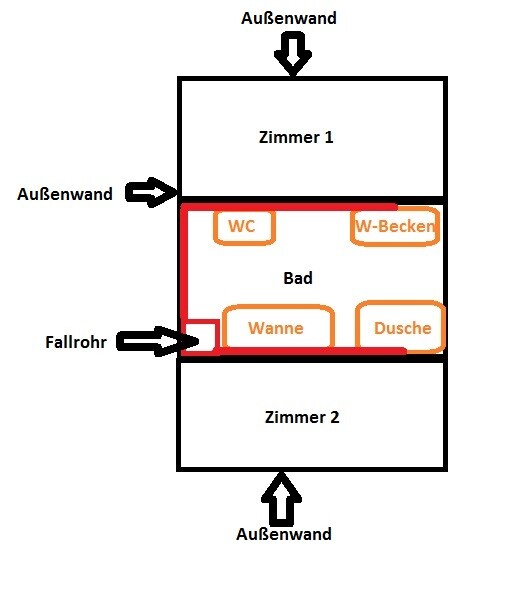
The red lines represent the drain pipes, all leading to the soil stack. The noise mainly affects room 1. In room 2, you can clearly hear the water rushing down the soil stack. Since this room is only used as a study, it is not too problematic. Room 1 is used as a bedroom, and there you can hear everything. You can even hear the light switch being operated and the toilet paper being unrolled.
As I said, the priority for me is to determine the cause first. Only then can I consider whether this is a construction defect or not.
I still hope for constructive contributions.
Thank you in advance for your help.
First of all, thank you very much for the previous answers and sorry for the delayed reply. The reason is my daughter, who decided to arrive a bit earlier than expected.
But now back to the topic.
My main goal is to identify the cause of this (in my opinion) increased noise level and then find a solution. Of course, I could also tear down the walls and install drywall partitions, but honestly, I bought a new house to avoid having to do something like that right away.
klblb schrieb:
Were the pipes soundproofed?
Could the noise possibly be transmitted through the ceiling? What is the ceiling construction like? Plasterboard? OSB boards? Is there a gap between the wall and ceiling? What kind of insulation is above the ceiling?
According to the company that did the plumbing installation, the pipes were insulated. Is there a difference between insulation and soundproofing? How can I check whether the pipes were really insulated without having to tear down the walls completely?
I can’t say exactly how the noise is transmitted. With my amateur understanding, I would say it is transmitted through the walls. But that is just a guess.
ypg schrieb:
Since I’ve lived in aerated concrete walls before (an aerated concrete wall is still a wall), I assume the noise is transmitted through something.
What is behind the toilet? Is the knee wall raised due to masonry? -> Resonance chamber?
Unfortunately, I can’t answer this question. We moved in when everything was already finished. All I can say is that the toilet is wall-mounted. The flush tank is boxed in.
I have created a simple sketch of the living situation, which might help to better understand and get to the bottom of the cause. It is not very professional and doesn’t exactly match the real layout but should be sufficient to give initial clues about the cause.
The red lines represent the drain pipes, all leading to the soil stack. The noise mainly affects room 1. In room 2, you can clearly hear the water rushing down the soil stack. Since this room is only used as a study, it is not too problematic. Room 1 is used as a bedroom, and there you can hear everything. You can even hear the light switch being operated and the toilet paper being unrolled.
As I said, the priority for me is to determine the cause first. Only then can I consider whether this is a construction defect or not.
I still hope for constructive contributions.
Thank you in advance for your help.
 EveundGerd14 Feb 2015 19:58
First of all, congratulations!
After reading along here and having the plumbers visit our construction site last week, I asked them a few questions. We are currently building with Ytong.
They said there are still plenty of companies using pipes that do not provide sound insulation. We were advised that, in addition to using sound-insulating pipes, the pipes should be further wrapped by the drywall installers in the shaft casing.
We have already discussed this with our drywall contractor.
But since you can almost hear a pin drop at your place... it’s possible that the sound is transmitted through the ceiling.
How is your ceiling constructed?
After reading along here and having the plumbers visit our construction site last week, I asked them a few questions. We are currently building with Ytong.
They said there are still plenty of companies using pipes that do not provide sound insulation. We were advised that, in addition to using sound-insulating pipes, the pipes should be further wrapped by the drywall installers in the shaft casing.
We have already discussed this with our drywall contractor.
But since you can almost hear a pin drop at your place... it’s possible that the sound is transmitted through the ceiling.
How is your ceiling constructed?
Similar topics