
ᐅ Installing vinyl flooring in a new basement. How to ensure it is waterproof?
Created on: 22 Jan 2023 20:02
J
jolt
Hello everyone,
We would like to have vinyl flooring installed in the basement of our newly built house. The basement is constructed as a waterproof concrete shell (“white tank”), so I don’t really expect any water, but you never know. In the laundry room, there is a floor drain in the center.
The current floor structure is as follows:
However, if water actually accumulates in the basement, I assume it will become an issue at the wall edges. In that case, you would probably need to proceed as in a bathroom, using sealing tape and a waterproof membrane? This would be quite a bit of extra work for the entire basement, but probably in excess of what’s necessary.
How would you approach this? What should I keep in mind?
Thank you.
We would like to have vinyl flooring installed in the basement of our newly built house. The basement is constructed as a waterproof concrete shell (“white tank”), so I don’t really expect any water, but you never know. In the laundry room, there is a floor drain in the center.
The current floor structure is as follows:
- Perimeter insulation
- Concrete slab
- Bitumen waterproofing membrane
- PU (polyurethane) insulation
- Underfloor heating
- Cement screed
- Sanding the screed
- Priming
- Self-leveling compound application
- Sanding again??
- Vinyl gluing
However, if water actually accumulates in the basement, I assume it will become an issue at the wall edges. In that case, you would probably need to proceed as in a bathroom, using sealing tape and a waterproof membrane? This would be quite a bit of extra work for the entire basement, but probably in excess of what’s necessary.
How would you approach this? What should I keep in mind?
Thank you.
Hello @KlaRa
I believe there is a small misunderstanding.
There is no risk of flooding from the public sewer system. The basement drainage runs through the sump pit and a “loop” above the backwater level.
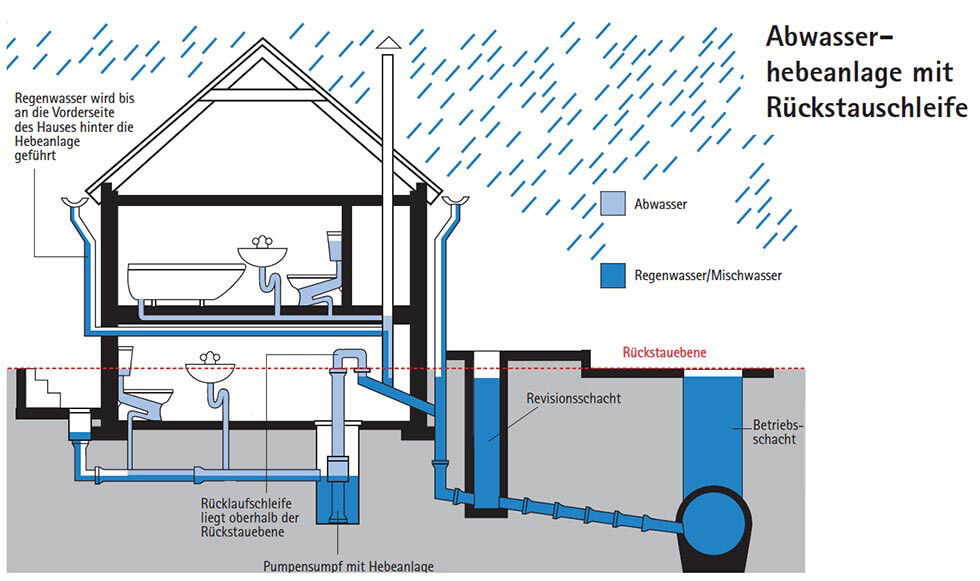
The scenario is that water drains through the outlet in front of the basement exterior door, filling the sump pit. The pump activates, but during prolonged heavy rain, the water behind the loop cannot drain further because the sewer system is already “full.” In that case, the sump pit would fill up first, and ultimately, according to my limited knowledge of physics, the water would come through or rise up at the highest point—namely, through the basement door and the floor drain in the laundry room. This means it is rainwater. Of course, that does not make the situation any better.
I believe there is a small misunderstanding.
There is no risk of flooding from the public sewer system. The basement drainage runs through the sump pit and a “loop” above the backwater level.
The scenario is that water drains through the outlet in front of the basement exterior door, filling the sump pit. The pump activates, but during prolonged heavy rain, the water behind the loop cannot drain further because the sewer system is already “full.” In that case, the sump pit would fill up first, and ultimately, according to my limited knowledge of physics, the water would come through or rise up at the highest point—namely, through the basement door and the floor drain in the laundry room. This means it is rainwater. Of course, that does not make the situation any better.

Hello "jolt"
Admittedly, it is always difficult to describe the situation precisely in just a few words.
The situation, which is now clear to me, was also experienced by my mother in her single-family home built in the early 1960s. The neighbors had the same issue, as their houses were built the same way.
The only way to solve the problem was to generously cover the irrigated area, thereby keeping rainwater away, and to seal off the floor drain completely.
This is how it worked for those houses at the time.
From my memory, the actual scenario in practice, when the backflow flows into the basement rooms, is quite clear.
To put it delicately, there are other situations I would much prefer for my leisure time than the necessary surface cleaning :-)
-------------------
Good luck: KlaRa
Admittedly, it is always difficult to describe the situation precisely in just a few words.
The situation, which is now clear to me, was also experienced by my mother in her single-family home built in the early 1960s. The neighbors had the same issue, as their houses were built the same way.
The only way to solve the problem was to generously cover the irrigated area, thereby keeping rainwater away, and to seal off the floor drain completely.
This is how it worked for those houses at the time.
From my memory, the actual scenario in practice, when the backflow flows into the basement rooms, is quite clear.
To put it delicately, there are other situations I would much prefer for my leisure time than the necessary surface cleaning :-)
-------------------
Good luck: KlaRa
T
taschenonkel30 Jan 2023 10:46Don’t worry too much. Just lay it on the floor and that’s it. Vinyl is extremely durable. Either have it glued down or keep it simple and go for some click-lock rigid vinyl with built-in impact sound insulation and just click it together.
We have a house from 1983 and have had laminate flooring in the basement for years (with a vapor barrier and 5mm (2 inch) XPS underneath). No problems at all.
We have a house from 1983 and have had laminate flooring in the basement for years (with a vapor barrier and 5mm (2 inch) XPS underneath). No problems at all.
Similar topics