
Hello everyone,
We are building a KfW 55 single-family house, which means a blower door test is required.
In the attic, we have a collar beam ceiling leading to the unheated loft. This means that insulation bats will be installed between the rafters, with a vapor control layer directly underneath, and 22mm (0.87 inches) OSB boards above.
The heating contractor has now installed the ventilation ducts for our central ventilation system.
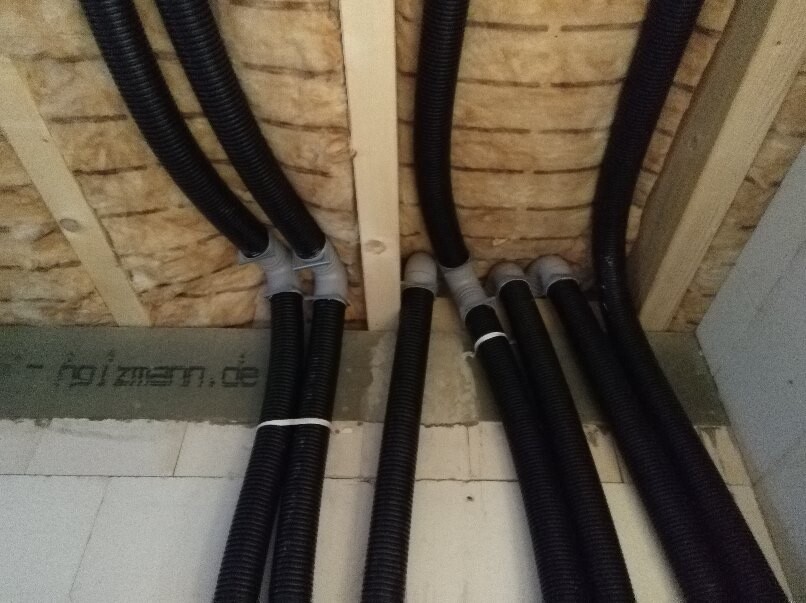
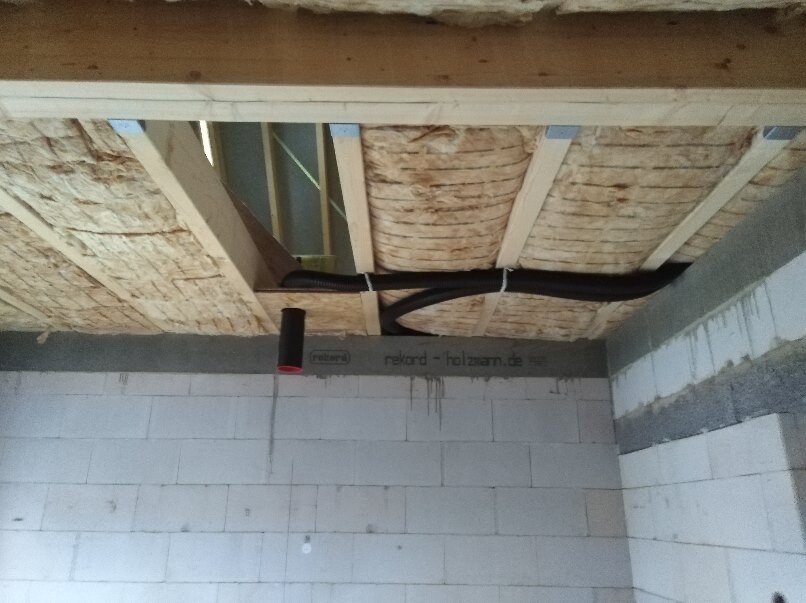
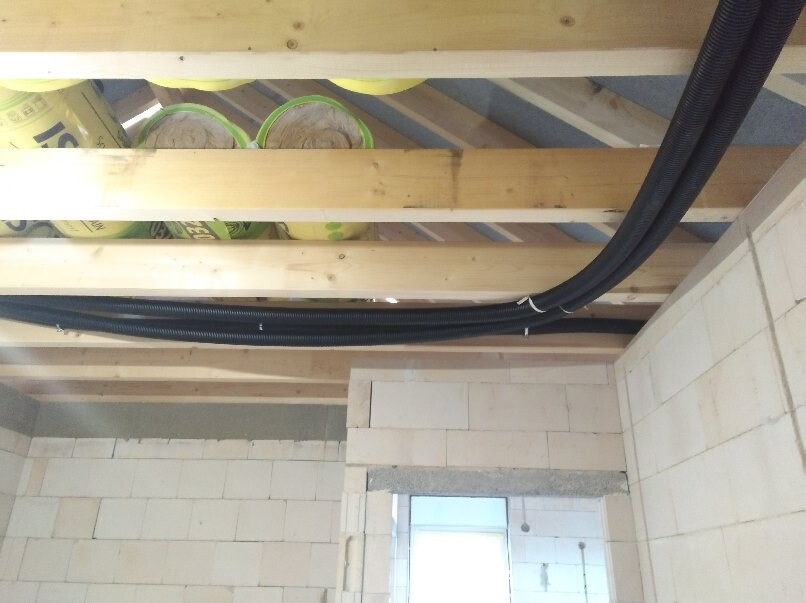
In the following pictures, you can see that the ducts will penetrate the airtight layer multiple times.
I am puzzled about how the vapor control layer can be made airtight afterwards, especially since no sealing collars can be installed anymore.
It is said that the membrane could be taped under the ducts everywhere, but even this would not help with image 1.
These multiple penetrations worry me not only because of the blower door test but, more importantly, due to potential moisture damage from leaks in the membrane.
Are our concerns justified? Or is this common practice nowadays and the airtight bonding of the membrane will be manageable without issues?
Good luck
We are building a KfW 55 single-family house, which means a blower door test is required.
In the attic, we have a collar beam ceiling leading to the unheated loft. This means that insulation bats will be installed between the rafters, with a vapor control layer directly underneath, and 22mm (0.87 inches) OSB boards above.
The heating contractor has now installed the ventilation ducts for our central ventilation system.
In the following pictures, you can see that the ducts will penetrate the airtight layer multiple times.
I am puzzled about how the vapor control layer can be made airtight afterwards, especially since no sealing collars can be installed anymore.
It is said that the membrane could be taped under the ducts everywhere, but even this would not help with image 1.
These multiple penetrations worry me not only because of the blower door test but, more importantly, due to potential moisture damage from leaks in the membrane.
Are our concerns justified? Or is this common practice nowadays and the airtight bonding of the membrane will be manageable without issues?
Good luck

For this reason, I always recommend installing it within the floor on the upper floor. This makes many things easier. But as it looks for you now, images 2 and 3 are not a problem at all. For image 1, the ventilation installer or whoever is responsible must seal the membrane very well with the appropriate sealing materials.
Mycraft schrieb:
For that reason, I always recommend installing in the floor on the upper floor. It makes many things easier. But as it looks in your case, pictures 2 and 3 are not a problem at all. For picture 1, the ventilation installer or whoever is responsible must seal the membrane very well with the appropriate sealing materials.Thanks in advance for the quick feedback.
At least the exhaust pipes are installed in the floor; the structural engineer considered the supply air pipes too much to be placed there. These now partly lie ON the floor, and the rest as shown in the pictures.
Where the bundle runs up the wall, will it be covered with drywall? If the supply air is installed ON the floor, can it then be distributed to each room and installed inside the walls instead of the ceiling?
I originally planned to run supply and exhaust air through the ceiling on the upper floor, but after considering the forum comments, I decided to have exhaust air in the walls and supply air coming from the floor.
I originally planned to run supply and exhaust air through the ceiling on the upper floor, but after considering the forum comments, I decided to have exhaust air in the walls and supply air coming from the floor.
Stephan— schrieb:
Will the bundle running up the wall be covered with drywall? If the supply air is now installed ON the floor, can it then be distributed into each room and routed inside the walls instead of the ceiling?
I also wanted to have supply and exhaust air through the ceiling on the upper floor, but after reading the forum comments, I decided to run the exhaust air inside the walls and the supply air from the floor. Yes, it will need to be covered there. It’s in the kids’ bathroom anyway, where some parts have to be built out anyway for the plumbing.
Unfortunately, there isn’t enough space on the floor to install all seven flat ducts for the exhaust air. Our hallway, where the distribution could be done, is only 1.5m (5 feet) wide, and the water pipes from the heating engineer are already installed there.
Routing the pipes inside the walls is also tricky. We have many 11.5cm (4.5 inch) walls, so there won’t be much wall left in the end. If so, drywall would probably have to be used there as well.
Try looking for Primur 600ml; my drywall contractor uses something like that for every pipe penetrating the vapor retarder, etc. This might also solve your problem.
How far is the substructure planned to extend beneath the rafters? Looking at picture 3, it should be at least 75mm (3 inches) — I assume these are DN75 ventilation pipes?! Ideally, it would go through the rafters (STRUCTURAL ISSUE, don’t do this) or, similar to picture 1, run above the rafters. The latter wouldn’t look very nice from above (since the attic is not really used) but would benefit the ceiling height.
How far is the substructure planned to extend beneath the rafters? Looking at picture 3, it should be at least 75mm (3 inches) — I assume these are DN75 ventilation pipes?! Ideally, it would go through the rafters (STRUCTURAL ISSUE, don’t do this) or, similar to picture 1, run above the rafters. The latter wouldn’t look very nice from above (since the attic is not really used) but would benefit the ceiling height.
Similar topics