
ᐅ Location of Air-to-Water Heat Pump for a Semi-Detached House – Is It Too Close to the Neighbor?
Created on: 9 Sep 2020 10:15
B
Baugreenhorn
Hello everyone,
We are considering using an air-to-water heat pump for heating in our semi-detached house. However, I’m concerned that the noise from the heat pump at our preferred installation location (Option 1) might disturb our neighbor (the other half of the semi-detached house). Of course, we want to avoid that.
Does anyone have experience with how this is handled, for example, in terraced housing estates? Is my concern about the noise justified?
Am I even allowed to install a heat pump when my neighbor’s house is directly next to mine?
Here is the plan of our ground floor with the two possible installation locations:
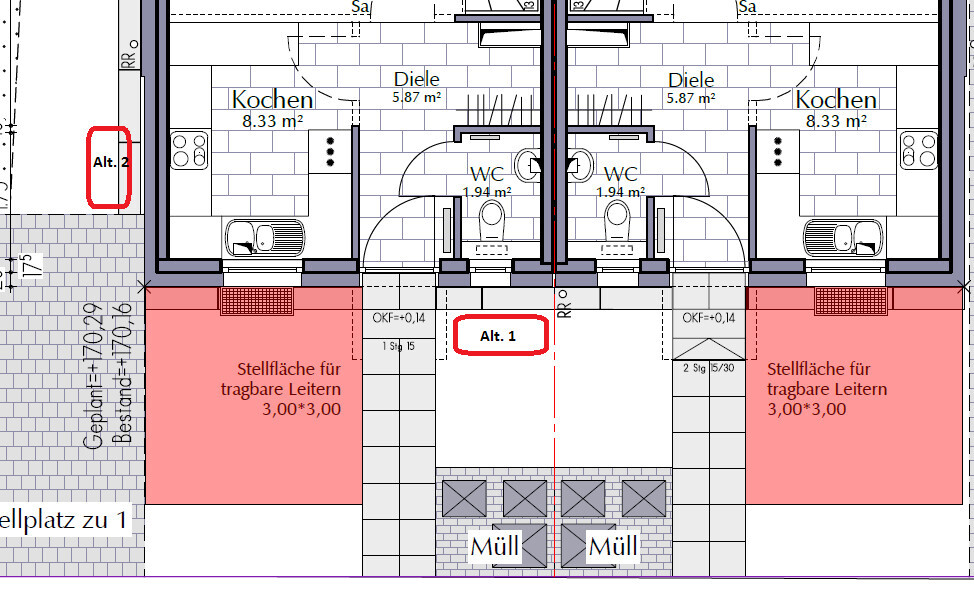
I was also thinking that the pump could alternatively be installed on the gable side, but that would mean losing some space. The neighbor is much further away there. However, the pump would then be in the garden, so we would need to be careful with the carport planning.
Alternatively, I would consider an indoor installation (if feasible, as this would only be possible in the basement, and I’m not sure if we can get air ducts to the outside somehow. Maybe someone knows how this can be done).
Thank you very much for your help!
We are considering using an air-to-water heat pump for heating in our semi-detached house. However, I’m concerned that the noise from the heat pump at our preferred installation location (Option 1) might disturb our neighbor (the other half of the semi-detached house). Of course, we want to avoid that.
Does anyone have experience with how this is handled, for example, in terraced housing estates? Is my concern about the noise justified?
Am I even allowed to install a heat pump when my neighbor’s house is directly next to mine?
Here is the plan of our ground floor with the two possible installation locations:
I was also thinking that the pump could alternatively be installed on the gable side, but that would mean losing some space. The neighbor is much further away there. However, the pump would then be in the garden, so we would need to be careful with the carport planning.
Alternatively, I would consider an indoor installation (if feasible, as this would only be possible in the basement, and I’m not sure if we can get air ducts to the outside somehow. Maybe someone knows how this can be done).
Thank you very much for your help!
B
Baugreenhorn14 Sep 2020 16:02With district heating, if they stick to what the general contractor plans. We want to deviate.
Permissible Limits
The least strict limit for outdoor-installed equipment applies to industrial areas, where 70 dB(A) is considered acceptable. At the other end of the spectrum are areas that include hospitals and similar facilities, where the noise emission limits are 45 dB(A) during the day and 35 dB(A) at night. In purely residential areas, the limit is 50 dB(A) during the day and 35 dB(A) at night. However, there is another complication: these limits refer to noise emissions—that is, the total noise exposure from all sources. This total exposure is hardly controllable by an individual heat pump operator. The only solution is to have the heat pump officially classified as an “irrelevant noise source” to be exempt from this overall responsibility. For this, the permitted limit must be undershot by 6 dB(A).
Have the installer provide you with a written confirmation that the noise level at your neighbor’s window is 35 dB(A); this will be sufficient for now. Otherwise, you could be held liable!
The least strict limit for outdoor-installed equipment applies to industrial areas, where 70 dB(A) is considered acceptable. At the other end of the spectrum are areas that include hospitals and similar facilities, where the noise emission limits are 45 dB(A) during the day and 35 dB(A) at night. In purely residential areas, the limit is 50 dB(A) during the day and 35 dB(A) at night. However, there is another complication: these limits refer to noise emissions—that is, the total noise exposure from all sources. This total exposure is hardly controllable by an individual heat pump operator. The only solution is to have the heat pump officially classified as an “irrelevant noise source” to be exempt from this overall responsibility. For this, the permitted limit must be undershot by 6 dB(A).
Have the installer provide you with a written confirmation that the noise level at your neighbor’s window is 35 dB(A); this will be sufficient for now. Otherwise, you could be held liable!
D
daniel1985ffo15 Sep 2020 14:25I am quite surprised that you can deviate from that so easily, since the heating system type must be specified in the building permit / planning permission application.
We indicated an air-to-water heat pump.
A few weeks later, we received a letter from the building authority asking us to adjust the official site plan (marking and dimensioning the heat pump) and to submit the full documentation of the heat pump for the preparation of a noise impact assessment.
Later, the building authority requested information about the required distance of our heat pump from the neighbor’s property and from the sidewalk.
We indicated an air-to-water heat pump.
A few weeks later, we received a letter from the building authority asking us to adjust the official site plan (marking and dimensioning the heat pump) and to submit the full documentation of the heat pump for the preparation of a noise impact assessment.
Later, the building authority requested information about the required distance of our heat pump from the neighbor’s property and from the sidewalk.
B
Baugreenhorn16 Sep 2020 11:46Neither the building authority, the developer, nor the district heating supplier have raised any objections. I called the building authority, and installation is possible without an application. The notary who drafted the unified contract also gave the green light. The only condition is that the neighbor must not be disturbed by noise.
D
daniel1985ffo16 Sep 2020 14:18Yes, exactly, the neighbor must not be disturbed. So you need an acoustic report that proves this. Otherwise, how will you be able to prove after 5 years that the noise levels are being maintained if the neighbor is bothered and demands a "complaint/action"?
Similar topics