
ᐅ Should You Install a Photovoltaic Battery Storage System or Not?
Created on: 2 Dec 2020 17:42
H
Heidi1965
Our new build is already quite advanced. Next week, 15 photovoltaic modules with a total output of 5.1 kWp will be installed. We are getting a heat pump with a capacity of 5.12 kWh. Initially, a battery storage system was not planned because we wanted to live in the house for at least one year to monitor our electricity consumption patterns, and then potentially add a battery or expand the photovoltaic system later. Now there is a new program that offers a 40% subsidy for battery storage—but only in connection with new builds. That sounds tempting. Should we go for it? What capacity should the battery have at a minimum? The condition is: "The ratio of system output to usable battery storage capacity must be at least 1.2 kWp to kWh of battery storage. Storage capacity exceeding this ratio is not eligible for funding." Have I understood correctly that only a battery with a capacity of 4.25 kWh would be eligible for funding?
Or is this all too small? Just “play equipment”?
Or is this all too small? Just “play equipment”?

When building a house, we distinguish between construction costs and ongoing expenses. The construction costs are something we can afford at the current stage, or not. In the broadest sense, these are calculable. The ongoing expenses, however, are the unknown factor. During the build, we tried as much as possible to consider what will create a bigger burden for us in the future. We could afford the construction costs that occurred, which is why we proceeded with them. From our perspective, the ongoing expenses are very variable and therefore unpredictable. So, we are trying—based on the current situation—to do everything possible to reduce these ongoing costs.
Of course, there is a certain amount of idealism involved as well.
Whether this strategy will pay off remains to be seen.
Nevertheless, we feel confident with the use of a ground source heat pump, photovoltaic panels, and related technology.
A battery storage system is deliberately excluded for now but is planned and can be retrofitted at any time.
I’m curious whether we are on the right track with this "approach."
Of course, there is a certain amount of idealism involved as well.
Whether this strategy will pay off remains to be seen.
Nevertheless, we feel confident with the use of a ground source heat pump, photovoltaic panels, and related technology.
A battery storage system is deliberately excluded for now but is planned and can be retrofitted at any time.
I’m curious whether we are on the right track with this "approach."
Tarnari schrieb:
When building a house, we distinguish between construction costs and ongoing expenses. The construction costs are something we can afford at the current stage—more or less predictable. Ongoing expenses, however, are the unknown factor. During the build, we tried to anticipate what will create higher expenses for us in the future. The construction costs were manageable for us at the time; otherwise, we wouldn’t have gone ahead with them. Ongoing costs are, in our view, very uncertain and hard to predict. So, based on the current situation, we try to do as much as possible to keep those ongoing costs low.
Of course, there is quite a bit of idealism involved. Whether this strategy will work out, we will see. Still, we feel confident investing in a ground source heat pump, photovoltaic system, and related technologies.
We have deliberately excluded a battery storage system for now, but it is planned and can be retrofitted at any time.
I’m curious to see if our “idea” is the right one. I proceeded in a similar way, but after last winter, I realized that photovoltaics, a KfW55 standard, and a solid heat pump alone are not a cure-all if you don’t use the electricity when it’s essentially free. So, I drilled into my wife and myself when it makes the most sense to use or charge the dryer, washing machine, dishwasher, showers, cooking, baking, and car. Basically, we created an energy consumption plan for all major consumers.
At first, it sounds strange, but if you do the opposite, you shouldn’t be surprised when your self-sufficiency rate falls below 20% and you waste electricity at 8 cents per kilowatt-hour.
H
hampshire4 Dec 2020 12:44Anyone who buys a photovoltaic system based solely on the lowest price per kWp and at the same time discusses in the forum whether window frames should have a matte or glossy finish clearly lacks the ability to consider aesthetics and cost-effectiveness together. Great windows paired with ugly panels on the roof? That’s just laughable.
The claim that the share of self-consumption does not play an economic role is ridiculous when the price of a kilowatt-hour from the provider is three times higher than the feed-in tariff. Hmm – where do you think the kilowatt-hour is more economically used?
When it comes to photovoltaics, those who are still stuck in the old subsidy mindset clearly have some blinders on.
The claim that the share of self-consumption does not play an economic role is ridiculous when the price of a kilowatt-hour from the provider is three times higher than the feed-in tariff. Hmm – where do you think the kilowatt-hour is more economically used?
When it comes to photovoltaics, those who are still stuck in the old subsidy mindset clearly have some blinders on.
Bookstar schrieb:
Storage systems are definitely worthwhile nowadays, even without subsidies. It was quite different two years ago. So go for it! A 40% grant is amazing.But for that, the storage system has to be very affordable. Typically, such subsidies come with strict limitations on feed-in. So make sure to carefully check the conditions and do the calculations.H
hampshire7 Dec 2020 14:26Calculations involving the battery storage are based on different assumptions. When only solar hours are considered, the result looks like the left side of the illustration. When cloudy days are also taken into account, it can look like the right side. From this, an assumption about the cycles of the battery storage is derived. This assumption determines the calculated cost per kWh from the battery storage. Therefore, the calculation can be presented in a positive or negative way.
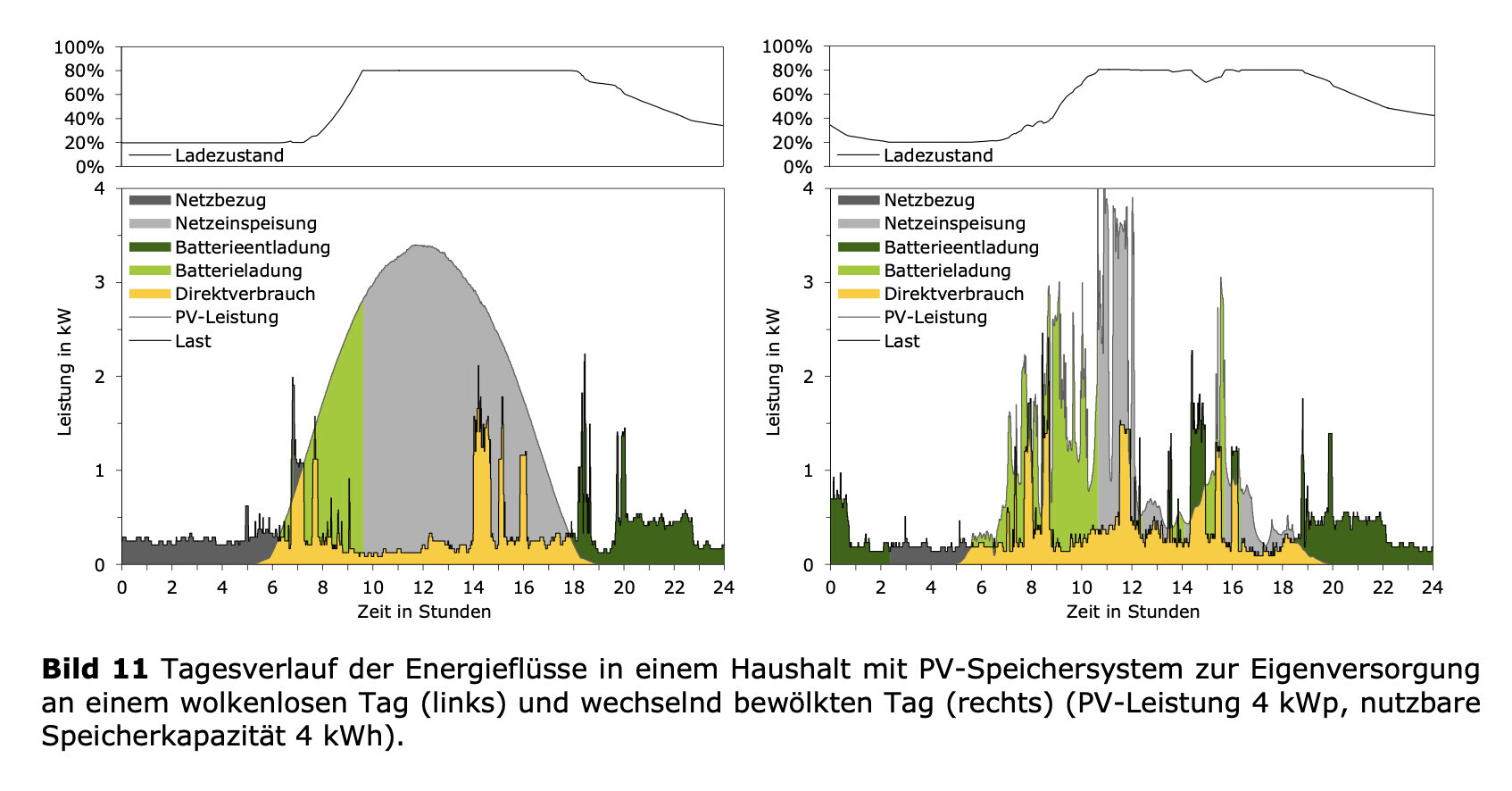
(Source: HTW Berlin)
(Source: HTW Berlin)
H
Heidi196512 Dec 2020 22:22The funding is available through the NBank. Therefore, it applies in Lower Saxony.
Similar topics