
Hello everyone,
I want to section off a bathroom in a room. I have marked the wall lines in red in the picture.
The wall will be 3.40m (11 ft 2 in) high.
For the cladding, I plan to use 15mm (5/8 inch) OSB boards with 12.5mm (1/2 inch) drywall panels on top.
I want to build it with metal UW and CW profiles.
Can you tell me what minimum width the UW and CW profiles should have?
My other questions are:
- Should the OSB boards be installed with staggered joints?
- Do the joints of the OSB boards need to be filled and sanded?
- I have read that you should leave a few millimeters of gap between the boards and the wall/floor/ceiling. How can I seal this gap to prevent sound transmission?
Thank you in advance
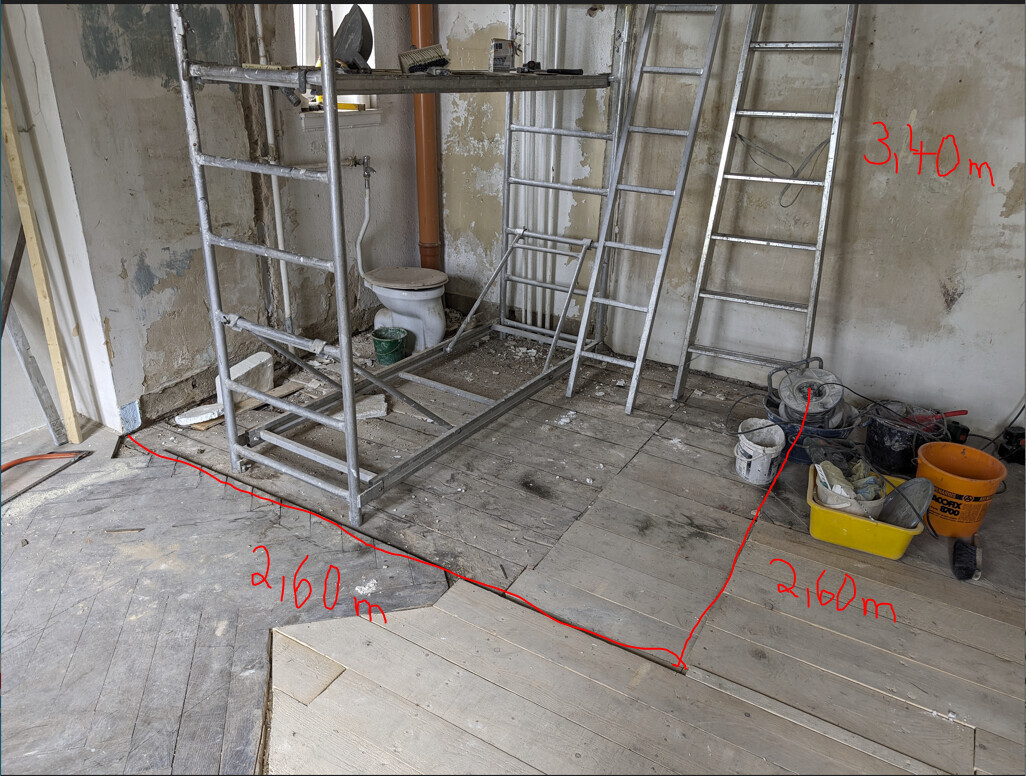
I want to section off a bathroom in a room. I have marked the wall lines in red in the picture.
The wall will be 3.40m (11 ft 2 in) high.
For the cladding, I plan to use 15mm (5/8 inch) OSB boards with 12.5mm (1/2 inch) drywall panels on top.
I want to build it with metal UW and CW profiles.
Can you tell me what minimum width the UW and CW profiles should have?
My other questions are:
- Should the OSB boards be installed with staggered joints?
- Do the joints of the OSB boards need to be filled and sanded?
- I have read that you should leave a few millimeters of gap between the boards and the wall/floor/ceiling. How can I seal this gap to prevent sound transmission?
Thank you in advance
B
Buchsbaum0666 Jun 2024 15:20In this forum, you have to expect everything.
It is full of professional expertise.
So clear statements are necessary. And a circular saw is definitely not the same as a handheld circular saw.
A cordless drill is not a drill press, even though both can be used for drilling.
It is full of professional expertise.
So clear statements are necessary. And a circular saw is definitely not the same as a handheld circular saw.
A cordless drill is not a drill press, even though both can be used for drilling.

Excuse me? Are you trying to mock me?
Circular saws are divided into stationary and handheld types, each of which can be further categorized (table saws, swing-arm saws, miter saws / plunge saws).
So, a circular saw can definitely be a handheld circular saw.
A handheld circular saw is always a circular saw.
The statement that a circular saw is not a handheld circular saw is simply incorrect. Possibly a lie (to avoid admitting that someone just wanted to appear more knowledgeable), but in any case, wrong.
Circular saws are divided into stationary and handheld types, each of which can be further categorized (table saws, swing-arm saws, miter saws / plunge saws).
So, a circular saw can definitely be a handheld circular saw.
A handheld circular saw is always a circular saw.
The statement that a circular saw is not a handheld circular saw is simply incorrect. Possibly a lie (to avoid admitting that someone just wanted to appear more knowledgeable), but in any case, wrong.
Make peace with each other!
Another important question for me: the walls measure 2.6m (8.5 feet) wide and 3.4m (11.2 feet) high.
I have OSB panels measuring 205 x 67.5cm (81 x 27 inches) and drywall boards measuring 120 x 60cm (47 x 24 inches).
Did I choose the drywall boards too small? Does this have any negative impact on the stability of the wall?
Another important question for me: the walls measure 2.6m (8.5 feet) wide and 3.4m (11.2 feet) high.
I have OSB panels measuring 205 x 67.5cm (81 x 27 inches) and drywall boards measuring 120 x 60cm (47 x 24 inches).
Did I choose the drywall boards too small? Does this have any negative impact on the stability of the wall?
You install the OSB panels horizontally first (groove facing down) from bottom to top. Then place the gypsum plasterboards vertically. Ideally, you shouldn’t have joints with insufficient offset along the way. You might want to lay out the plasterboards beforehand to check this; otherwise, make one corrective cut.
B
Buchsbaum0666 Jun 2024 21:33Yes, you could definitely have chosen larger drywall panel sizes, such as 2.60 x 0.6 meters (8.5 x 2 feet) or even better, 3.60 meters (12 feet) in height. This way, however, you will need to do more joint finishing due to the increased number of seams.
You also have to be able to transport them.
You also have to be able to transport them.
Would you first cover the entire ceiling with gypsum fiberboards and then attach the metal stud frames over the continuous surface, or would you screw the metal stud frames onto the wooden battens, raise the wall, and only then cover the ceiling once two rooms have been created? Regarding the wooden battens, I cannot achieve a continuous surface, which means the metal studs would rest on a batten only every 30cm (12 inches), with gaps in between.
Similar topics