
Hello everyone,
I had a consultation last week with a prefab house provider.
Of course, we also discussed the desired energy efficiency class for the house.
KfW55 is basically standard for prefab houses, and KfW40 is quite easy to achieve. After all, the houses basically consist of just a few wooden beams and insulation material.
Since I want to install a photovoltaic system on the roof anyway, it quickly leads to KfW40+.
My plan was to aim for KfW40+ with a solar system, an air-to-water heat pump, and underfloor heating.
My advisor now suggested an alternative: instead of the air-to-water heat pump and underfloor heating throughout the house, use infrared heating panels. This would save the costs for the heat pump (including maintenance) and underfloor heating. KfW40+ would still be achievable since the insulation stays the same and the heat energy is generated by the photovoltaic system.
I unfortunately forgot how the domestic hot water would be heated (I think either purely electric or with additional solar thermal).
A rough calculation showed that there would be no big difference in total costs. However, with infrared heating, maintenance costs and wear and tear would be eliminated.
Has anyone had experience with equipping an entire house with infrared heating?
So far, I only knew about it being used as bathroom mirrors.
Oh, and this manufacturer was recommended to me: try googling "Infrarot Riedlingen" 🙂
I had a consultation last week with a prefab house provider.
Of course, we also discussed the desired energy efficiency class for the house.
KfW55 is basically standard for prefab houses, and KfW40 is quite easy to achieve. After all, the houses basically consist of just a few wooden beams and insulation material.
Since I want to install a photovoltaic system on the roof anyway, it quickly leads to KfW40+.
My plan was to aim for KfW40+ with a solar system, an air-to-water heat pump, and underfloor heating.
My advisor now suggested an alternative: instead of the air-to-water heat pump and underfloor heating throughout the house, use infrared heating panels. This would save the costs for the heat pump (including maintenance) and underfloor heating. KfW40+ would still be achievable since the insulation stays the same and the heat energy is generated by the photovoltaic system.
I unfortunately forgot how the domestic hot water would be heated (I think either purely electric or with additional solar thermal).
A rough calculation showed that there would be no big difference in total costs. However, with infrared heating, maintenance costs and wear and tear would be eliminated.
Has anyone had experience with equipping an entire house with infrared heating?
So far, I only knew about it being used as bathroom mirrors.
Oh, and this manufacturer was recommended to me: try googling "Infrarot Riedlingen" 🙂

ypg schrieb:
He has nothing against small houses—rather against designing a house (here quite modest in size) with features that are usually “expected” in larger homes, because the investment tends to pay off more on larger floor areas. No. First of all, I don’t just *have nothing against* small houses—I actually think it’s *really good* when someone doesn’t build beyond their means. Secondly, it’s not about whether the features in terms of level of equipment are worth it relative to the floor area size category. I am pointing out that the features mentioned here by the original poster do not fit the type of house models he is considering. This feature set comes from a world of people who are on average ten years further along in life, career, and self-reflection than the typical homebuyers of the house models he is thinking of adding them to. I see the original poster starting a family within five years and changing properties within another ten years. The potential secondhand buyers will be the same type typically purchasing these young family home models—they do not look for these features nor do they want to pay extra for them. Without corresponding price reductions—I assume the full amortization of the upgrade cost—the house would become difficult to sell on the resale market. Additionally, this feature set is not planned for in the construction of these highly space-efficient models and will present tricky improvisation challenges for the builders (which, in the best case, will result in awkward drywall additions). While it is commendable not to go beyond one’s means with an “advanced bachelor pad” instead of a showy mansion in terms of size, a product from the “space miracle” category seems highly unsuitable here as a base model.
https://www.instagram.com/11antgmxde/
https://www.linkedin.com/company/bauen-jetzt/

hampshire schrieb:
Everything that goes out through the window is lost; they do not block infrared radiation.How do greenhouses work then? (Fifth word)H
hampshire15 May 2021 07:47Tolentino schrieb:
How do greenhouses work then? (Fifth word)Infrared radiation passes through the glass and heats the materials inside. The heat emitted within the greenhouse warms the air. The warm air cannot escape easily because of the glass. Evaporation through the plants generates humidity. This creates the greenhouse climate. If the heat source inside the greenhouse were the heat itself, all the warmth would escape.I hardly dare to disagree, but with all due respect, I have learned it a bit differently:
Shortwave solar radiation (UV) can pass through glass, while longwave infrared radiation, which is reflected by the materials inside, passes through much less effectively (air, of course, even less so).
See eyeglass lenses...
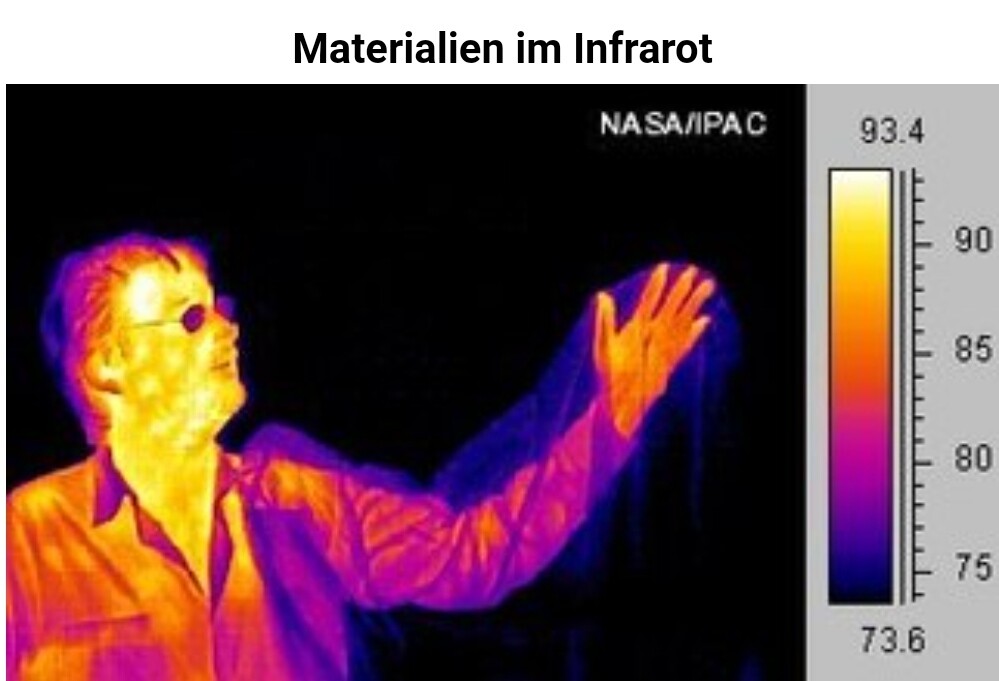
CR: NASA
Shortwave solar radiation (UV) can pass through glass, while longwave infrared radiation, which is reflected by the materials inside, passes through much less effectively (air, of course, even less so).
See eyeglass lenses...
CR: NASA
D
Daniel-Sp15 May 2021 09:09Bookstar schrieb:
Then there is the hot water issue or rather the risk of legionella
...Another controversial topic often used to argue against heat pumps. Because here too, planning or misplanning is crucial. Oversized tanks and stagnant water in pipes are the problem, regardless of the upstream heat source. Even maintaining storage temperatures above 70°C (158°F) doesn’t help. That only selects for the more heat-resistant strains. Besides, you would have to flush all pipes simultaneously with the high storage temperature, which is not done. With an appropriately sized tank and sufficient hot water turnover, your system will have no legionella issues, whether you use gas heating, pellet boilers, or a heat pump.H
hampshire16 May 2021 11:27No contradiction. The principle of infrared heating is based on warming materials, not the air. Glass is a poor heat store. Therefore, it is not practical to install an infrared heater opposite a window. Your thermal image shows that the lenses of glasses have not retained any heat.
The sun emits a very broad spectrum of radiation, including UV and infrared. You feel UV as sunburn on your skin, and infrared as warmth. Have you ever felt the sun through a window? The window feels cold, while the skin warms up. The radiation passes through.
The sun emits a very broad spectrum of radiation, including UV and infrared. You feel UV as sunburn on your skin, and infrared as warmth. Have you ever felt the sun through a window? The window feels cold, while the skin warms up. The radiation passes through.
Similar topics