
Hi,
we’re about to start building soon, and the building permit-free process was not objected to.
However, on the advice of the construction manager, we informed the local authority that rainwater would be infiltrated via a soakaway basin in the garden.
The authority states:
Rainwater must be infiltrated; a calculation of the infiltration system according to ATV-DVWK A-138 is required and must be documented. An infiltration test or an equivalent laboratory test is necessary.
We have no expertise in this matter ourselves. I’ve tried to read up a bit, but the whole topic seems very complex.
As mentioned, we specified a soakaway basin, so the local authority was able to approve it directly and did not have to forward it to the lower water authority.
One neighbor in our new development installed a soakaway tank and prefers it over a basin because it doesn’t create a “wet biotope” in the garden.
Another neighbor who has already built (using the same earthworks company/gardening contractor as we are) installed a trench soakaway system.
Now I’m wondering which option is better or more cost-effective?
Attached is the offer, which also includes the trench soakaway.
The soakaway tank seems to be quite a bit cheaper??
I hope you can help me decide the best infiltration method.

we’re about to start building soon, and the building permit-free process was not objected to.
However, on the advice of the construction manager, we informed the local authority that rainwater would be infiltrated via a soakaway basin in the garden.
The authority states:
Rainwater must be infiltrated; a calculation of the infiltration system according to ATV-DVWK A-138 is required and must be documented. An infiltration test or an equivalent laboratory test is necessary.
We have no expertise in this matter ourselves. I’ve tried to read up a bit, but the whole topic seems very complex.
As mentioned, we specified a soakaway basin, so the local authority was able to approve it directly and did not have to forward it to the lower water authority.
One neighbor in our new development installed a soakaway tank and prefers it over a basin because it doesn’t create a “wet biotope” in the garden.
Another neighbor who has already built (using the same earthworks company/gardening contractor as we are) installed a trench soakaway system.
Now I’m wondering which option is better or more cost-effective?
Attached is the offer, which also includes the trench soakaway.
The soakaway tank seems to be quite a bit cheaper??
I hope you can help me decide the best infiltration method.
bierkuh83 schrieb:
You don’t disappoint me with that.. That’s great.. Your municipality is probably happy that the sewers are being properly flushed since the pipes are so large that otherwise hardly any sufficient flow velocity is achieved...
In the end, it’s a matter of personal calculation and decision whether one is allowed or wants to discharge or prefers infiltration..
The next person comes along and wants to wash their laundry with rainwater or water mom’s tulips... No, no. We have to infiltrate. No discharging into the sewers. That’s why I’m so relieved that only roofs count. Otherwise, we would have around 400sqm (4300 sq ft) of surface to manage.

Hi, I recently contacted the local water authority again and I’m really confused.
We don’t want to build a soakaway pit on our property anymore for rainwater infiltration, but to install a soakaway trench instead. The soakaway pit was originally submitted with the building permit / planning permission application.
I have already been in touch with the local water authority regarding this. They wrote:
Dear Mr. XXX,
in your application, you need to specify how you will drain all sealed surfaces, including walkways, terraces, and parking areas.
Using permeable materials for these surfaces unfortunately does not mean that runoff won’t occur during heavy rain events (depending on the chosen material).
Please note that runoff from traffic areas must not be directed into a soakaway trench without prior treatment according to DWA-M 153.
We therefore recommend that you provide a slight slope on these surfaces toward the nearest green area. In this way, you can channel rainwater that cannot infiltrate directly through the permeable surfaces into a dedicated soakaway pit, preventing it from leaving your property.
You should also include garage or carport roof surfaces in your calculations from the start. This will save you from needing a second application and ensures that your infiltration system is properly sized.
So, we initially stated in the building permit / planning permission application that we would build a soakaway pit.
If I’ve read it correctly, the calculation for the size of the pit was based on an infiltration area of 160m² (1722 sqft).
As far as I know, this 160m² (1722 sqft) refers only to the roof.
This was approved as such.
Now I am suddenly supposed to include the terrace (whose size is not yet determined), a garage of possibly 30m² (323 sqft), and driveway/walkways that also have no defined dimensions yet.
Do you have any experience with this?
Initially, it was enough to infiltrate just the roof water, but now I’m expected to manage infiltration for everything possible?
My attitude is: if it rains, it rains... In the past, this was never such a big issue. The water just soaks into the ground on the property, and not every public street has a soakaway trench every few meters. It simply flows into the sewer system just like “our” rainwater would.
Well, I hope you can help me with your experience.
We don’t want to build a soakaway pit on our property anymore for rainwater infiltration, but to install a soakaway trench instead. The soakaway pit was originally submitted with the building permit / planning permission application.
I have already been in touch with the local water authority regarding this. They wrote:
Dear Mr. XXX,
in your application, you need to specify how you will drain all sealed surfaces, including walkways, terraces, and parking areas.
Using permeable materials for these surfaces unfortunately does not mean that runoff won’t occur during heavy rain events (depending on the chosen material).
Please note that runoff from traffic areas must not be directed into a soakaway trench without prior treatment according to DWA-M 153.
We therefore recommend that you provide a slight slope on these surfaces toward the nearest green area. In this way, you can channel rainwater that cannot infiltrate directly through the permeable surfaces into a dedicated soakaway pit, preventing it from leaving your property.
You should also include garage or carport roof surfaces in your calculations from the start. This will save you from needing a second application and ensures that your infiltration system is properly sized.
So, we initially stated in the building permit / planning permission application that we would build a soakaway pit.
If I’ve read it correctly, the calculation for the size of the pit was based on an infiltration area of 160m² (1722 sqft).
As far as I know, this 160m² (1722 sqft) refers only to the roof.
This was approved as such.
Now I am suddenly supposed to include the terrace (whose size is not yet determined), a garage of possibly 30m² (323 sqft), and driveway/walkways that also have no defined dimensions yet.
Do you have any experience with this?
Initially, it was enough to infiltrate just the roof water, but now I’m expected to manage infiltration for everything possible?
My attitude is: if it rains, it rains... In the past, this was never such a big issue. The water just soaks into the ground on the property, and not every public street has a soakaway trench every few meters. It simply flows into the sewer system just like “our” rainwater would.
Well, I hope you can help me with your experience.
A different question: Does your local water authority conduct inspections? We were explicitly told that they do not check whether a soakaway system has actually been installed. After all, it is supposedly in our own interest.
Nevertheless, we will intercept the water from the driveway. The water from the terrace just flows into the garden.
In other words, just create a plan with a properly sized system including a sediment filter, etc. How you actually build it is up to you.
Nevertheless, we will intercept the water from the driveway. The water from the terrace just flows into the garden.
In other words, just create a plan with a properly sized system including a sediment filter, etc. How you actually build it is up to you.
Hm... we did it the same way with the flower beds.
But the local water authority is a completely different organization.
How can I find out if they actually check this?
It’s hard to ask, "Do you even inspect this?"
I only know that our home builder also wanted to know if we need an infiltration system. So, they had the city fill out some paperwork.
The checked box is already noted here on page 1:
Stormwater must/should infiltrate; a calculation of the infiltration system according to ATV-DVWK A-138 is required and must be documented. An infiltration test or an equivalent laboratory test is required.
So I have no idea if they really verify this.
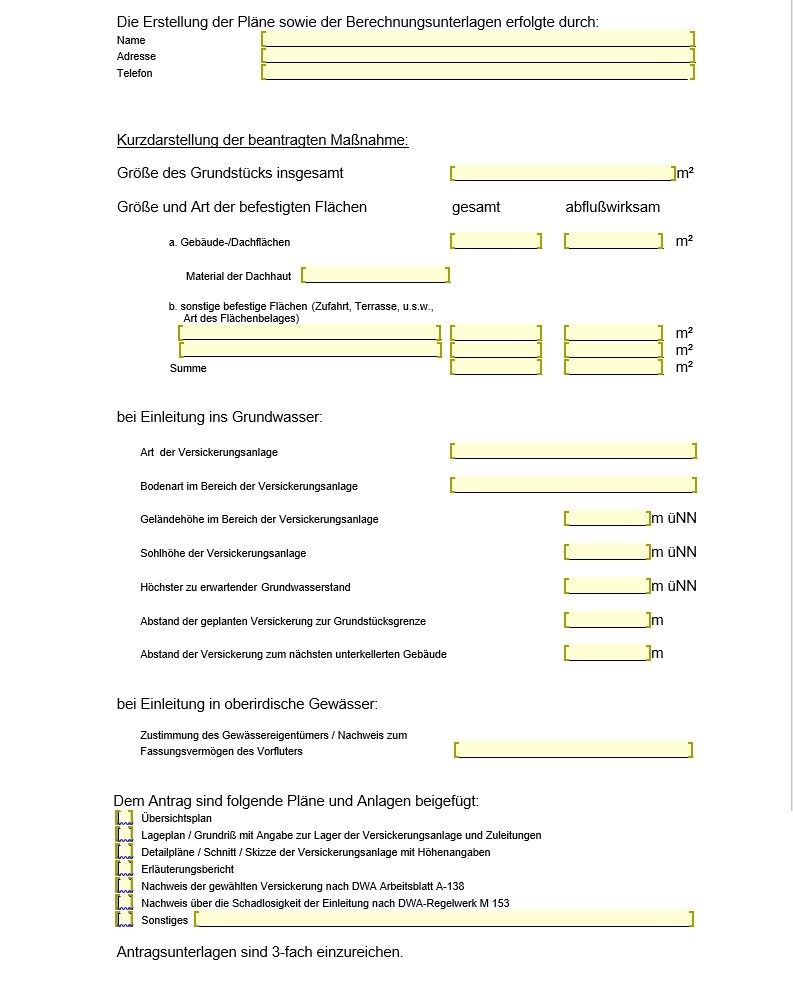
In the first email from the local water authority, she also mentioned that I need to fill out the following application and submit it in three copies. (See attachment)

But the local water authority is a completely different organization.
How can I find out if they actually check this?
It’s hard to ask, "Do you even inspect this?"
I only know that our home builder also wanted to know if we need an infiltration system. So, they had the city fill out some paperwork.
The checked box is already noted here on page 1:
Stormwater must/should infiltrate; a calculation of the infiltration system according to ATV-DVWK A-138 is required and must be documented. An infiltration test or an equivalent laboratory test is required.
So I have no idea if they really verify this.
In the first email from the local water authority, she also mentioned that I need to fill out the following application and submit it in three copies. (See attachment)

Similar topics