
ᐅ Induction cooktop with downdraft extractor, unducted recirculation – any experiences?
Created on: 11 Nov 2023 21:37
H
hauskauf1987
Good evening everyone,
Today the installation of our kitchen was completed. An AEG Flexbridge 2-in-1 induction cooktop with a recirculating extractor hood was installed. Due to the cabinet layout and appliance components, this is set up as an "unguided recirculation" system. My kitchen fitter did not create a slot in the plinth or similar. According to him, the air escapes through the cabinets and so on.
Google tells me that the after-run function is important to keep the area dry after cooking.
Are there any professionals here who can approve this installation situation?
I have attached a photo.
Thanks in advance.
Good luck
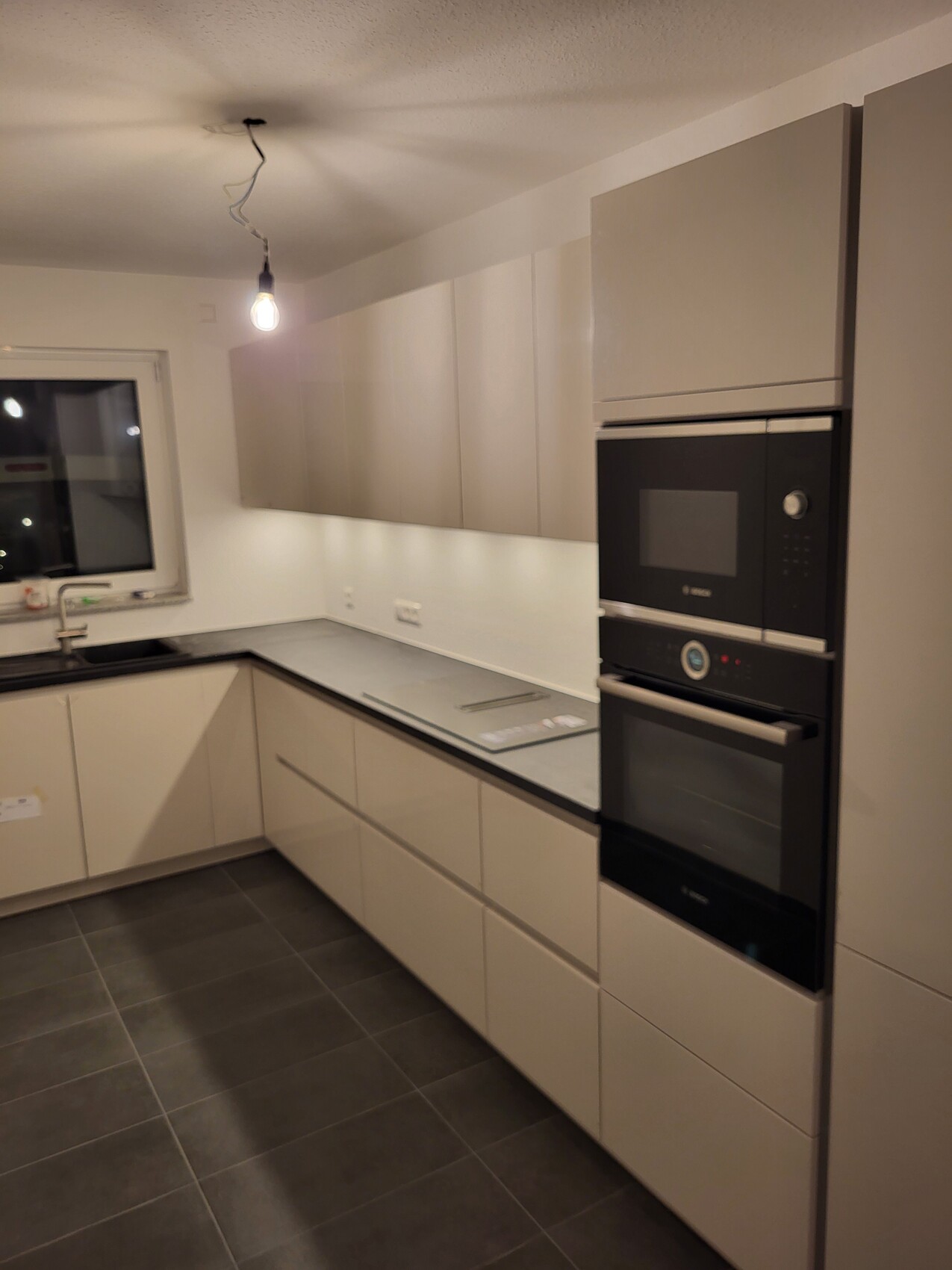
Today the installation of our kitchen was completed. An AEG Flexbridge 2-in-1 induction cooktop with a recirculating extractor hood was installed. Due to the cabinet layout and appliance components, this is set up as an "unguided recirculation" system. My kitchen fitter did not create a slot in the plinth or similar. According to him, the air escapes through the cabinets and so on.
Google tells me that the after-run function is important to keep the area dry after cooking.
Are there any professionals here who can approve this installation situation?
I have attached a photo.
Thanks in advance.
Good luck
N
Nice-Nofret12 Nov 2023 14:04I see a planning mistake here. Downdraft cooktops are actually designed for installation in an island, not to be placed under wall cabinets. The cabinets above the cooktop are likely to suffer from swelling damage within a few years if pasta, potatoes, rice, or soup is frequently cooked without a lid.
For understandable reasons (the customer wants it that way, and the kitchen cabinet manufacturer aims to increase sales), this planning mistake becomes reality, as in your case. Uncontrolled recirculated air directed into base cabinets—especially against an exterior wall—will, in my opinion, also lead to serious problems.
For understandable reasons (the customer wants it that way, and the kitchen cabinet manufacturer aims to increase sales), this planning mistake becomes reality, as in your case. Uncontrolled recirculated air directed into base cabinets—especially against an exterior wall—will, in my opinion, also lead to serious problems.
H
hauskauf198712 Nov 2023 14:46Nice-Nofret schrieb:
I see a design flaw here. Downdraft cooktops are actually intended for installation in an island setup, not to be installed under wall cabinets. The cabinets above the cooktop are likely to develop swelling damage within a few years if items like pasta, potatoes, rice, or soup are frequently cooked without lids.
For understandable reasons (the customer wants it that way, and the kitchen fitter wants the sale), this design flaw becomes reality, as in your case. Uncontrolled recirculated air venting into base cabinets—especially if located on an exterior wall—leads, in my opinion, to a truly problematic situation. Thank you for your opinion and also to xmister.
Induction cooktops can be installed under wall cabinets according to manufacturers like Bora and others, with a minimum distance of 50cm (20 inches). Let’s say the kitchen was planned “privately,” not by professionals, then the planner passed away, etc.—a bit of unfortunate circumstances, but basically the kitchen is as we wanted it.
In the meantime, I have noticed that with the toe kicks there is a continuous gap of about 1 to 2cm (0.4 to 0.8 inches), as these are only clipped on. Is that sufficient for air circulation?

hauskauf1987 schrieb:
There is a continuous gap 1 to 2cm (0.4 to 0.8 inches) high, since these are only clipped on. Is that enough for air circulation?Yes, that provides sufficient cross-sectional area for the fan. Nobody will be looking at the creepy cabinet anyway. 😉
H
hauskauf198712 Nov 2023 20:29Nida35a schrieb:
Yes, that cross-section is sufficient for the fan,
no one will see the horror chamber anyway 😉I can already tell you’re definitely against vent hoods over the stove, right?
But that doesn’t help me. I’m trying to get the best results possible and look forward to more responses and experiences.

In the left picture, you can see the exhaust duct. It needs to be routed from the underside of the cooktop down into the plinth, meaning it must go through the cabinet base. Usually, there should be a cutout at the back of the cabinet floor for this. If it wasn’t done at the factory, you’ll have to modify it yourself. The exhaust pipe can either end inside the plinth or be routed forward to an exhaust grille in the plinth.
Without an exhaust grille, the air will simply spread inside the plinth of all the cabinets and slowly escape through the gaps (do not seal with silicone).
Personally, I haven’t found a high enough plinth board yet, so I don’t have one installed, but when I do, I plan to try the grille. It just feels safer to me.
Without an exhaust grille, the air will simply spread inside the plinth of all the cabinets and slowly escape through the gaps (do not seal with silicone).
Personally, I haven’t found a high enough plinth board yet, so I don’t have one installed, but when I do, I plan to try the grille. It just feels safer to me.

We had this setup in our old house and had it installed the same way in the new one. The only difference is that, in our case, it’s integrated into an island. It also uses unducted recirculating air. Most of the air still exits at the bottom of the island, even without a visible vent. You can feel it near your feet when the extractor is on high. We’ve never experienced moisture problems or “musty cabinets.” However, our experience only covers two years so far. We have pull-out drawers beneath the cooktop, and if condensation occurred, we would probably notice. So far, in practical use, we have had zero issues, and we cook almost every day, sometimes twice a day.
We do have a controlled mechanical ventilation system in the house, plus an exhaust vent directly in the kitchen corner. I would highly recommend this combination because it effectively distributes moisture throughout the house. You can tell by how quickly laundry dries in the utility room. Our cooktop is from Bora, and its filter can be easily cleaned in the dishwasher without much effort. We do this regularly to prevent any greasy buildup in the kitchen.
We do have a controlled mechanical ventilation system in the house, plus an exhaust vent directly in the kitchen corner. I would highly recommend this combination because it effectively distributes moisture throughout the house. You can tell by how quickly laundry dries in the utility room. Our cooktop is from Bora, and its filter can be easily cleaned in the dishwasher without much effort. We do this regularly to prevent any greasy buildup in the kitchen.
Similar topics