
Hello!
We are currently in the more detailed planning phase of our construction project and are obtaining quotes from potential building companies. We have received a design that we generally like. However, the issue is the knee wall height on the upper floor after finishing, which is 75cm (30 inches) with a roof pitch of 42°.
There is no zoning plan for our plot, only regulations from the building authority that specify a eaves height of 4m (13 feet) and a ridge height of 8.50m (28 feet).
How could the knee wall possibly be increased? Would this only be possible by setting back the walls, thus losing floor space on the upper floor? A consultant from another company told me that raising the knee wall is not a problem at all and can be done without losing any floor area...
We would like a knee wall of at least 90cm (35 inches), preferably 1m (39 inches). However, to my non-expert understanding, this would mean exceeding the eaves height?
A lot of space is simply lost in the rooms, and I find the layout of the bathroom quite unfavorable.
I look forward to any suggestions.
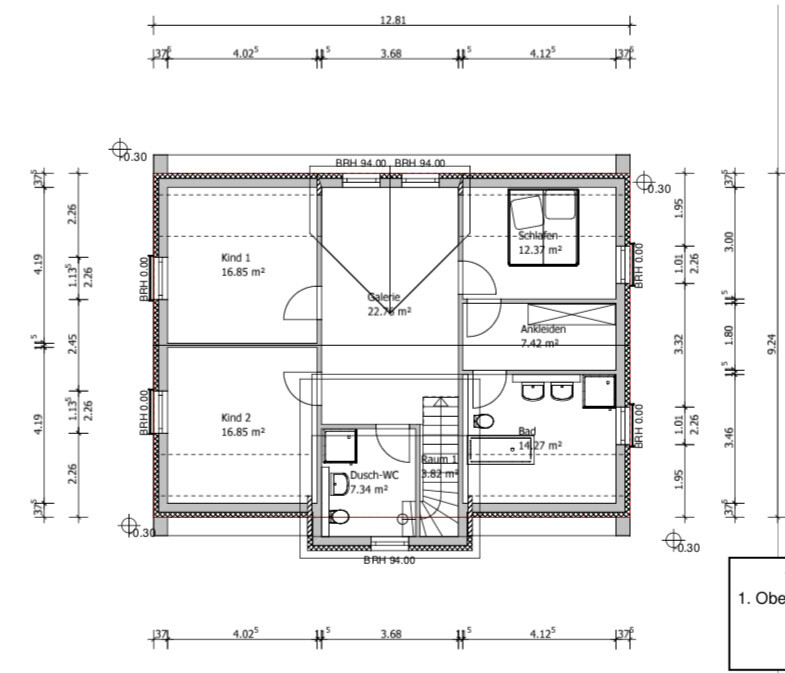
We are currently in the more detailed planning phase of our construction project and are obtaining quotes from potential building companies. We have received a design that we generally like. However, the issue is the knee wall height on the upper floor after finishing, which is 75cm (30 inches) with a roof pitch of 42°.
There is no zoning plan for our plot, only regulations from the building authority that specify a eaves height of 4m (13 feet) and a ridge height of 8.50m (28 feet).
How could the knee wall possibly be increased? Would this only be possible by setting back the walls, thus losing floor space on the upper floor? A consultant from another company told me that raising the knee wall is not a problem at all and can be done without losing any floor area...
We would like a knee wall of at least 90cm (35 inches), preferably 1m (39 inches). However, to my non-expert understanding, this would mean exceeding the eaves height?
A lot of space is simply lost in the rooms, and I find the layout of the bathroom quite unfavorable.
I look forward to any suggestions.
L
LotteBerlin21 Oct 2019 15:20Hello everyone,
Thank you for your replies. We have received the following information from the building authority in Berlin Neukölln:
An exception allows construction behind the 20 m (65.6 ft) building depth, subject to the following rear yard requirements:
· Only for residential use
· Detached single-story house with a converted attic used as living space (according to the land use ordinance § 68, living rooms in the attic are included in the total floor area)
· Distance from the gable to the neighboring boundary > 4 m (13.1 ft), distance from the side wall > 3 m (9.8 ft)
· Dormer less than 1.5 m (4.9 ft) high but less than 1/3 of the roof height, length less than half of the ground floor wall length
· Outer edge set back more than 0.5 m (1.6 ft) from the ground floor wall
· Eaves wall height less than 4 m (13.1 ft) (measured from the established ground level to the intersection of external wall and roof surface) and ridge height less than 8.5 m (27.9 ft) above terrain
· One parking space or garage in the rear yard
Basically, we would like to build a house with the same dimensions as the one on the front lot, but with an additional flat-roofed gable facing the street and a flat-roof dormer flush with the ground floor wall at the back.
The existing house has a ridge height of 8.10 m (26.6 ft) and an eaves height of 4.30 m (14.1 ft). We have also “discovered” additional gables facing the street on two other houses that were built in the second row on this street.
In the children’s room, the minor loss of space might be acceptable since those areas can be used for storage. However, the bedroom and bathroom are more concerning in this regard.
Thank you for your replies. We have received the following information from the building authority in Berlin Neukölln:
An exception allows construction behind the 20 m (65.6 ft) building depth, subject to the following rear yard requirements:
· Only for residential use
· Detached single-story house with a converted attic used as living space (according to the land use ordinance § 68, living rooms in the attic are included in the total floor area)
· Distance from the gable to the neighboring boundary > 4 m (13.1 ft), distance from the side wall > 3 m (9.8 ft)
· Dormer less than 1.5 m (4.9 ft) high but less than 1/3 of the roof height, length less than half of the ground floor wall length
· Outer edge set back more than 0.5 m (1.6 ft) from the ground floor wall
· Eaves wall height less than 4 m (13.1 ft) (measured from the established ground level to the intersection of external wall and roof surface) and ridge height less than 8.5 m (27.9 ft) above terrain
· One parking space or garage in the rear yard
Basically, we would like to build a house with the same dimensions as the one on the front lot, but with an additional flat-roofed gable facing the street and a flat-roof dormer flush with the ground floor wall at the back.
The existing house has a ridge height of 8.10 m (26.6 ft) and an eaves height of 4.30 m (14.1 ft). We have also “discovered” additional gables facing the street on two other houses that were built in the second row on this street.
In the children’s room, the minor loss of space might be acceptable since those areas can be used for storage. However, the bedroom and bathroom are more concerning in this regard.
LotteBerlin schrieb:
In the kids’ room, the negligible loss of space might be true, as you can use those areas for storage. However, the bedroom and bathroom cause me more concern in this regard. Do you really have to position the bed that way? Perhaps you could swap the bedroom and walk-in closet? Then you could install a wardrobe covering the entire length of the wall in the walk-in closet. Photo attached.
I don’t see any issues with the bathroom. With the right ideas when building walls, it can look really nice. Just search for “bathtub under sloped ceiling.” Maybe you could even build a recessed shelf into the wall. Photo attached as well... There are definitely plenty of ideas. A shower under the sloped ceiling could also be an option... I wouldn’t worry too much about it.
As for the kids’ room, the ideas have already been described. That’s how we will do it too.

Without knowledge of the ground floor, it is more difficult to assess. What are the approximately 40cm (16 inches) long overhangs of the gable walls?
In principle, exceptions to building codes should be as possible as exceptions to zoning plans. Would it be possible to “sink” the house into the ground?
I consider placing a knee wall in front of the short wall to be the greatest nonsense: a Pyrrhic victory that throws the baby out with the bathwater, when trying to fight fire with fire.
https://www.instagram.com/11antgmxde/
https://www.linkedin.com/company/bauen-jetzt/
In principle, exceptions to building codes should be as possible as exceptions to zoning plans. Would it be possible to “sink” the house into the ground?
I consider placing a knee wall in front of the short wall to be the greatest nonsense: a Pyrrhic victory that throws the baby out with the bathwater, when trying to fight fire with fire.
https://www.instagram.com/11antgmxde/
https://www.linkedin.com/company/bauen-jetzt/

Well, if the neighbor is at 4.30 m (14.1 ft), the project is practically approved already. I would push it to the maximum here. Embed the foundation slab, ceiling height 2.65 m (8.7 ft) + ceiling thickness 25 cm (10 inches) = floor-to-ceiling height 2.90 m (9.5 ft).
4.30 m (14.1 ft) - 2.90 m (9.5 ft) = knee wall 1.40 m (4.6 ft). Theoretical.
4.30 m (14.1 ft) - 2.90 m (9.5 ft) = knee wall 1.40 m (4.6 ft). Theoretical.
kaho674 schrieb:
Well, if the neighbor is at 4.30m (14 feet), the matter is practically already approved.I don't think it will work to include the existing buildings in the first row in the integration definition of the construction projects in the second row when densifying residential areas.https://www.instagram.com/11antgmxde/
https://www.linkedin.com/company/bauen-jetzt/
LotteBerlin schrieb:
We received the following information from the building department Berlin Neukölln:On what legal basis is this information provided? To me, it sounds like extracts from a development plan and a design ordinance. Otherwise, where would the reference to the German Land Use Ordinance Section 68 come from? Did you receive this information specifically for your property, or is it more general?
LotteBerlin schrieb:
established ground levelWho determined the ground level? Where is this determination documented? Who planned for you? A local architect? Have the legal planning fundamentals explained to you clearly by the designer.
Similar topics