
ᐅ Incorrect slope in a walk-in shower – repair the tiles or start over?
Created on: 15 Dec 2025 12:47
T
Tolentino
Hello dear housebuilding forum members,
Here is the situation:
In our new build, we made a mistake when tiling the walk-in shower: the last tile has the wrong slope, causing water to collect there during longer showers and eventually flow out of the shower area.
For the past two years, we managed with a splash guard and a sliding barrier. But it was always inconvenient, and when the splash guard recently became leaky, I decided to do something different.
At first, I thought I could simply raise the incorrectly installed tiles and the threshold, so that no water could escape. However, we also had a seating ledge inside the shower that was intended as a place to sit, but in practice was just filled with wash gel and shampoo bottles and collected dirt (yes, many ideas but poorly executed due to time pressure).
So, I started by tearing down this ledge. Unfortunately, I completely misremembered how it was installed.
We had tiled the walls first, then the floor (based on my father-in-law's advice, so the floor tiles wouldn’t get dirty or damaged). For some reason, I was convinced that we did it differently in the shower (because of the slope). But we did not. This means that the floor tiles were cut out around the ledge, right in the shower area (so from the drain’s perspective, even before the tiles in question), basically leaving a hole where, of course, the waterproofing underneath is now damaged.
Now I’m considering how to proceed.
My options as I see them are:
a) Raise the entire surface. This would involve filling the cutout with a leveling compound, then applying a new waterproofing layer on top of and over the existing tiles, followed by new tiles.
How to handle the floor drain (Geberit Cleanline)? I don’t think it can be adjusted in height afterwards.
The threshold would be raised with an exaggerated slope inward to ensure nothing leaks out.
- Disadvantage: It might look patchy. Waterproofing might not be perfectly possible at the wall connections.
- Advantage: Much less effort, faster, and cheaper.
b) Do everything new. This would of course be the proper solution, but when tearing down the seating ledge I noticed how strongly the tile adhesive has bonded. It would be a huge job to remove all tiles. Then the surface would have to be re-leveled, probably requiring a new leveling compound (meaning the floor height inside the shower would again be higher than outside). Then new waterproofing and new tiles. This is a project I really do not want to take on right now, although I know it’s the right way to go.
Is there anything I might have forgotten? Any other possible option that might be simpler and faster? Or maybe something with an effort similar to a) but more reliable regarding waterproofing?
Does anyone here have experience with the Geberit Cleanline channel and know a trick to possibly raise its height afterwards?
Otherwise, I would probably have to work with rounded end profiles to minimize the dirt edge. Or does anyone know another solution?
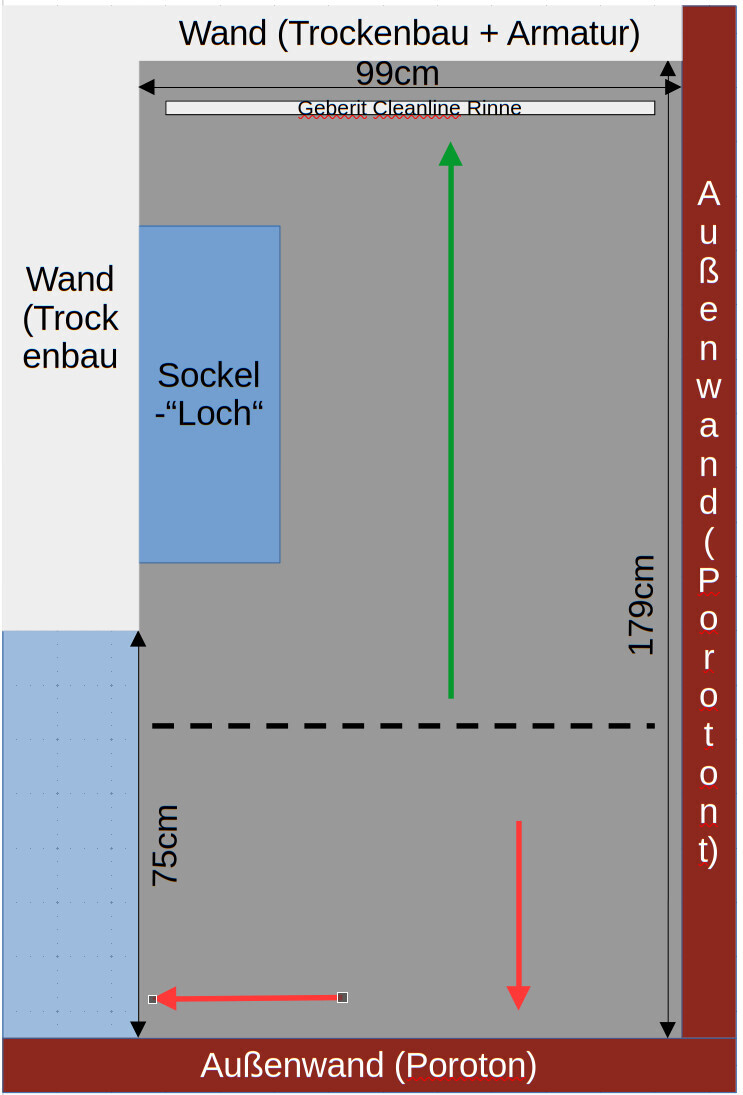
Attached is a sketch of the shower niche.
The arrows indicate the current correct (green) and incorrect (red) slopes. The entrance is at the bottom left of the plan.
I kindly ask to keep any mocking comments to a minimum—I’m already frustrated enough and want to focus only on solutions now.
Thank you very much and best wishes for the holiday season,
Tolentino
Here is the situation:
In our new build, we made a mistake when tiling the walk-in shower: the last tile has the wrong slope, causing water to collect there during longer showers and eventually flow out of the shower area.
For the past two years, we managed with a splash guard and a sliding barrier. But it was always inconvenient, and when the splash guard recently became leaky, I decided to do something different.
At first, I thought I could simply raise the incorrectly installed tiles and the threshold, so that no water could escape. However, we also had a seating ledge inside the shower that was intended as a place to sit, but in practice was just filled with wash gel and shampoo bottles and collected dirt (yes, many ideas but poorly executed due to time pressure).
So, I started by tearing down this ledge. Unfortunately, I completely misremembered how it was installed.
We had tiled the walls first, then the floor (based on my father-in-law's advice, so the floor tiles wouldn’t get dirty or damaged). For some reason, I was convinced that we did it differently in the shower (because of the slope). But we did not. This means that the floor tiles were cut out around the ledge, right in the shower area (so from the drain’s perspective, even before the tiles in question), basically leaving a hole where, of course, the waterproofing underneath is now damaged.
Now I’m considering how to proceed.
My options as I see them are:
a) Raise the entire surface. This would involve filling the cutout with a leveling compound, then applying a new waterproofing layer on top of and over the existing tiles, followed by new tiles.
How to handle the floor drain (Geberit Cleanline)? I don’t think it can be adjusted in height afterwards.
The threshold would be raised with an exaggerated slope inward to ensure nothing leaks out.
- Disadvantage: It might look patchy. Waterproofing might not be perfectly possible at the wall connections.
- Advantage: Much less effort, faster, and cheaper.
b) Do everything new. This would of course be the proper solution, but when tearing down the seating ledge I noticed how strongly the tile adhesive has bonded. It would be a huge job to remove all tiles. Then the surface would have to be re-leveled, probably requiring a new leveling compound (meaning the floor height inside the shower would again be higher than outside). Then new waterproofing and new tiles. This is a project I really do not want to take on right now, although I know it’s the right way to go.
Is there anything I might have forgotten? Any other possible option that might be simpler and faster? Or maybe something with an effort similar to a) but more reliable regarding waterproofing?
Does anyone here have experience with the Geberit Cleanline channel and know a trick to possibly raise its height afterwards?
Otherwise, I would probably have to work with rounded end profiles to minimize the dirt edge. Or does anyone know another solution?
Attached is a sketch of the shower niche.
The arrows indicate the current correct (green) and incorrect (red) slopes. The entrance is at the bottom left of the plan.
I kindly ask to keep any mocking comments to a minimum—I’m already frustrated enough and want to focus only on solutions now.
Thank you very much and best wishes for the holiday season,
Tolentino
Similar topics