
ᐅ Incorrect Construction Methods: Drywall and Insulation from Knauf?
Created on: 15 Jul 2020 12:10
I
Infuso00
Hello fellow home builders,
We are currently building a townhouse with a developer and are facing an issue with the drywall partitions. According to the construction specifications, we are supposed to receive simply boarded metal stud walls with insulation. So far, so good!
Regarding the assembly (W111): Profiles from Knauf CW75 (75mm / 3 inches) are used, along with Knauf mineral wool insulation (40mm / 1.5 inches). According to Knauf, these must be installed securely to prevent slipping, as they do not fill 80% of the cavity and therefore require fastening. Our developer says that since this is friction-fit felt insulation, no securing is necessary. We are now at a loss because the rooms on both floors are adjacent to bathrooms and we are worried that if the insulation slips, we will hear everything. Knauf informed me again that they have had cases where the insulation slipped and therefore do not provide a warranty if anything happens.
Does the developer have to follow Knauf’s installation guidelines in this case?
We also find it odd that the drywall in the bathroom interiors has an 18mm (about 0.7 inches) gypsum board on the bathroom side and 12.5mm (0.5 inches) on the backside. I have not seen any approval from Knauf for this kind of construction— is this acceptable? Normally, I understand that bathrooms should have double-layer drywall.
Does anyone have more detailed information? I would be very grateful.
Best regards, Infuso00
We are currently building a townhouse with a developer and are facing an issue with the drywall partitions. According to the construction specifications, we are supposed to receive simply boarded metal stud walls with insulation. So far, so good!
Regarding the assembly (W111): Profiles from Knauf CW75 (75mm / 3 inches) are used, along with Knauf mineral wool insulation (40mm / 1.5 inches). According to Knauf, these must be installed securely to prevent slipping, as they do not fill 80% of the cavity and therefore require fastening. Our developer says that since this is friction-fit felt insulation, no securing is necessary. We are now at a loss because the rooms on both floors are adjacent to bathrooms and we are worried that if the insulation slips, we will hear everything. Knauf informed me again that they have had cases where the insulation slipped and therefore do not provide a warranty if anything happens.
Does the developer have to follow Knauf’s installation guidelines in this case?
We also find it odd that the drywall in the bathroom interiors has an 18mm (about 0.7 inches) gypsum board on the bathroom side and 12.5mm (0.5 inches) on the backside. I have not seen any approval from Knauf for this kind of construction— is this acceptable? Normally, I understand that bathrooms should have double-layer drywall.
Does anyone have more detailed information? I would be very grateful.
Best regards, Infuso00

Hello,
So the drywall contractor is using insulation that does not fully fill the cavity in the cross-section? I can’t judge what you are entitled to, but personally, I would not build it that way.
Regarding the sheathing: As a simple partition wall, single-sided sheathing is possible. Double-sided sheathing is recommended where loads are expected. But even then, at least where items are to be screwed on (kitchen, bathroom radiators, etc.), an OSB board should be installed for reinforcement. A full-surface covering with OSB is, of course, nicer but more expensive for you and not strictly necessary if you adhere to the specified heights.
About the different board thickness: Is the board in the bathroom the green type?
To assess your concern: I believe that with this construction, airborne sound transmission of bathroom noises is possible.
Regarding the water pipes, it is more important that there are no impact points, the pipes are well insulated, and sound-damping pipes are used (usually indicated on the pipes). Naturally, the pipes must not have any contact with the wall, as that would be critical.
With a 75mm (3 inches) metal stud, there is usually not much space for piping inside the wall—at most, drinking water and DN50 (50mm/2 inches) wastewater from the sink.
I will send a picture shortly showing how we solve bathroom walls here (though this always depends on the budget).
I am not familiar with construction developer law to advise what steps you can take.
Whether this construction is permitted depends on whether the generally accepted technical standards are followed. While a DIN standard may seem to represent these, it does not necessarily do so. However, manufacturer specifications must be implemented. Ignoring these will make it difficult to argue that the construction still complies with the generally accepted technical standards.
Infuso00 schrieb:
Profiles used are Knauf CW75 (75mm/3 inches) along with Knauf mineral wool insulation (40mm/1.5 inches). According to Knauf, these must be installed so they do not slip because they do not fill the cavity by 80%.
So the drywall contractor is using insulation that does not fully fill the cavity in the cross-section? I can’t judge what you are entitled to, but personally, I would not build it that way.
Regarding the sheathing: As a simple partition wall, single-sided sheathing is possible. Double-sided sheathing is recommended where loads are expected. But even then, at least where items are to be screwed on (kitchen, bathroom radiators, etc.), an OSB board should be installed for reinforcement. A full-surface covering with OSB is, of course, nicer but more expensive for you and not strictly necessary if you adhere to the specified heights.
Infuso00 schrieb:
We also find it odd that the drywall walls in the bathrooms have 18mm (0.7 inches) gypsum boards on the inside and 12.5mm (0.5 inches) on the outside.
Regards, Infuso00
About the different board thickness: Is the board in the bathroom the green type?
To assess your concern: I believe that with this construction, airborne sound transmission of bathroom noises is possible.
Regarding the water pipes, it is more important that there are no impact points, the pipes are well insulated, and sound-damping pipes are used (usually indicated on the pipes). Naturally, the pipes must not have any contact with the wall, as that would be critical.
With a 75mm (3 inches) metal stud, there is usually not much space for piping inside the wall—at most, drinking water and DN50 (50mm/2 inches) wastewater from the sink.
I will send a picture shortly showing how we solve bathroom walls here (though this always depends on the budget).
I am not familiar with construction developer law to advise what steps you can take.
Whether this construction is permitted depends on whether the generally accepted technical standards are followed. While a DIN standard may seem to represent these, it does not necessarily do so. However, manufacturer specifications must be implemented. Ignoring these will make it difficult to argue that the construction still complies with the generally accepted technical standards.
CORRECTION:
I can no longer edit my previous message, so here is a correction:
I was a bit too quick to say that a 40mm (1.6 inches) insulation in a 75mm (3 inches) profile is too thin. It depends on the product!
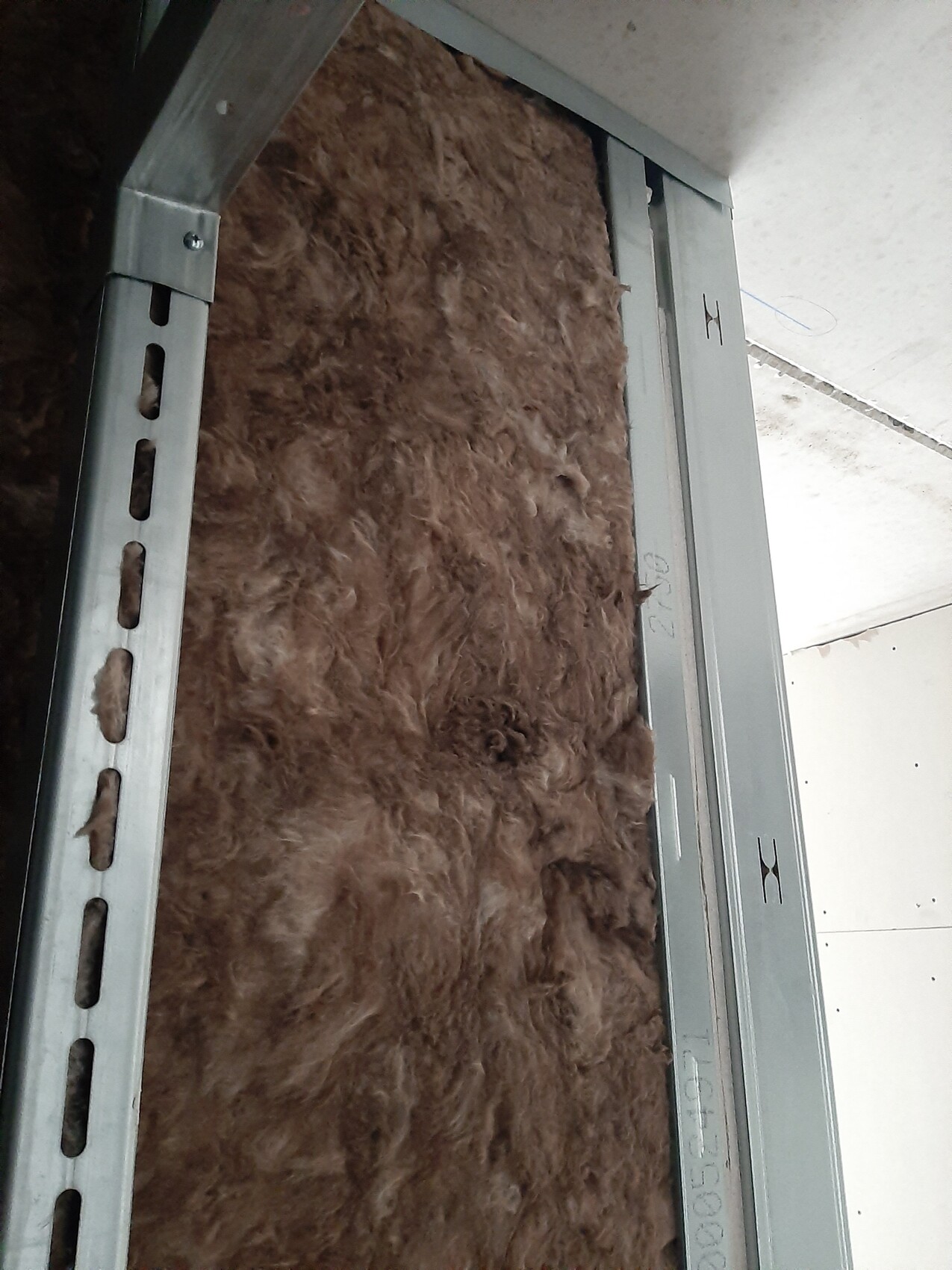
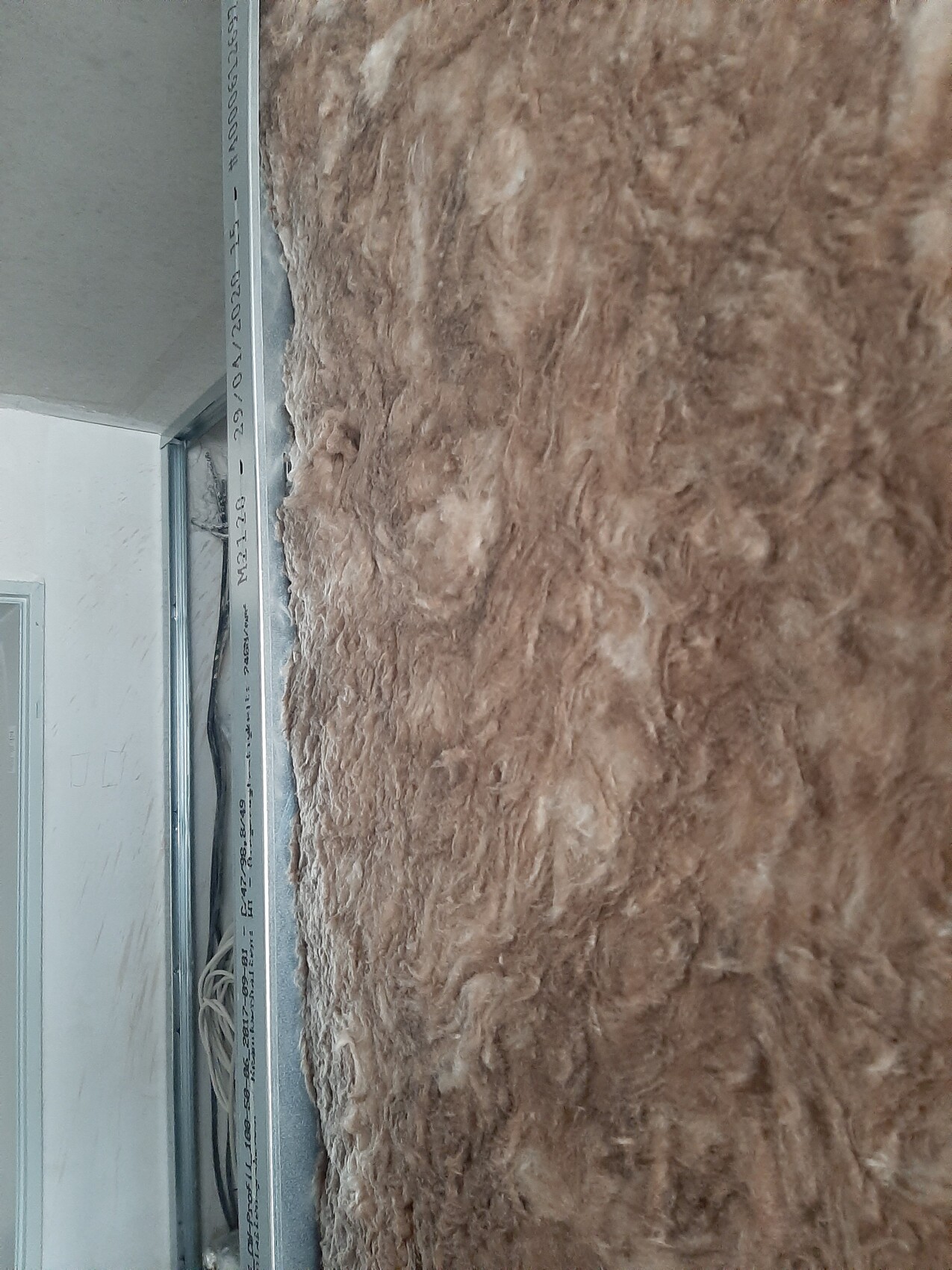
I just inserted a 40mm (1.6 inches) panel into a 75mm (3 inches) profile, and the panel fills the cavity very well. The insulation stays in place on its own.
Therefore, I withdraw my statement that you should expect noise issues. Because there is only a single layer of cladding, some mass is naturally missing, but I do not want to judge the resulting sound problems. Just to ease concerns: if the insulation looks like in the picture, it is fine in my opinion. I would not consider it a defect. There still need to be boxes and cables inside the wall anyway.
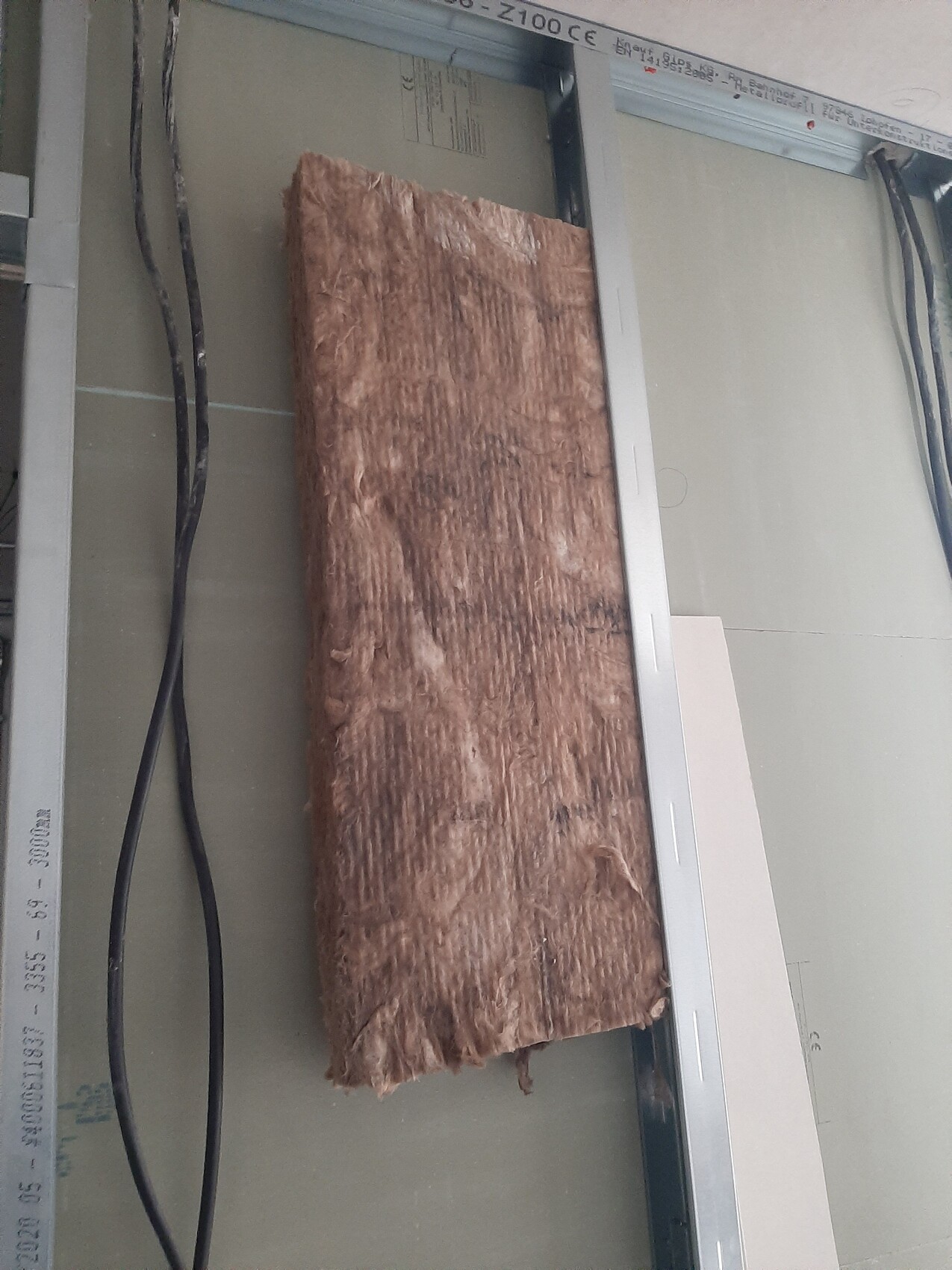
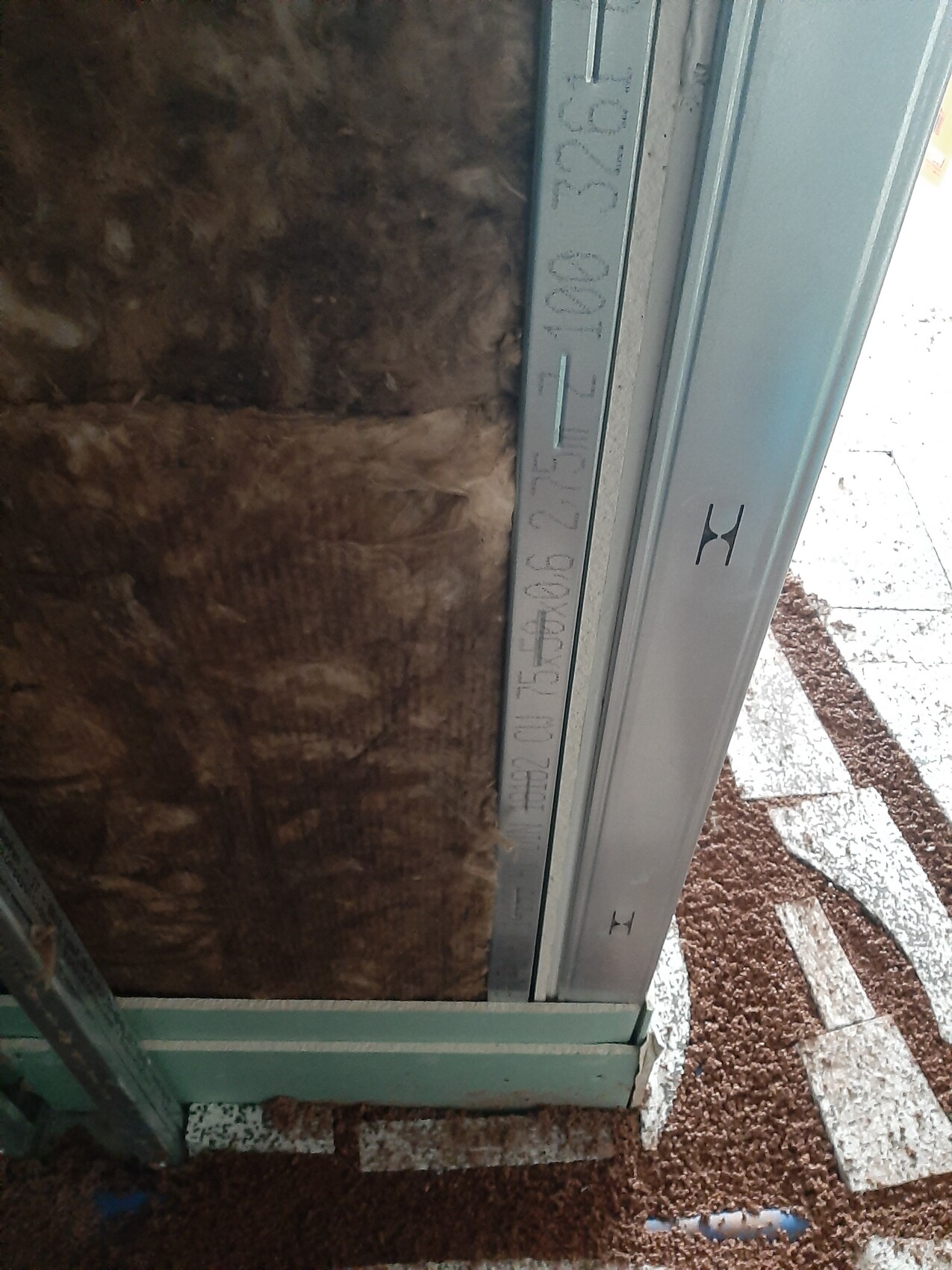
I also photographed the case where a 40mm (1.6 inches) panel is installed in a 100mm (4 inches) profile. There you can see that the cavity is not filled. I would report this as a defect and have it corrected (No, this was no coincidence; you usually notice such things before a "wall and shaft inspection" before closing).
I can no longer edit my previous message, so here is a correction:
I was a bit too quick to say that a 40mm (1.6 inches) insulation in a 75mm (3 inches) profile is too thin. It depends on the product!
I just inserted a 40mm (1.6 inches) panel into a 75mm (3 inches) profile, and the panel fills the cavity very well. The insulation stays in place on its own.
Therefore, I withdraw my statement that you should expect noise issues. Because there is only a single layer of cladding, some mass is naturally missing, but I do not want to judge the resulting sound problems. Just to ease concerns: if the insulation looks like in the picture, it is fine in my opinion. I would not consider it a defect. There still need to be boxes and cables inside the wall anyway.
I also photographed the case where a 40mm (1.6 inches) panel is installed in a 100mm (4 inches) profile. There you can see that the cavity is not filled. I would report this as a defect and have it corrected (No, this was no coincidence; you usually notice such things before a "wall and shaft inspection" before closing).

Tolentino schrieb:
So I was basically lucky to have found someone who not only provided one, made it part of the contract, but mostly stuck to it as well? If the scope of work description becomes part of the contract, it must be followed. However, this is generally the case with the general contractor (GC), but not with the turnkey builder (TB).
https://www.instagram.com/11antgmxde/
https://www.linkedin.com/company/bauen-jetzt/
Similar topics