
Hello forum,
We are currently moving into a split-level house built in 1981 and want to improve its energy efficiency at the same time. My question concerns the gable walls of the house, which are constructed as follows:
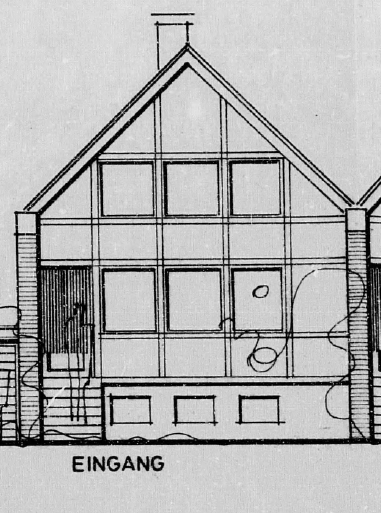
Timber frame construction. The windows are directly screwed into the timber frame. The infill panel layers from outside to inside are:
6mm (1/4 inch) fiber cement board > 80mm (3 inches) mineral wool > 12.5mm (1/2 inch) drywall
According to Ubakus, the wall currently has this performance level:

During the renovation and partial refurbishment, there is an opportunity to improve the thermal insulation of the infill panels with relatively little effort. I would remove the inner drywall, replace the 80mm mineral wool with 160mm (6 inches) WLG 032 insulation wool, then recess the wall inward accordingly and close it again with drywall. This raises two questions:
The timber frame currently sets the wall thickness. I assume the existing drywall is screwed directly onto the frame. If I recess the wall, there will be a gap between the timber frame and the interior wall surface. To avoid a thermal bridge, this gap should be insulated with something like WLG 022 instead of WLG 032, correct?
The second question concerns the overall plan. What I definitely want to avoid is introducing moisture into the wall. The fiber cement boards are relatively vapor resistant. There is no ventilation behind them. Perhaps it would make more sense to replace the 80mm mineral wool from the 1980s with 80mm instead of 160mm WLG 032 insulation?
Maybe you have other suggestions.
Thanks in advance.
We are currently moving into a split-level house built in 1981 and want to improve its energy efficiency at the same time. My question concerns the gable walls of the house, which are constructed as follows:
Timber frame construction. The windows are directly screwed into the timber frame. The infill panel layers from outside to inside are:
6mm (1/4 inch) fiber cement board > 80mm (3 inches) mineral wool > 12.5mm (1/2 inch) drywall
According to Ubakus, the wall currently has this performance level:
During the renovation and partial refurbishment, there is an opportunity to improve the thermal insulation of the infill panels with relatively little effort. I would remove the inner drywall, replace the 80mm mineral wool with 160mm (6 inches) WLG 032 insulation wool, then recess the wall inward accordingly and close it again with drywall. This raises two questions:
The timber frame currently sets the wall thickness. I assume the existing drywall is screwed directly onto the frame. If I recess the wall, there will be a gap between the timber frame and the interior wall surface. To avoid a thermal bridge, this gap should be insulated with something like WLG 022 instead of WLG 032, correct?
The second question concerns the overall plan. What I definitely want to avoid is introducing moisture into the wall. The fiber cement boards are relatively vapor resistant. There is no ventilation behind them. Perhaps it would make more sense to replace the 80mm mineral wool from the 1980s with 80mm instead of 160mm WLG 032 insulation?
Maybe you have other suggestions.
Thanks in advance.
Hello,
how about replacing the drywall boards with wood fiber boards? 80 mm (3 inches) wood fiber plaster carrier board with tongue and groove. Unfortunately, it only has a thermal conductivity of 0.041 W/(m·K) (at least the product I looked at). I am currently working with the 40 mm (1.5 inches) version myself and am quite impressed. I’m not sure how this works with a vapor retarder in timber frame construction. Maybe someone else knows more about that.
how about replacing the drywall boards with wood fiber boards? 80 mm (3 inches) wood fiber plaster carrier board with tongue and groove. Unfortunately, it only has a thermal conductivity of 0.041 W/(m·K) (at least the product I looked at). I am currently working with the 40 mm (1.5 inches) version myself and am quite impressed. I’m not sure how this works with a vapor retarder in timber frame construction. Maybe someone else knows more about that.
@Cronos86
So you mean removing the drywall, replacing the 80mm (3 inches) mineral wool with new 80mm (3 inches) insulation with a thermal conductivity of 0.032 W/(m·K), and then adding, for example, 80mm (3 inches) wood fiber insulation on top?
@Grundaus
The fiber cement boards probably contain asbestos. However, we would not touch those. The mineral wool would be replaced.
If I install a vapor retarder, wouldn’t that negate the capillary-active properties of the wood fiber boards? Since there are also wall connections and so on, I doubt we could make it airtight. From what I’ve read so far, it seems better if the moisture can dry toward the interior.
All windows will be replaced with plastic frames and triple glazing.
So you mean removing the drywall, replacing the 80mm (3 inches) mineral wool with new 80mm (3 inches) insulation with a thermal conductivity of 0.032 W/(m·K), and then adding, for example, 80mm (3 inches) wood fiber insulation on top?
@Grundaus
The fiber cement boards probably contain asbestos. However, we would not touch those. The mineral wool would be replaced.
If I install a vapor retarder, wouldn’t that negate the capillary-active properties of the wood fiber boards? Since there are also wall connections and so on, I doubt we could make it airtight. From what I’ve read so far, it seems better if the moisture can dry toward the interior.
All windows will be replaced with plastic frames and triple glazing.
I would check the mineral wool after removing the drywall panels; if it looks good, I would even consider leaving it in place. The vapor barrier should be installed between the mineral wool and the wood fiber boards. Ideally, use one with a variable diffusion resistance (SD value).