
Thank you for all suggestions!
------------------
Development Plan/Restrictions
Building gap in an older residential area, no detailed development plan, but subject to §34
Plot is surrounded by roads on three sides
Plot size = 610 m² (6566 sq ft)
Slope = approx. 0.50 m (1.6 ft) south-facing slope
Site coverage ratio = not explicitly defined
Floor area ratio = not explicitly defined
Building envelope, building line, and limits = not explicitly defined (state building code requires 2.50 m (8.2 ft) distance)
Edge development = a neighbor’s shed at the northeast boundary
Number of parking spaces = 4 (state building code requires: 2 per dwelling unit)
Number of floors = 1 ½ (presumably required due to §34)
Roof type = gable roof (presumably required due to §34)
Architectural style = similar to surrounding buildings (§34)
Orientation = unclear, existing buildings are varied
Maximum height/limits = unclear, existing buildings mostly around 7.50 m (24.6 ft) ridge height
Other requirements = none known
Immediate surroundings have no trees
Owners’ Requirements
Architectural style, roof type, building type = no preference, just what’s allowed
Basement, floors = no basement (budget reasons), desired number of floors is 2, but only 1 ½ permitted
Number of residents, age = initially Dwelling Unit 1 (ground floor): 2 adults (tenants or holiday renters) + Dwelling Unit 2 (attic): 2 adults, 1 child (2 years old)
In about 10 years, after conversion to a single-family house: 2 adults
Space requirement on ground and upper floor = small, current space needs not permanent, DU2 (attic) needs about 10 m² (108 sq ft) of storage space in basement/attic
Office: family use or home office? = no dedicated office but a utility/cleaning/common room
Overnight guests per year = none
Open or closed architecture = open
Conservative or modern construction style = no preference, just what is permitted
Open kitchen, cooking island = open kitchen yes, cooking island only if space allows (therefore no)
Number of dining seats = initially DU1 (ground floor): 4 + DU2 (attic): 4
Fireplace = no
Music/sound system wall = no
Balcony, roof terrace = no (budget reasons)
Garage, carport = no (budget reasons)
Utility garden, greenhouse = no
Additional wishes/special requirements/daily routine, also reasons why certain things should or should not be included
= Single-family house divided into two small rental units for a few years, one rented to relatives,
- to avoid a separate utility room on the ground floor, building services/heating/ventilation systems will be distributed between the common room and the attic,
- the seemingly “normal” dormer on the south side is omitted mainly due to budget,
- the roof pitch is steep (45°) to maximize usable space,
- the house orientation should allow wide unobstructed views and solar panels should be feasible,
- the site is very sunny, so excessive south-facing windows are not desired
House Design
Planning source = do-it-yourself
What do you particularly like? Why? = House can be easily converted into a single-family home
What do you dislike? Why? = Ground floor space utilization is not optimal, no practical option to add a balcony later on the attic floor
Cost estimate according to architect/planner = unknown (“can be done very nicely for 400000”)
Personal budget limit for house including equipment = 200000 (two hundred thousand), excluding kitchen and furniture
Preferred heating system = district heating (required by the municipality, but acceptable)
If you have to give up something, which details/extensions
- can you give up = everything “common today but not 20 years ago,” kitchens, glass panels in front doors, separate dressing rooms, roller shutters on north/west/east, roof windows
- reluctant to give up = underfloor heating (because it is hard to retrofit)
- cannot give up = utility/cleaning/common room, some storage space somewhere, division into two rentable units
Why did the design turn out as it is now? = A mix of many examples from various magazines/internet, simplified/reduced to fit the very limited budget
-------
By the way, the light blue shaded rectangles on the site plan are intended to represent parking spaces for cars
first, I picked out two sentences
I just posted our wishes and some ideas on how to save money based on them. But so far, I’m not even close to 200,000 euros. Maybe there are more money-saving ideas?
kbt09 schrieb:
I would first design a house the way I would probably like to live in it in about 10 years
kbt09 schrieb:
And only at the very end can you calculate how to manage with the given or currently desired resources, and whether there is potential for savings.
I just posted our wishes and some ideas on how to save money based on them. But so far, I’m not even close to 200,000 euros. Maybe there are more money-saving ideas?
Regarding the question about terrace options, I have marked on the site plan where the car access points and parking areas are located in the surrounding houses (in gray) and where the seating areas or terraces are (in ocher), in case anyone is interested.
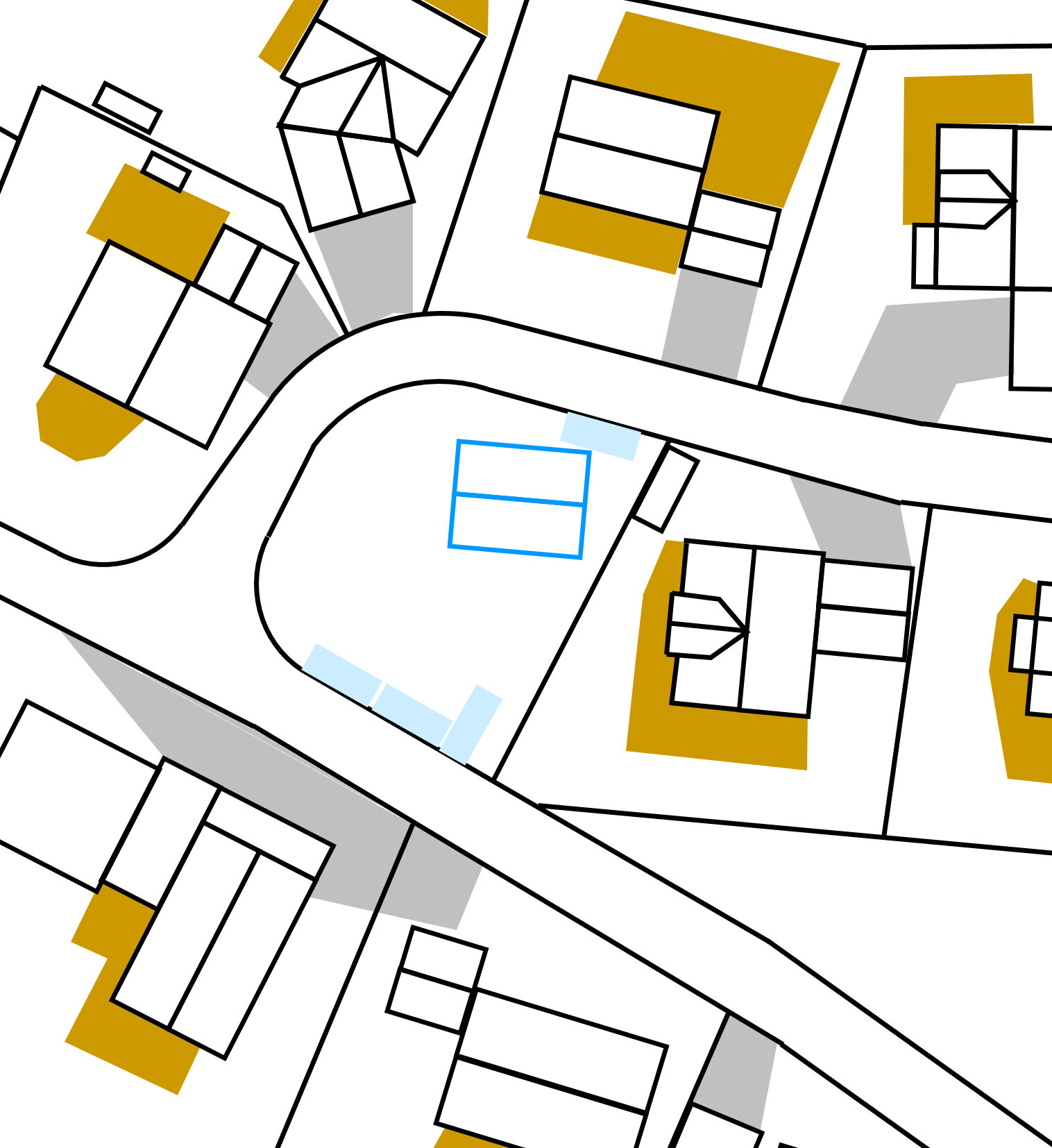
As for the question about sheltered corners with shade: there are currently none (no hedges, no trees, etc.), the only spot of this kind would be north of the house itself.
As for the question about sheltered corners with shade: there are currently none (no hedges, no trees, etc.), the only spot of this kind would be north of the house itself.

bindig schrieb:
I would really like to know what is wrong with the design Everything. As you can clearly see from the huge gap between
bindig schrieb:
Our dream house:
- Bungalow 180 m² (according to living space regulations)
- L-shape and what has been drawn so far.
bindig schrieb:
and what doesn’t work (besides it seeming flawed, which can also be an important gut feeling). The only gut feeling (in favor) is that the design pleasantly reminds me of my own early house planning experiments as a teenager. The counterarguments are all rational ones—except that the spatial feeling throughout the house will be as awkwardly folded twice as the staircase is. “Back to square one” is a wise conclusion.
I’ve also considered an L-shaped bungalow, with a guest apartment for holiday visitors and a separate unit for a long-term tenant.
Bungalows exist, including masonry-built ones, starting at about 90 m² (970 sq ft); in L-shape starting at about 120 m² (1,290 sq ft).
Partial basements are generally not recommended from a cost-efficiency perspective. L-shaped floor plans are an exception here: it can be cheaper if the basement is built as a rectangle (omitting the part that extends beyond one leg of the L).
bindig schrieb:
- my partner doesn’t want foam plastic cladding on the outside walls and ideally no prefab house either I already wrote in your other thread that this can be achieved with monolithic aerated concrete walls at 36.5 cm (14 inches); also with pumice blocks (e.g., KLB, Bisotherm).
bindig schrieb:
against:
- it is very likely not allowed to be built on this plot I can’t imagine that, since a "captain’s house"
bindig schrieb:
pro:
- is allowed to be built, the neighbors have it as a rather Frisian architectural style is allowed according to §34 in Baden-Württemberg 🙂
Regarding a garage (which you plan to use only in ten years), I wouldn’t worry about that in today’s budget. You can still accommodate a utility room (HAR) and a broom closet easily.
If you look back at your starting point here: basically, you began the house build process by looking for a wall build-up where concrete would act like a safety container on both sides for an insulation type your partner dislikes.
The fact that so far only a vacation home with an awkwardly folded staircase has come out of it could have been worse. Meanwhile, it has been explained to you that even with simple, widely available materials—and in the case of aerated concrete, even workable as a DIY project by your cousin?—walls are possible. You can find many sample designs as a basis for suitable houses—providers of solid construction also translate wall insulation system (ETICS) designs back into monolithic walls. Many “building proposals” from solid construction companies with external insulation actually originate from house types of an aerated concrete manufacturer.
You will also get closer to financing with any “more normal” design: the intended super-special vacation witch house would definitely not have opened any banker’s heart—simply because it cannot be easily monetized.
https://www.instagram.com/11antgmxde/
https://www.linkedin.com/company/bauen-jetzt/
Well, if I had to build with a tight budget and was just aiming to meet the minimum energy-saving regulations, without caring much about the aesthetics, I would go to a local planner who works with a builder from nearby that constructs small, simple houses. Four walls, a pitched roof, and done. The price-to-performance ratio is right.
Find a team like that. They also know everyone at the building authority and understand who can get what approved and how.
What do you really want later on? Just plan for that.
Why build a second shower you don’t need?
Why include a second kitchen? Why a second front door?
Take a close look at floor plans designed for 2 people or about 100 square meters (1,076 square feet) of living space.
Find a team like that. They also know everyone at the building authority and understand who can get what approved and how.
What do you really want later on? Just plan for that.
Why build a second shower you don’t need?
Why include a second kitchen? Why a second front door?
Take a close look at floor plans designed for 2 people or about 100 square meters (1,076 square feet) of living space.
bindig schrieb:
- my budget is only 200,000 (just for the house, excluding kitchen and furniture)That sounds better than I only have 200,000 available AI 🙂
bindig schrieb:
I am currently saving almost 2,000 euros per monthIf you save 2,000 per month, why wouldn’t it be possible to plan for, for example, 230,000 for a house?
bindig schrieb:
- bungalow 180 m² (according to living space regulation)
- L-shape
- basement
- double garage with storage room for car and garden equipmentHaha, almost everyone wants that and it’s a bit like reaching for the stars, even if the budget is well filled. But ok, so you at least have a starting point that looks different from building a house to rent to relatives, especially since the relatives don’t have money, so a holiday apartment also has to be part of it. There is not a single wish of yours in that plan, except for your cousin’s. And you don’t build a house out of goodwill alone when you have to do the math yourself.
bindig schrieb:
- 120 instead of 180 m²
- leave out the garage
unsolved:
- you can’t leave out the basement if you’re leaving out the garage. An alternative to the basement would be the attic, but there is no standing height in a bungalow attic, there are beams in the way, there is no daily usable staircase, and there is no space for a normal staircase eitherActually, you can. You can skip the basement and live well without a double garage! However, of course we don’t know how big your own family is planned to be in 10 years – I think we all here are assuming the same thing: that it’s planned without children. But I have the feeling that might not be the case?! 😳 Please clarify for us, so we can give better advice 🙂
So, you can leave out garages and basements, and there are bungalow roofs that can be used for storage. There are even bungalows with gable roofs 😉 Almost anything is possible, and even with a limited budget, plans with compromises can work well. In the end, you’re not necessarily sorry to have made compromises – rather the opposite.
Since you have no time anyway, I would postpone building your house. With a low budget, some things can be done later... You can keep saving monthly and keep an eye on interest rates.
When you build, do it according to your achievable wishes – not for others. If it’s not possible to plan or manage differently, you could sublet temporarily, but I would advise against short-term tenants because that tends to wear down the property.
Similar topics