
Hello!
Apparently, our floor plan, as we originally wanted it, is causing some practical issues.
We are planning a prefab house (9.42 x 9.42 meters (31 x 31 feet)) with a gable roof, knee wall height 1.60 meters (5 ft 3 in), and roof pitch of 25 degrees. At our request, the entrance is planned on the eaves side on the north.
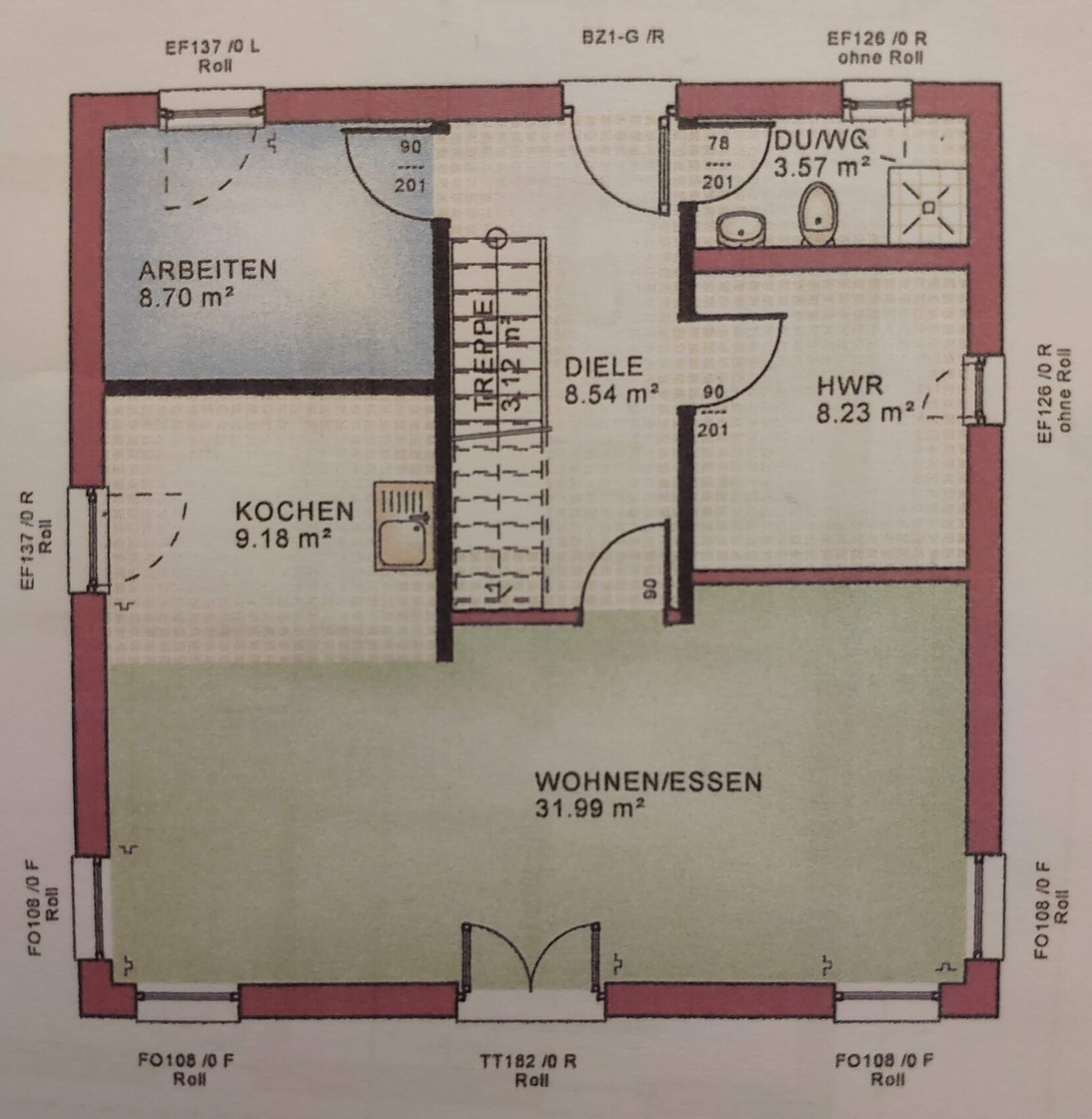
We are actually happy with the ground floor. Our main priorities on the ground floor were an open living-dining area, a guest/workroom, and a guest toilet with shower. The utility room has a window that is located under the carport.
Now about the upper floor, which I like but is causing problems:
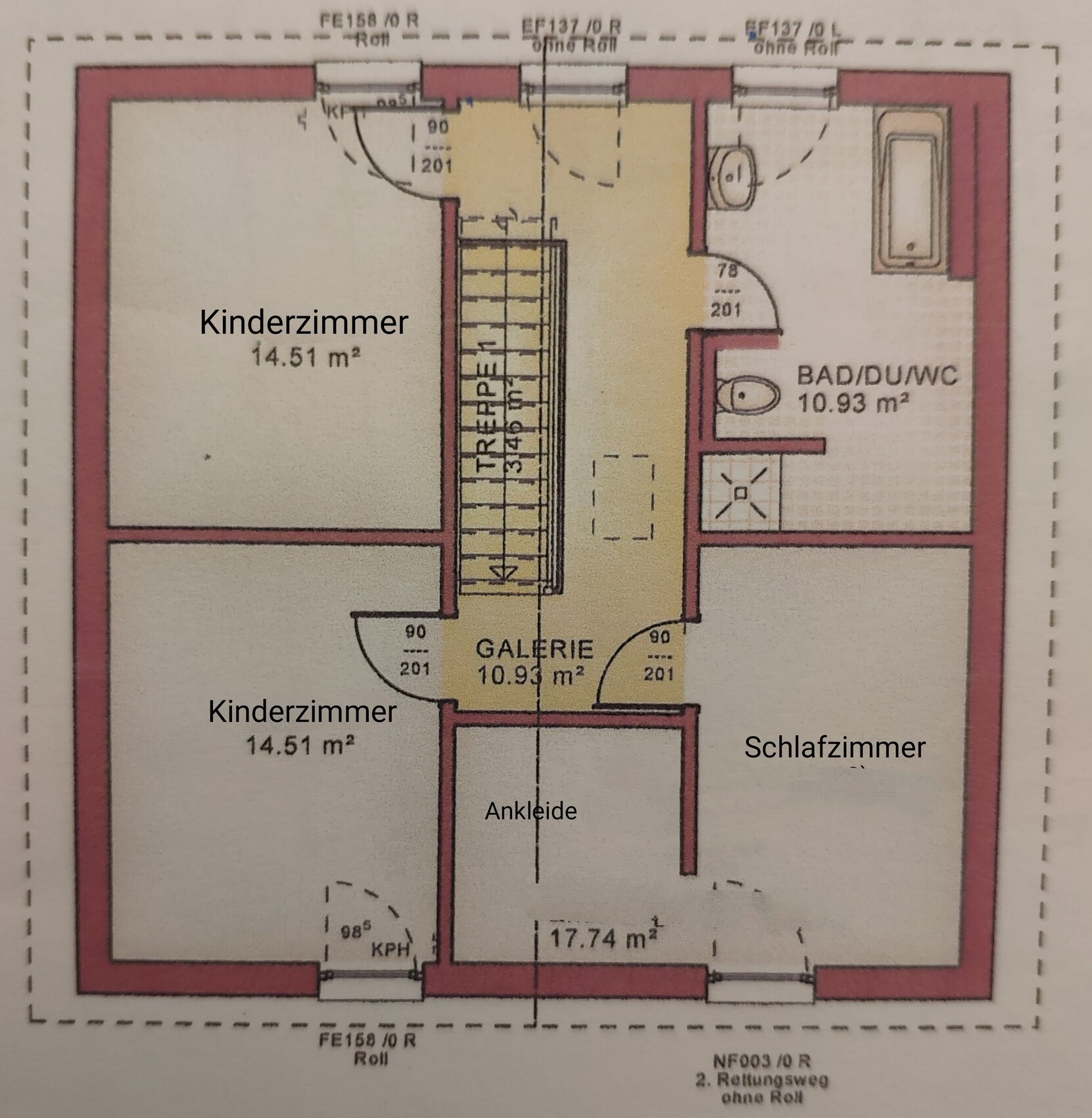
1. The door of the north-facing children's room opens against the window. Should it open into the room? Or open outward into the hallway, like the bedroom door is planned (why is it like that there…)?
2. The window in the master bedroom on the upper floor (south side) is planned without a roller blind. This is because a distance of 2.05 meters (6 ft 9 in) to the side wall with the roof slope must be maintained for a roller blind. In the current plan (open walk-in closet) the window could still be moved slightly. However, I wanted to close off the wall to the walk-in closet so that it is accessible from the hallway. According to my calculations, to fit the window there, the walk-in closet would have to be reduced by about 70 cm (28 inches), which is hardly possible.
Do you have any ideas for redesigns that could help us here?
Apparently, our floor plan, as we originally wanted it, is causing some practical issues.
We are planning a prefab house (9.42 x 9.42 meters (31 x 31 feet)) with a gable roof, knee wall height 1.60 meters (5 ft 3 in), and roof pitch of 25 degrees. At our request, the entrance is planned on the eaves side on the north.
We are actually happy with the ground floor. Our main priorities on the ground floor were an open living-dining area, a guest/workroom, and a guest toilet with shower. The utility room has a window that is located under the carport.
Now about the upper floor, which I like but is causing problems:
1. The door of the north-facing children's room opens against the window. Should it open into the room? Or open outward into the hallway, like the bedroom door is planned (why is it like that there…)?
2. The window in the master bedroom on the upper floor (south side) is planned without a roller blind. This is because a distance of 2.05 meters (6 ft 9 in) to the side wall with the roof slope must be maintained for a roller blind. In the current plan (open walk-in closet) the window could still be moved slightly. However, I wanted to close off the wall to the walk-in closet so that it is accessible from the hallway. According to my calculations, to fit the window there, the walk-in closet would have to be reduced by about 70 cm (28 inches), which is hardly possible.
Do you have any ideas for redesigns that could help us here?

145 sqm (1,552 sq ft) is definitely not very small – but a square shape is always a challenge for a floor plan, and in my opinion, the edge length of 9.5 m (31 ft) is clearly the limit where the layout can still work. The house is not absolutely too small but relatively so, considering the floor plan options: having a home office is already a strain when dividing the area, separating the bed and wardrobes is also difficult, and a children’s bathroom (which you have, at least, left out) would not be possible at all.
It’s not entirely true that you didn’t get any alternatives: I at least mentioned the Editions 134 and Evolution 134 models from the same provider. And if I remember correctly, I also suggested considering a model with a non-square rectangular floor plan as a starting point. By the way, your floor plan is (I swear!) typical of a “town villa,” so I was genuinely surprised that your house supplier actually offers a “country house” version based on it.
Heating technology is clearly not something for amateurs; most regular homeowners don’t usually have it as a hobby either. That’s why I thought it was important to point out that if you still need to get informed, the various options cannot be ranked in a simple linear better-to-worse order. Instead, each technology is optimal relative to the desired energy efficiency standard of the house. I also wanted to warn that although the builder knows more about this than the customers, they don’t always share that knowledge transparently and are influenced by their own interests. I can’t yet speculate about the motivation behind advising you away from the “town villa” by claiming it would cost 30,000 EUR more. Fundamentally, that’s misleading because what makes the “town villa” affordable is partly its simple roof. By designing it as a knee-wall house rather than a “town villa,” a significantly more expensive roof structure is required. The difference is mainly structural. The intuitive logic that a knee wall of 180 cm (71 in) costs more than 160 cm (63 in), 200 cm (79 in) even more, and a straight wall (which can be seen as a knee wall of about 250 cm (98 in)) should be even more expensive is a misconception (which suppliers often exploit to scare customers with extra costs and push them towards the house they want to sell). You shouldn’t rely too much on @Tolentino here either, as their calculation for “solid construction” is structured differently. Regional “solid construction” general contractors often favor “town villas” in their economy segment. In reality, the “town villa” cannot be more expensive – actually, quite the opposite! – it’s just that the supplier can price it higher in their calculation. That should just encourage you to consider offers from other builders!
So when you bought the plot, the piling was simply not yet completed but was already included in the purchase price?
https://www.instagram.com/11antgmxde/
https://www.linkedin.com/company/bauen-jetzt/
It’s not entirely true that you didn’t get any alternatives: I at least mentioned the Editions 134 and Evolution 134 models from the same provider. And if I remember correctly, I also suggested considering a model with a non-square rectangular floor plan as a starting point. By the way, your floor plan is (I swear!) typical of a “town villa,” so I was genuinely surprised that your house supplier actually offers a “country house” version based on it.
Heating technology is clearly not something for amateurs; most regular homeowners don’t usually have it as a hobby either. That’s why I thought it was important to point out that if you still need to get informed, the various options cannot be ranked in a simple linear better-to-worse order. Instead, each technology is optimal relative to the desired energy efficiency standard of the house. I also wanted to warn that although the builder knows more about this than the customers, they don’t always share that knowledge transparently and are influenced by their own interests. I can’t yet speculate about the motivation behind advising you away from the “town villa” by claiming it would cost 30,000 EUR more. Fundamentally, that’s misleading because what makes the “town villa” affordable is partly its simple roof. By designing it as a knee-wall house rather than a “town villa,” a significantly more expensive roof structure is required. The difference is mainly structural. The intuitive logic that a knee wall of 180 cm (71 in) costs more than 160 cm (63 in), 200 cm (79 in) even more, and a straight wall (which can be seen as a knee wall of about 250 cm (98 in)) should be even more expensive is a misconception (which suppliers often exploit to scare customers with extra costs and push them towards the house they want to sell). You shouldn’t rely too much on @Tolentino here either, as their calculation for “solid construction” is structured differently. Regional “solid construction” general contractors often favor “town villas” in their economy segment. In reality, the “town villa” cannot be more expensive – actually, quite the opposite! – it’s just that the supplier can price it higher in their calculation. That should just encourage you to consider offers from other builders!
LuiseRadiese schrieb:
Not an option or idea, but this is how we will take over the plot.
So when you bought the plot, the piling was simply not yet completed but was already included in the purchase price?
https://www.instagram.com/11antgmxde/
https://www.linkedin.com/company/bauen-jetzt/

11ant schrieb:
145 m² (1560 ft²) is definitely not XS – but a square shape is always a challenge for a floor plan, and in my opinion, the edge length of 9.5 m (31 feet) is clearly the limit for the floor plan still to work. *Math digression:
Take a rectangle and specify its area. Then you can fix one side, e.g., the length, and the width will result. When building a house aiming for a certain floor area, this is basically the approach.
Now, the square is the rectangle with the smallest perimeter (that is, the shortest exterior wall) among all rectangles of the same area. Also, the center point (intersection of the diagonals) is furthest away from any exterior wall.
End of math*
For the floor plan, this means there is relatively little space for windows (less than any other rectangle of the same area), and the windows are also far from the house center (so there is an area in the middle that is hard to illuminate naturally). I think this makes designing square floor plans somewhat more challenging.
If there is no specific reason for a square shape, I would rather lean toward a moderate rectangular layout.
A straightforward question: if you have already signed a contract, isn’t the house type already fixed? Are you still allowed to change it? Depending on the contract terms, this possibility might not be so obvious.

I think your math course is good and the content is also correct. However, the limited space for windows here results from the knee wall height, not from the perimeter or the available exterior wall area.
A square is indeed more challenging in terms of layout for the floor plan, but this is not due to the perimeter; rather, it is caused by the resulting room shapes and the positioning of the stairs as well as the necessary hallway design.
A 10 x 10 m (33 x 33 ft) plan has a perimeter of 40 m (131 ft)
An 8 x 12.5 m (26 x 41 ft) plan has a perimeter of 41 m (135 ft)
This is not the decisive factor for the windows.
A square is indeed more challenging in terms of layout for the floor plan, but this is not due to the perimeter; rather, it is caused by the resulting room shapes and the positioning of the stairs as well as the necessary hallway design.
A 10 x 10 m (33 x 33 ft) plan has a perimeter of 40 m (131 ft)
An 8 x 12.5 m (26 x 41 ft) plan has a perimeter of 41 m (135 ft)
This is not the decisive factor for the windows.
Altai schrieb:
I think that makes designing square floor plans a bit more challenging.No, the difficulty in planning a floor plan with the requirement that it be a square or rectangular shape lies in the fact that the rooms to be accommodated often are not all either square themselves or, as an alternative, proportionally narrower or wider compared to neighboring rooms in relation to a square. This inevitably leads to a) creaking and squeaking at every corner and joint, b) rooms with stagnant air or awkward indentations, c) rooms that curve around each other until the wall layouts become as convoluted as a maze. If a bulky object is added (such as a kitchen island, straight staircase, or built-in bedroom closet area, commonly called a “walk-in wardrobe”), then either the floor plan bursts with a loud bang or additional space must be allowed to relieve the pressure—resulting in roughly 30% more area than actually needed (and financially feasible). What you can achieve quite well with a simple box-shaped house on a square footprint—and why it is so popular with builders—is the pleasing illusion of a successful home, enhanced with a few trendy accessories that appeal to a wide range of customers. Additionally, this form naturally leads to a building envelope optimized for surface area and thermal efficiency, hence the nickname “KfW cube.”
https://www.instagram.com/11antgmxde/
https://www.linkedin.com/company/bauen-jetzt/
Similar topics