
ᐅ Implementing a Terrace Without Drainage in the Best Possible Way
Created on: 3 Apr 2024 15:13
F
Finch039
Hello,
we want to renovate our approximately 20 sqm (215 sq ft) terrace. The old tiles have already been removed – underneath there is a thick layer of sand (about 7-8 cm (3 inches)), followed by gravel, and then the soil. There is no drainage or anything similar.
As shown in the picture, the terrace of our semi-detached house is located between the house and the garden on one side. On the other side, next to the neighboring house, which is just visible in the photo, is the flat roof of our garage.
Everything here is very tightly built, which complicates the situation. There is practically no way to install drainage and lead it around the house towards the sewer or street.
What surprises me, however, is that our basement walls, which are in contact with the soil on the terrace side, are dry. So it seems there is some kind of waterproofing, but it must be at least 50 years old.
As a complete layperson in this field, I have several questions and hope you can give me some general guidance.
I hope the explanation is not too complicated. I am happy to provide more information if needed.
Thanks in advance!
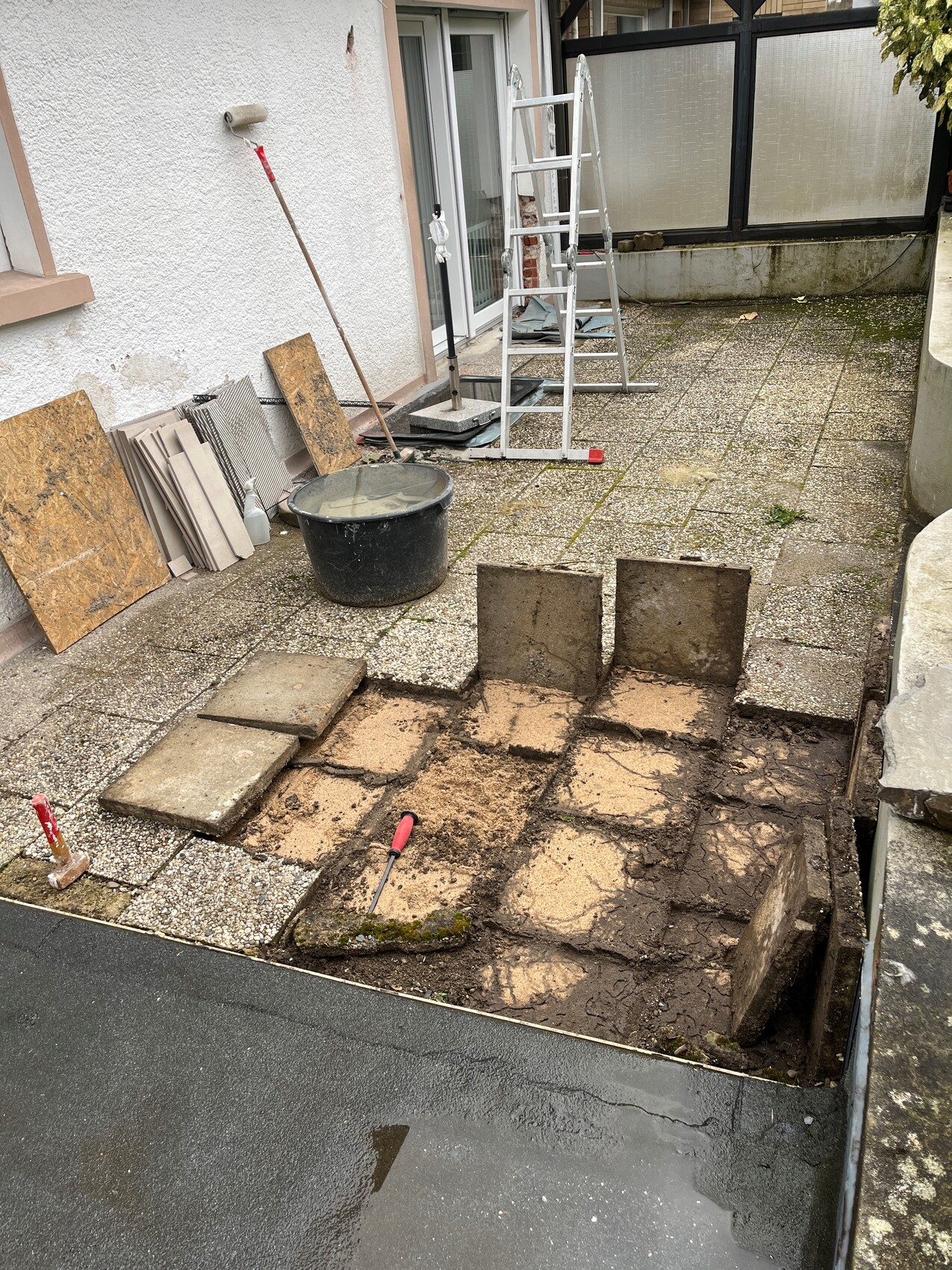
we want to renovate our approximately 20 sqm (215 sq ft) terrace. The old tiles have already been removed – underneath there is a thick layer of sand (about 7-8 cm (3 inches)), followed by gravel, and then the soil. There is no drainage or anything similar.
As shown in the picture, the terrace of our semi-detached house is located between the house and the garden on one side. On the other side, next to the neighboring house, which is just visible in the photo, is the flat roof of our garage.
Everything here is very tightly built, which complicates the situation. There is practically no way to install drainage and lead it around the house towards the sewer or street.
What surprises me, however, is that our basement walls, which are in contact with the soil on the terrace side, are dry. So it seems there is some kind of waterproofing, but it must be at least 50 years old.
As a complete layperson in this field, I have several questions and hope you can give me some general guidance.
- Is the construction of the terrace subfloor as described still up to current standards? Or should I excavate the material and replace it / supplement it with other materials?
- Since the garden will already be disturbed during this work, would you recommend waterproofing the basement wall from the outside as well? Or, given that the walls are dry, should I leave the existing waterproofing untouched?
- For drainage purposes (especially considering increasing heavy rainfall events), would it be sufficient to slope the terrace away from the house and install a channel with infiltration into the soil on the garden side? I am somewhat skeptical.
- Are there any other drainage options you know of?
I hope the explanation is not too complicated. I am happy to provide more information if needed.
Thanks in advance!
Hello everyone, the topic of the terrace has become urgent now, and we have taken care of disposing of the slabs and the sand.
We have now noticed that there apparently is some drainage. The water (from the terrace and also from the garage roof) is directed into a small shaft located in front of the stairs to the garden. The shaft is covered with a grate. Inside this shaft, there is a drain. We dug a little around it and found a pipe embedded in concrete, running towards the house and then down into the ground. After that, the trail disappears—unless we dig a meter (or more) deep into the soil.
There are now two possibilities:
a) There is a main drainage pipe running underneath the house towards the street and the sewer system.
There is also a gutter/downpipe for the roof drainage that leads into the ground on the terrace. So it’s quite likely that the water is channeled into a main drain, right?
b) The water infiltrates the ground. I find this hard to imagine since the basement walls, as mentioned, are relatively dry.
If water were constantly seeping in front of the basement wall, I would assume that it would eventually penetrate the wall.
What do you think? Could such drainage with main pipes already have existed back in 1927? Does anyone have experience with houses from this period?
If so, what is the best way to obtain plans? It was already a challenge to get any plans or floor layouts of the house. I assume it will be even harder to find drainage plans.
We have now noticed that there apparently is some drainage. The water (from the terrace and also from the garage roof) is directed into a small shaft located in front of the stairs to the garden. The shaft is covered with a grate. Inside this shaft, there is a drain. We dug a little around it and found a pipe embedded in concrete, running towards the house and then down into the ground. After that, the trail disappears—unless we dig a meter (or more) deep into the soil.
There are now two possibilities:
a) There is a main drainage pipe running underneath the house towards the street and the sewer system.
There is also a gutter/downpipe for the roof drainage that leads into the ground on the terrace. So it’s quite likely that the water is channeled into a main drain, right?
b) The water infiltrates the ground. I find this hard to imagine since the basement walls, as mentioned, are relatively dry.
If water were constantly seeping in front of the basement wall, I would assume that it would eventually penetrate the wall.
What do you think? Could such drainage with main pipes already have existed back in 1927? Does anyone have experience with houses from this period?
If so, what is the best way to obtain plans? It was already a challenge to get any plans or floor layouts of the house. I assume it will be even harder to find drainage plans.
M
MachsSelbst24 Jul 2024 22:30You could hire someone to perform a camera inspection inside the pipe. Alternatively, you could introduce water using a garden hose and check at the connection point if it arrives there. For wastewater and rainwater, there is likely an appropriate inspection chamber. With the garden hose, combined with a flow meter (available for 20–30 EUR), you could also experimentally determine the flow rate at which your drainage system reaches its limits. Trial and error, right...
The camera will arrive tomorrow, and we will inspect the pipe; I will report back.
There is a shaft, at least for wastewater, in the laundry room. Wastewater from the house was previously discharged through a downpipe, then beneath the basement floor via a concrete channel into an old, deteriorated soakaway chamber. This old soakaway chamber is the only known connection point from the house to the sewer system.
During the renovation, the old downpipe inside the house was removed, and a new downpipe was installed at a different location. From there, we laid a new drain pipe under the basement floor, which involved breaking up the basement floor, installing a PVC pipe (KG pipe) in sand with a slope, and then re-concreting it. The new pipe leads into a new inspection shaft, which we installed instead of the old soakaway chamber and connected to the sewer system. Long story short—the old channel has been decommissioned, and any rainwater previously directed here may theoretically no longer flow into the sewer system.
It is, of course, possible that rainwater from the roof and terrace also drained through the channel and ultimately into the old soakaway chamber. In that case, a significant amount of water should now have collected in the old channel. I could check this with a trial bore if necessary.
Therefore, I hope that the roof and terrace are drained by other means, ideally via a separate drain pipe, independent of the old, decommissioned channel.
There is a shaft, at least for wastewater, in the laundry room. Wastewater from the house was previously discharged through a downpipe, then beneath the basement floor via a concrete channel into an old, deteriorated soakaway chamber. This old soakaway chamber is the only known connection point from the house to the sewer system.
During the renovation, the old downpipe inside the house was removed, and a new downpipe was installed at a different location. From there, we laid a new drain pipe under the basement floor, which involved breaking up the basement floor, installing a PVC pipe (KG pipe) in sand with a slope, and then re-concreting it. The new pipe leads into a new inspection shaft, which we installed instead of the old soakaway chamber and connected to the sewer system. Long story short—the old channel has been decommissioned, and any rainwater previously directed here may theoretically no longer flow into the sewer system.
It is, of course, possible that rainwater from the roof and terrace also drained through the channel and ultimately into the old soakaway chamber. In that case, a significant amount of water should now have collected in the old channel. I could check this with a trial bore if necessary.
Therefore, I hope that the roof and terrace are drained by other means, ideally via a separate drain pipe, independent of the old, decommissioned channel.
M
MachsSelbst25 Jul 2024 17:28Did you hire a company, or are you doing it yourself? May I ask, how much does it cost?
Similar topics