
ᐅ Implementing LAN and Satellite Systems in a Single-Family Home with a Centralized Server Cabinet
Created on: 26 Feb 2019 13:16
E
enoausa
Hello everyone!
I have already looked around the forum a bit to find answers to my (partly more specific) questions about LAN/SAT wiring in a single-family house. However, overall, I didn’t really get the information I needed. Therefore, I would like to explain my situation here in detail, hoping to get some answers to my questions.
Key points:
I am currently planning the LAN/SAT cabling for our single-family house. The rest of the electrical work will be carried out by a professional. To save some money, I want to install the LAN and SAT myself.
Our single-family house has a ground floor (GF), an upper floor (UF), a garage with a workshop, and a small attic. We do not have a basement.
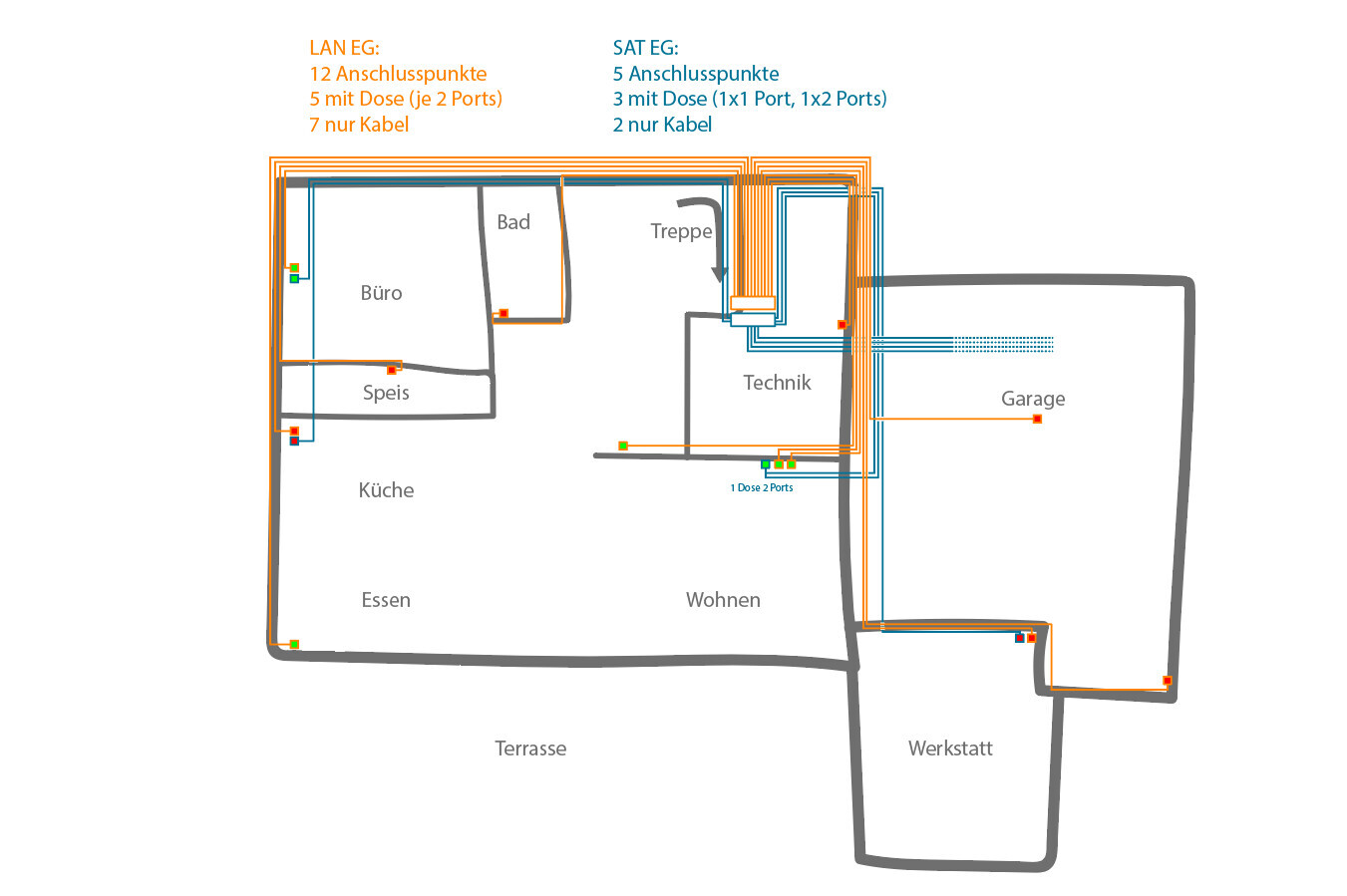
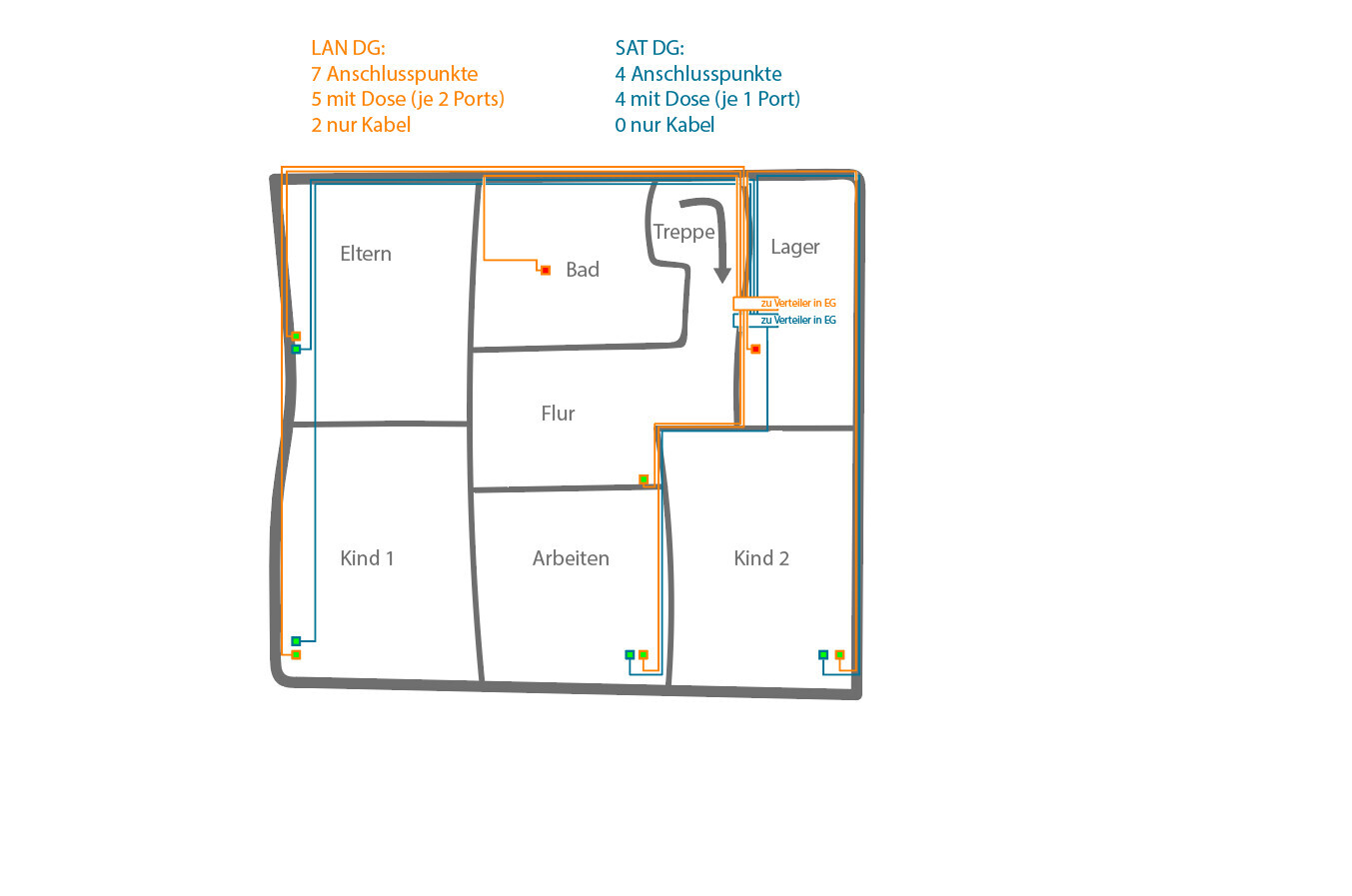
The LAN and SAT outlets should be generously distributed throughout the house and converge in the technical room on the ground floor.
The basic layout should look like in the two attached images.
At the green connection points, one outlet each will be installed (LAN with 2 ports, SAT 1 or 2 ports). The red connection points currently only have cables without outlets and are intended for optional future connections:
In total, the following number of connection points are planned throughout the house:
LAN – GF: 12 connection points (5 with outlets (each with 2 ports), 7 cables only)
LAN – UF: 7 connection points (5 with outlets (each with 2 ports), 2 cables only)
LAN – Total: 19 connection points (10 with outlets (2 ports each), 9 cables only)
SAT – GF: 5 connection points (3 with outlets (one 1port and one 2port), 2 cables only)
SAT – UF: 4 connection points (4 with outlets with 1 port each)
SAT – Total: 9 connection points (7 with outlets (five 1 port, one 2 port), 2 cables only)
All cabling should converge in the technical room and be installed in a server cabinet (19-inch, 12 rack units – RU). This cabinet should ideally be recessed into the wall (then it would be on the other side underneath the stairs).
For LAN, I plan to use duplex CAT7 installation cable, Gigabit 10 Gbit network cable, 1000 MHz shielded twisted pair (S/FTP).
For SAT, I plan to use 135 dB coaxial SAT cable, antenna cable, 4-fold shielded coaxial cable suitable for DVB-S/S2, DVB-C, and DVB-T BK.
All cables (19 duplex LAN = 38 connection points, including those currently only running inside the wall on the opposite side) will then be connected via two 24-port patch panels and a 24-port switch to the Fritzbox (Internet).
From the satellite dish, I want to connect to a multiswitch (inside the server cabinet) and from there to the SAT outlets in the house.
Questions:
I have already looked around the forum a bit to find answers to my (partly more specific) questions about LAN/SAT wiring in a single-family house. However, overall, I didn’t really get the information I needed. Therefore, I would like to explain my situation here in detail, hoping to get some answers to my questions.
Key points:
I am currently planning the LAN/SAT cabling for our single-family house. The rest of the electrical work will be carried out by a professional. To save some money, I want to install the LAN and SAT myself.
Our single-family house has a ground floor (GF), an upper floor (UF), a garage with a workshop, and a small attic. We do not have a basement.
The LAN and SAT outlets should be generously distributed throughout the house and converge in the technical room on the ground floor.
The basic layout should look like in the two attached images.
At the green connection points, one outlet each will be installed (LAN with 2 ports, SAT 1 or 2 ports). The red connection points currently only have cables without outlets and are intended for optional future connections:
In total, the following number of connection points are planned throughout the house:
LAN – GF: 12 connection points (5 with outlets (each with 2 ports), 7 cables only)
LAN – UF: 7 connection points (5 with outlets (each with 2 ports), 2 cables only)
LAN – Total: 19 connection points (10 with outlets (2 ports each), 9 cables only)
SAT – GF: 5 connection points (3 with outlets (one 1port and one 2port), 2 cables only)
SAT – UF: 4 connection points (4 with outlets with 1 port each)
SAT – Total: 9 connection points (7 with outlets (five 1 port, one 2 port), 2 cables only)
All cabling should converge in the technical room and be installed in a server cabinet (19-inch, 12 rack units – RU). This cabinet should ideally be recessed into the wall (then it would be on the other side underneath the stairs).
For LAN, I plan to use duplex CAT7 installation cable, Gigabit 10 Gbit network cable, 1000 MHz shielded twisted pair (S/FTP).
For SAT, I plan to use 135 dB coaxial SAT cable, antenna cable, 4-fold shielded coaxial cable suitable for DVB-S/S2, DVB-C, and DVB-T BK.
All cables (19 duplex LAN = 38 connection points, including those currently only running inside the wall on the opposite side) will then be connected via two 24-port patch panels and a 24-port switch to the Fritzbox (Internet).
From the satellite dish, I want to connect to a multiswitch (inside the server cabinet) and from there to the SAT outlets in the house.
Questions:
- Is it reasonable that everything (2x 24-port patch panels (2 RU), switch (1 RU), telephone system, SAT multiswitch + possibly a second switch + possibly NAS) fits comfortably into a 19-inch server cabinet with 12 RU (it shouldn’t be unnecessarily cramped)? Or would 9 RU even suffice?
- Is it easy to feed the currently 47 cables (19x LAN duplex + 9 coax) into the server cabinet?
- Is there a mounting frame for the SAT distribution equipment designed for installation inside a server cabinet?
- Do I need to worry about overheating? The technical room also contains the main service connection, a washing machine, and a (condensation) dryer.
- Can a 19-inch server cabinet with 12 RU, which is actually intended for wall mounting, be recessed into a wall? I was thinking of simply creating an appropriately sized hole so the server cabinet passes through the wall and protrudes out the other side (this would be no problem since it is under the stairs).
- What is the best way to ground the entire system?
- Is it really necessary to run the cables inside conduits (empty ducts)? Does this method truly allow the cables to be replaced later, or is it usually too difficult in practice to be a viable option? (We are building with a timber frame structure, if that is relevant.)
- Would you recommend installing Wi-Fi access points? If yes, where? I often read "in the ceiling," but I would actually prefer not to do that.
- Would you recommend installing more outlets? Overall, I would still have 10 free ports on the patch panels.


I think that would be somewhat oversized. Basically, it’s enough for me if every PC connects to the internet via the different outlets in the house and every phone through the Wi-Fi with my Fritzbox...
A simplified version like that should be possible, right?
It could always be expanded later on.
A simplified version like that should be possible, right?
It could always be expanded later on.
Separate Wi-Fi for the children with parental controls, time restrictions, guest access, and a separate network for the home office. IoT devices, possibly cameras...
The Fritzbox inside the steel framework is causing you trouble. You’re stuck on the slow 2.4 GHz network.
A simple solution would be a cheap switch (with PoE) and one or two NanoHD units. These can be configured via app without a controller and will work. VLANs, etc., won’t be available though. Still, disable the Fritzbox Wi-Fi.
The Fritzbox inside the steel framework is causing you trouble. You’re stuck on the slow 2.4 GHz network.
A simple solution would be a cheap switch (with PoE) and one or two NanoHD units. These can be configured via app without a controller and will work. VLANs, etc., won’t be available though. Still, disable the Fritzbox Wi-Fi.
Rick2018’s ideas are good, but I would simplify it a bit.
- Depending on the internet connection (vectoring, super vectoring, cable, fiber), use a FritzBox that matches it, but with Wi-Fi turned off. (You won't get much performance out of the standard device anyway.)
- One access point per floor for Wi-Fi — I would also recommend something from UniFi. The controller software is enough for setup if it runs on your PC. It doesn’t need to run 24/7.
- A non-PoE switch with many ports (24 or 48).
- For only two PoE devices, use injectors; for more PoE devices, add a small extra switch with 5 or 8 ports.
Switches can be from UniFi or other manufacturers. I find the GS1900 series (smart managed) from Zyxel to be quite good. I have the GS1900-E myself. With large PoE switches, be aware that they usually have fans that can be quite noisy. The smaller ones usually don’t have fans yet.
How do you plan to implement the phone system?
- Depending on the internet connection (vectoring, super vectoring, cable, fiber), use a FritzBox that matches it, but with Wi-Fi turned off. (You won't get much performance out of the standard device anyway.)
- One access point per floor for Wi-Fi — I would also recommend something from UniFi. The controller software is enough for setup if it runs on your PC. It doesn’t need to run 24/7.
- A non-PoE switch with many ports (24 or 48).
- For only two PoE devices, use injectors; for more PoE devices, add a small extra switch with 5 or 8 ports.
Switches can be from UniFi or other manufacturers. I find the GS1900 series (smart managed) from Zyxel to be quite good. I have the GS1900-E myself. With large PoE switches, be aware that they usually have fans that can be quite noisy. The smaller ones usually don’t have fans yet.
How do you plan to implement the phone system?
That sounds like a reasonable plan
It would be great if I could integrate the door intercom system and thus avoid the need for intercoms on every floor.
How will the telephone be set up?Telephone also via the FritzBox.
- 1-2 DECT cordless handsets and then also
- any number of (probably only 1 or 2 at first) wired telephones (which ones would be best to use here)
It would be great if I could integrate the door intercom system and thus avoid the need for intercoms on every floor.
@hanse987 The newer Unifi access points can be set up using the app (which is basically a controller). For one or two units and without using advanced features, running a controller on a computer doesn’t make much sense.
I think enoausa might find that a bit overwhelming.
@enoausa
With DECT phones, the question is how good the coverage is. The Fritzbox is inside a metal enclosure, so you might need repeaters. Unfortunately, many people have issues with this.
You can use your mobile phone as a handset via the FritzFon app. That’s convenient for when you’re on vacation: just connect via VPN at home and then you can make calls within Germany for free.
The phones connected to LAN are IP or SIP phones. Do you have the SIP credentials from your provider? These also require a power adapter or Power over Ethernet (PoE).
If you have multiple PoE devices, it makes sense to consider a PoE switch. Depending on the brand, the fans hardly ever run. I don’t get the impression that your network will be pushed to its limits.
What kind of door station do you want?
Some can be operated via a mobile phone, but usually through the manufacturer’s cloud service, which is a no-go for me.
Alternatively, you can use an SIP phone system. You can integrate it with both FritzFon and SIP phones/mobile devices.
I think enoausa might find that a bit overwhelming.
@enoausa
With DECT phones, the question is how good the coverage is. The Fritzbox is inside a metal enclosure, so you might need repeaters. Unfortunately, many people have issues with this.
You can use your mobile phone as a handset via the FritzFon app. That’s convenient for when you’re on vacation: just connect via VPN at home and then you can make calls within Germany for free.
The phones connected to LAN are IP or SIP phones. Do you have the SIP credentials from your provider? These also require a power adapter or Power over Ethernet (PoE).
If you have multiple PoE devices, it makes sense to consider a PoE switch. Depending on the brand, the fans hardly ever run. I don’t get the impression that your network will be pushed to its limits.
What kind of door station do you want?
Some can be operated via a mobile phone, but usually through the manufacturer’s cloud service, which is a no-go for me.
Alternatively, you can use an SIP phone system. You can integrate it with both FritzFon and SIP phones/mobile devices.
Similar topics