
ᐅ Ikea FAKTUM Kitchen: How to Darken NORJE Cabinet Fronts – Painting, Oiling, or Waxing?
Created on: 16 Feb 2013 14:35
S
sandaletten_svenS
sandaletten_sven16 Feb 2013 14:35Hello everyone,
I’m planning to purchase the above-mentioned kitchen soon. As a finishing touch, I would like to have the NORJE oak front a bit darker—something like the simplified example shown in the following picture (left side darkened, right side original):
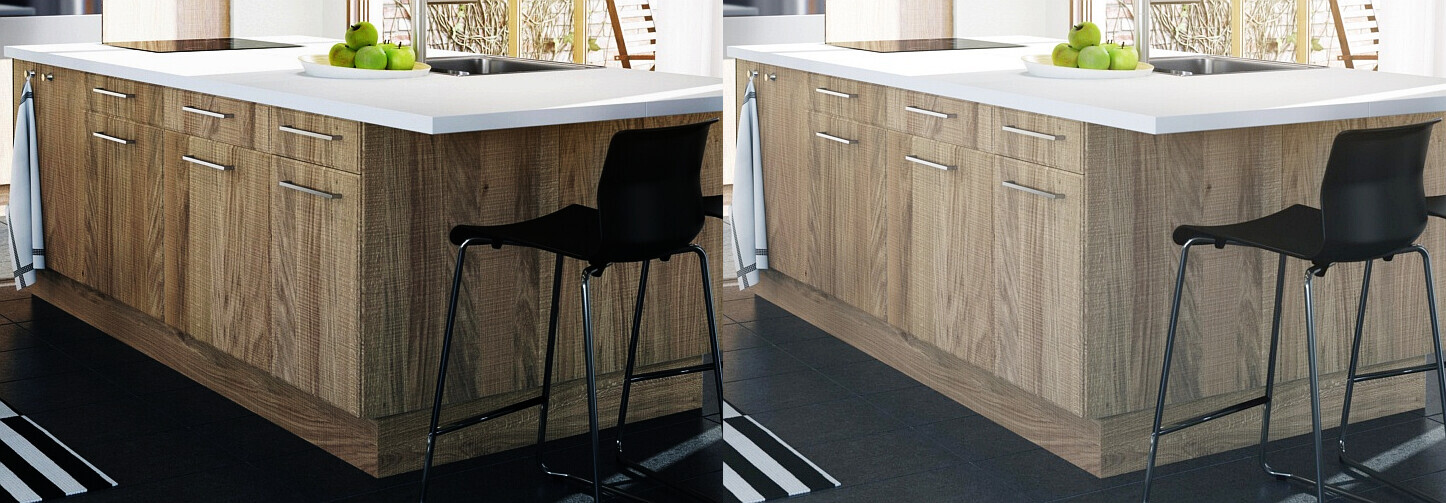
According to the catalog, the wood is already clear lacquered, which probably makes staining practically impossible, right? And I definitely don’t want to sand the fronts, as that would damage the surface texture...
Since I have almost no experience with furniture (re)finishing, I’m curious whether painting/oiling/waxing (each without sanding!) might achieve my goal and/or if any forum members have already refinished NORJE fronts in this way?
Thanks in advance—I’m looking forward to your replies!
sandaletten_sven
I’m planning to purchase the above-mentioned kitchen soon. As a finishing touch, I would like to have the NORJE oak front a bit darker—something like the simplified example shown in the following picture (left side darkened, right side original):
According to the catalog, the wood is already clear lacquered, which probably makes staining practically impossible, right? And I definitely don’t want to sand the fronts, as that would damage the surface texture...
Since I have almost no experience with furniture (re)finishing, I’m curious whether painting/oiling/waxing (each without sanding!) might achieve my goal and/or if any forum members have already refinished NORJE fronts in this way?
Thanks in advance—I’m looking forward to your replies!
sandaletten_sven
N
Nayla_106816 Feb 2013 22:06Hello sandaletten_sven,
great name. *giggle*
Okay, to answer your question, a clear NO!
Norje cannot be refinished. Norje is the only panel that has, I would say, a "peculiar" surface. The oak veneer looks visually appealing, but the grain running vertically is already unusual. These horizontal grooves lack any logical pattern. And it’s precisely these grooves that make it impossible to refinish the panel. You would never achieve a smooth surface, and trying to preserve the grooves won’t work either—they are simply too narrow.
Maybe it helps that the panel is real wood veneer and will naturally darken over time. Of course, this depends on the kitchen’s usage as well as exposure to heat and sunlight.
By the way, I actually find Norje quite beautiful overall, but those grooves... they will definitely collect dust and grime and so on… 🙄
Best regards
Nayla
great name. *giggle*
Okay, to answer your question, a clear NO!
Norje cannot be refinished. Norje is the only panel that has, I would say, a "peculiar" surface. The oak veneer looks visually appealing, but the grain running vertically is already unusual. These horizontal grooves lack any logical pattern. And it’s precisely these grooves that make it impossible to refinish the panel. You would never achieve a smooth surface, and trying to preserve the grooves won’t work either—they are simply too narrow.
Maybe it helps that the panel is real wood veneer and will naturally darken over time. Of course, this depends on the kitchen’s usage as well as exposure to heat and sunlight.
By the way, I actually find Norje quite beautiful overall, but those grooves... they will definitely collect dust and grime and so on… 🙄
Best regards
Nayla
N
Nayla_106817 Feb 2013 00:03Thank you, Dellas,
you are absolutely right. Somehow I completely missed the point of the question in my response. Maybe after a long day at Ikea, it’s best not to keep browsing the forum. 😀
But something just occurred to me. The front color in your pictures, whether unedited or edited, doesn’t match the oak tone of the original front at all. Please take a look at it in the hardware store and then decide if you really want to change the color at all.
Best regards
Nayla
you are absolutely right. Somehow I completely missed the point of the question in my response. Maybe after a long day at Ikea, it’s best not to keep browsing the forum. 😀
But something just occurred to me. The front color in your pictures, whether unedited or edited, doesn’t match the oak tone of the original front at all. Please take a look at it in the hardware store and then decide if you really want to change the color at all.
Best regards
Nayla
Z
zetterberg17 Feb 2013 09:03Not quite right.
You can sand NORJE, but not with sandpaper, belt sanders, or random orbit sanders. Use a drill or cordless screwdriver with a brush attachment, and work carefully along the grain of the grooves.
But you do realize that NORJE is oak veneer, and the grooves are intentional, giving the wood surface a rustic touch. The veneer is somewhat thicker than "normal" smooth veneer. Your challenge will be to remove the finish without losing too much of the veneer material. Another point to watch is the edges—make sure the brush doesn’t catch underneath and start mechanically peeling off the veneer.
If you have experience with wood, try it first on a 60 x 57 cm (24 x 22 inches) door, so any financial loss is limited if it doesn’t work out. Also consider whether you have enough time to carefully work on ALL the fronts this way.
After that, I would cut the front open without mercy to see how much veneer material is left. I don’t know for sure but I imagine the thickness varies between the smooth and grooved sides.
The next challenge will be applying stain, oil (which I would advise against for veneer), or a darker finish—make sure it’s applied evenly. Forget everything you have at home or in the workshop unless it’s a proper compressor system.
You can sand NORJE, but not with sandpaper, belt sanders, or random orbit sanders. Use a drill or cordless screwdriver with a brush attachment, and work carefully along the grain of the grooves.
But you do realize that NORJE is oak veneer, and the grooves are intentional, giving the wood surface a rustic touch. The veneer is somewhat thicker than "normal" smooth veneer. Your challenge will be to remove the finish without losing too much of the veneer material. Another point to watch is the edges—make sure the brush doesn’t catch underneath and start mechanically peeling off the veneer.
If you have experience with wood, try it first on a 60 x 57 cm (24 x 22 inches) door, so any financial loss is limited if it doesn’t work out. Also consider whether you have enough time to carefully work on ALL the fronts this way.
After that, I would cut the front open without mercy to see how much veneer material is left. I don’t know for sure but I imagine the thickness varies between the smooth and grooved sides.
The next challenge will be applying stain, oil (which I would advise against for veneer), or a darker finish—make sure it’s applied evenly. Forget everything you have at home or in the workshop unless it’s a proper compressor system.
N
Nayla_106817 Feb 2013 13:07
If you are familiar with wood, try it first on a 60x57 cm (24x22.5 inches) door; the financial loss will be limited if it doesn’t work out. Also, consider whether you have enough time to carefully work on ALL fronts like that.
Afterwards, I would recommend cutting the front panel open without mercy to see how much veneer material is still left. I’m not exactly sure, but I imagine the thickness differs between the smooth and grooved sides.
Since the original poster already mentioned that they don’t want to sand the front panel, which I completely overlooked in my first post, Dellas’ answer is the only correct one. Furthermore, the voiding of the warranty in this situation should also be mentioned.
NfU
Nayla
Similar topics