
Dear forum,
I am interested in a plot of land where a duplex is planned. The plot would then be shared with the other buyer. Unfortunately, the plot is not perfectly square. Now I am wondering whether, for this particular plot, a conceptual subdivision or a real subdivision would be better?
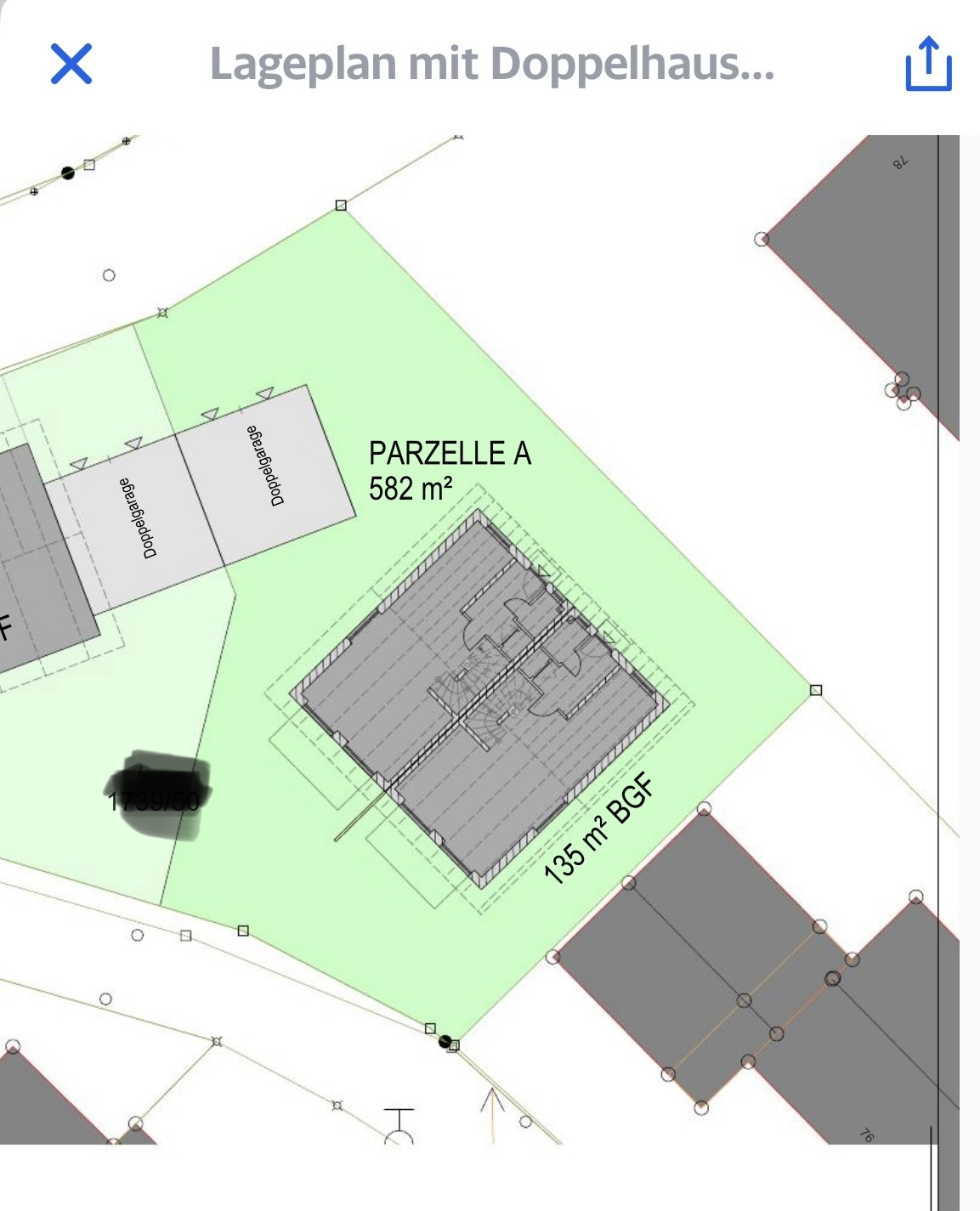
I am interested in a plot of land where a duplex is planned. The plot would then be shared with the other buyer. Unfortunately, the plot is not perfectly square. Now I am wondering whether, for this particular plot, a conceptual subdivision or a real subdivision would be better?
N
nordanney28 Jan 2026 14:26Tolentino schrieb:
So in this case, the contractor can still approach you, but only for 50%. No (in the example of the fence). If A commissions the work, the contractor cannot approach B at all. A is not acting on behalf of the homeowners’ association (HOA) or as a joint venture. A acts entirely alone. Provided that B has not agreed or explicitly refuses.
And if nothing is specially regulated in the declaration of division, B can sue A for unauthorized structural alterations. Because without regulations in the declaration of division, a resolution by the HOA is required. And A will lose the case, for sure.
N
nordanney28 Jan 2026 14:26But we are digressing from the topic ;-)

So, this is not a developer project, and construction is planned according to section 34. However, some basic points remain unclear, which the original poster should clarify—among other things, who they actually are, especially in relation to the adjoining neighbor and the seller/project developer. Are they an interested party? Is the purchase of the plot marked as "Parcel A" (dark light green) intended jointly with their immediate neighbor? Who provided the depicted division of the land regarding the parcels dark light green and light light green? Does a potential ideal division (and/or the entire project) involve two or all four halves? Does the specified "BGF" refer to the gross floor area of just one half of the semi-detached house, or to the gross floor area of the dummy floor plan of the entire semi-detached house? Is access provided from the street at the top of the plan despite an apparently existing street running at the bottom of the plan? — So many questions whose answers could change the entire situation in various ways!
First, as usual, my reading recommendation is a similar thread: https://www.hausbau-forum.de/threads/Grundstück-real-teilen-aber-beide-das-gleiche-baurecht-haben.h8v9b1/ (this involved someone who bought a plot jointly with a colleague and "brotherly divided" it with a semi-detached house).
Then briefly on the flawed comparison of the homeowners' association (HOA) with a civil law partnership (GbR): this is firstly generally nonsense (not applicable) and secondly relevant to this thread only insofar as the HOA would be made up of two units (one semi-detached house) or four units (both semi-detached houses). With two units, the HOA would manage itself and the original poster would have half the votes with one half of the semi-detached house (no risk of being outvoted but a high risk of deadlock). With four units, the situation would be completely different, requiring professional management, a high risk of being outvoted, and a lower risk of deadlock.
A total living area of 135 sqm (square meters) (about 1450 sq ft) for one half of a semi-detached house is borderline (typical offers from the usual suspects propose 140/145 sqm (1500/1560 sq ft) over "two and a half" floors, sufficient for families with a third child, intended as a mid-terrace house with a usage horizon of around fifteen years until turnover, on a footprint of 78/80 sqm (840/860 sq ft) per half). 135 sqm (about 1450 sq ft) floor area for both halves would translate to a potential of about 120/125 sqm (1290/1345 sq ft) living area per half. Where does the figure of 135 sqm even come from: with construction under section 34, logically it would not be tied to a specified floor area ratio (FAR)?
Without a zoning plan, there will likely be no requirements regarding minimum plot size for a building plot, nor limitations on the number of residential units per plot. So, from my point of view, initial groundwork is needed concerning the basis of the discussion in order to provide a meaningful answer in this specific case. Generally, I consider it irrelevant whether a semi-detached plot is divided physically or just legally, even if a shared parking facility is divided physically, resulting in many virtual fences. Basically, nowadays anyone has an advantage who can acquire a semi-detached plot without mandatory connection to district heating or similar burdens.
And, as always, my note with reference to the Goalkeeper thread: a semi-detached house has TWO halves and should ideally be planned at least jointly with the neighboring half (and preferably also have the shell built jointly). The original poster mentions no basement, so the neighbor should either also have no basement or else be the first to build.
https://www.instagram.com/11antgmxde/
https://www.linkedin.com/company/bauen-jetzt/
First, as usual, my reading recommendation is a similar thread: https://www.hausbau-forum.de/threads/Grundstück-real-teilen-aber-beide-das-gleiche-baurecht-haben.h8v9b1/ (this involved someone who bought a plot jointly with a colleague and "brotherly divided" it with a semi-detached house).
Then briefly on the flawed comparison of the homeowners' association (HOA) with a civil law partnership (GbR): this is firstly generally nonsense (not applicable) and secondly relevant to this thread only insofar as the HOA would be made up of two units (one semi-detached house) or four units (both semi-detached houses). With two units, the HOA would manage itself and the original poster would have half the votes with one half of the semi-detached house (no risk of being outvoted but a high risk of deadlock). With four units, the situation would be completely different, requiring professional management, a high risk of being outvoted, and a lower risk of deadlock.
A total living area of 135 sqm (square meters) (about 1450 sq ft) for one half of a semi-detached house is borderline (typical offers from the usual suspects propose 140/145 sqm (1500/1560 sq ft) over "two and a half" floors, sufficient for families with a third child, intended as a mid-terrace house with a usage horizon of around fifteen years until turnover, on a footprint of 78/80 sqm (840/860 sq ft) per half). 135 sqm (about 1450 sq ft) floor area for both halves would translate to a potential of about 120/125 sqm (1290/1345 sq ft) living area per half. Where does the figure of 135 sqm even come from: with construction under section 34, logically it would not be tied to a specified floor area ratio (FAR)?
Without a zoning plan, there will likely be no requirements regarding minimum plot size for a building plot, nor limitations on the number of residential units per plot. So, from my point of view, initial groundwork is needed concerning the basis of the discussion in order to provide a meaningful answer in this specific case. Generally, I consider it irrelevant whether a semi-detached plot is divided physically or just legally, even if a shared parking facility is divided physically, resulting in many virtual fences. Basically, nowadays anyone has an advantage who can acquire a semi-detached plot without mandatory connection to district heating or similar burdens.
And, as always, my note with reference to the Goalkeeper thread: a semi-detached house has TWO halves and should ideally be planned at least jointly with the neighboring half (and preferably also have the shell built jointly). The original poster mentions no basement, so the neighbor should either also have no basement or else be the first to build.
https://www.instagram.com/11antgmxde/
https://www.linkedin.com/company/bauen-jetzt/
nordanney schrieb:
No, you’re totally on the wrong track there. Tolentino schrieb:
I checked again and you’re right. I wanted to say that too 😉
There is still a difference, of course. But to avoid going off-topic too much, there’s no need to discuss it further now.
I’m more concerned with the questions about why someone is considering this in the first place, like: Is the plot available and is the original poster wondering if it’s even possible? Because then completely different issues come into play, such as what can be built under section 34? What does the neighborhood look like? Are you buying the whole thing and then selling half of a duplex? Are you choosing a builder who will market the second half, and so on.
The land sale is being handled by a real estate company without a brokerage fee. Due to the size of the plot and its price, building a semi-detached house would be the only option for me. According to the seller, this would be possible. I will now start looking for someone who is also interested in the other half of the plot.
It would then make sense to agree on a construction company with the other buyer. The 135 m² (1,452 sq ft) was just an estimate. The main concern here is the cost— the larger the area, the higher the price.
There are similar semi-detached houses already built in the neighborhood. According to the local authority, there should be no problem obtaining a building permit / planning permission since there is no zoning plan in place.
It would then make sense to agree on a construction company with the other buyer. The 135 m² (1,452 sq ft) was just an estimate. The main concern here is the cost— the larger the area, the higher the price.
There are similar semi-detached houses already built in the neighborhood. According to the local authority, there should be no problem obtaining a building permit / planning permission since there is no zoning plan in place.
Similar topics