
ᐅ Hydraulic balancing for air-to-water heat pump + high-efficiency circulation pump
Created on: 3 Jan 2021 23:07
L
lesmue79
Warning: wall of text and lots of theorycrafting:
I am currently trying to optimize or fundamentally adjust the hydraulic and thermal balancing of my air-to-water heat pump system, including underfloor heating, but I am running into the following issues:
First, about the house: KfW-55 bungalow with controlled mechanical ventilation
Nearly 105 m2 (1130 ft²) of heated floor area
Air-to-water heat pump with underfloor heating throughout, 10cm (5 inches) pipe spacing, max 30°C (86°F) flow temperature. At -12°C (10°F) outside temperature, the calculated heating load is 3276 watts.
According to the datasheet, the heat pump delivers 3200 watts at -10°C (14°F) outside temperature with flow 35°C (95°F) and return 30°C (86°F).
All rooms are designed for 20°C (68°F), including the bathroom (to avoid an oversized heat pump by the general contractor). Additionally, for the bathroom, an electric radiator is planned to achieve a room temperature of 2°C (4°F) higher than the rest. However, in reality, the toilet, utility room, bedroom, and guest room should only be heated to 18°C (64°F) (it won’t be much lower in a new building). The bathroom is intended to be warmer, at around 21–22°C (70–72°F).
Currently, I have the following questions (though perhaps I am too focused on the self-regulation effect and avoiding actuator valves):
1. Circulation pump: Various guides, manuals, and forum posts recommend setting the circulation pump of the underfloor heating to a constant flow rate.
My conclusion: my circulation pump is a high-efficiency variable-speed pump, so I can set the flow rate on the manifold in L/min (based on the calculations from the general contractor / heating engineer) to whatever I want, but the flow always settles around 600–630 L/h (10–11 L/min). The only significant flow changes I get are when I activate the actuators and room thermostats, which then open or close the valves. The only adjustment parameter on the circulation pump is the minimum flow rate; no other settings are available. But I don’t fully understand how this function works.
2. Operating times of the heat pump / self-regulation: I usually read that the heat pump should run as long as possible, though some sources say short cycling a few times is normal.
My conclusion: if I run the system without actuators and room thermostats, the energy integral control does not work; the system basically runs almost 24/7 at low temperatures, with interruptions only for defrosting. As a result, with a flow temperature of 27°C (81°F), I only get about 19–20°C (66–68°F) room temperature, but I’d prefer around 21–23°C (70–73°F), especially in the bathroom. If I do it the other way, with energy integral control (EIC) and actuators and slightly higher curve so that 30°C (86°F) flow is demanded, the actuators close in the first rooms, which causes the flow to increase to the other rooms because the pump still distributes the volume flow among the remaining open valves. At the same time, the flow temperature rises for rooms where the actuators are still open until the desired temperature is reached and the actuators close. Then the energy integral kicks in and goes negative because actual flow temperature exceeds setpoint flow temperature, until the heat pump shuts off once the energy integral has been reduced.
So right now, I’m struggling with what is better: should the system just run steadily at a flow temperature of 27°C (81°F) (which I might still optimize a bit), with heating only interrupted for defrosting or when the compressor’s hysteresis is exceeded, causing the compressor to be locked out for a certain time? Or should I define time windows during which the system is allowed to operate?
Maybe I could manage this better by refining the balancing, but I guess I’ll have to throttle down so much for the energy integral to work that the flow rate will fall below the minimum required, and the bypass valve will open.
Or should I run the system at 30°C (86°F) flow with room thermostats and actuators, allowing the energy integral control to function properly and reach the desired room temperatures?
Another strange issue is: according to the heating load and underfloor heating calculations, the system requires about 840 L/h (14 L/min) at 4.4 K (7.9°F) delta T in the design case. If I set the flow according to this calculation or slightly lower, the pump only delivers 600–630 L/h (10–11 L/min) at a delta T of about 3–4 K (5.4–7.2°F).
According to the datasheet, the optimal flow rate for the heat pump is 540 L/h (9 L/min) at 5 K (9°F) delta T.
540 L/h * 5 K * 1.163 = 3132 watts
620 L/h * 3.5 K * 1.163 = 2527 watts
840 L/h * 4.4 K * 1.163 = 4287 watts
Calculated heating load at -12°C (10°F) = 3176 watts (and this heating load is probably overestimated since controlled mechanical ventilation was not included in the calculation, and I want only 15–18°C (59–64°F) in four rooms instead of the calculated 20°C (68°F). Also, average outside temperatures for the heat pump in my area are closer to -10°C (14°F) rather than -12°C (10°F), so there is some margin).
Maybe I have now gotten too caught up in theoretical and calculated values and can’t see the forest for the trees?
I am currently trying to optimize or fundamentally adjust the hydraulic and thermal balancing of my air-to-water heat pump system, including underfloor heating, but I am running into the following issues:
First, about the house: KfW-55 bungalow with controlled mechanical ventilation
Nearly 105 m2 (1130 ft²) of heated floor area
Air-to-water heat pump with underfloor heating throughout, 10cm (5 inches) pipe spacing, max 30°C (86°F) flow temperature. At -12°C (10°F) outside temperature, the calculated heating load is 3276 watts.
According to the datasheet, the heat pump delivers 3200 watts at -10°C (14°F) outside temperature with flow 35°C (95°F) and return 30°C (86°F).
All rooms are designed for 20°C (68°F), including the bathroom (to avoid an oversized heat pump by the general contractor). Additionally, for the bathroom, an electric radiator is planned to achieve a room temperature of 2°C (4°F) higher than the rest. However, in reality, the toilet, utility room, bedroom, and guest room should only be heated to 18°C (64°F) (it won’t be much lower in a new building). The bathroom is intended to be warmer, at around 21–22°C (70–72°F).
Currently, I have the following questions (though perhaps I am too focused on the self-regulation effect and avoiding actuator valves):
1. Circulation pump: Various guides, manuals, and forum posts recommend setting the circulation pump of the underfloor heating to a constant flow rate.
My conclusion: my circulation pump is a high-efficiency variable-speed pump, so I can set the flow rate on the manifold in L/min (based on the calculations from the general contractor / heating engineer) to whatever I want, but the flow always settles around 600–630 L/h (10–11 L/min). The only significant flow changes I get are when I activate the actuators and room thermostats, which then open or close the valves. The only adjustment parameter on the circulation pump is the minimum flow rate; no other settings are available. But I don’t fully understand how this function works.
2. Operating times of the heat pump / self-regulation: I usually read that the heat pump should run as long as possible, though some sources say short cycling a few times is normal.
My conclusion: if I run the system without actuators and room thermostats, the energy integral control does not work; the system basically runs almost 24/7 at low temperatures, with interruptions only for defrosting. As a result, with a flow temperature of 27°C (81°F), I only get about 19–20°C (66–68°F) room temperature, but I’d prefer around 21–23°C (70–73°F), especially in the bathroom. If I do it the other way, with energy integral control (EIC) and actuators and slightly higher curve so that 30°C (86°F) flow is demanded, the actuators close in the first rooms, which causes the flow to increase to the other rooms because the pump still distributes the volume flow among the remaining open valves. At the same time, the flow temperature rises for rooms where the actuators are still open until the desired temperature is reached and the actuators close. Then the energy integral kicks in and goes negative because actual flow temperature exceeds setpoint flow temperature, until the heat pump shuts off once the energy integral has been reduced.
So right now, I’m struggling with what is better: should the system just run steadily at a flow temperature of 27°C (81°F) (which I might still optimize a bit), with heating only interrupted for defrosting or when the compressor’s hysteresis is exceeded, causing the compressor to be locked out for a certain time? Or should I define time windows during which the system is allowed to operate?
Maybe I could manage this better by refining the balancing, but I guess I’ll have to throttle down so much for the energy integral to work that the flow rate will fall below the minimum required, and the bypass valve will open.
Or should I run the system at 30°C (86°F) flow with room thermostats and actuators, allowing the energy integral control to function properly and reach the desired room temperatures?
Another strange issue is: according to the heating load and underfloor heating calculations, the system requires about 840 L/h (14 L/min) at 4.4 K (7.9°F) delta T in the design case. If I set the flow according to this calculation or slightly lower, the pump only delivers 600–630 L/h (10–11 L/min) at a delta T of about 3–4 K (5.4–7.2°F).
According to the datasheet, the optimal flow rate for the heat pump is 540 L/h (9 L/min) at 5 K (9°F) delta T.
540 L/h * 5 K * 1.163 = 3132 watts
620 L/h * 3.5 K * 1.163 = 2527 watts
840 L/h * 4.4 K * 1.163 = 4287 watts
Calculated heating load at -12°C (10°F) = 3176 watts (and this heating load is probably overestimated since controlled mechanical ventilation was not included in the calculation, and I want only 15–18°C (59–64°F) in four rooms instead of the calculated 20°C (68°F). Also, average outside temperatures for the heat pump in my area are closer to -10°C (14°F) rather than -12°C (10°F), so there is some margin).
Maybe I have now gotten too caught up in theoretical and calculated values and can’t see the forest for the trees?
T
T_im_Norden4 Jan 2021 08:46It is helpful to record daily electricity consumption and the resulting heat output at the same time each day.
It is also best to note the outside temperature and any special circumstances (doors left open for a long time due to contractors, changes to the heat pump, more people in the house, etc.).
It is interesting to see how such factors affect consumption and how long it takes for everything to stabilize again.
It is also best to note the outside temperature and any special circumstances (doors left open for a long time due to contractors, changes to the heat pump, more people in the house, etc.).
It is interesting to see how such factors affect consumption and how long it takes for everything to stabilize again.
If it can really take several days, I might have been a bit impatient so far, since I’m used to old buildings with radiators. I expected underfloor heating to show a noticeable reaction within 24 hours at the latest.
Before I make any adjustments, here is the current status as of this morning:
Flow temperature setpoint 29°C (84°F) at an outdoor temperature of 2.5°C (36.5°F).
All rooms are at 20°C to 22°C (68°F to 72°F), including those that could actually be a bit cooler.
The system is running with an ERR flow rate of 430–450 liters per hour (1.9–2.0 US gallons per hour) with 3 actuators open—2 in the hallway and 1 in the bathroom—so 11 out of 14 heating circuits are currently closed. The manifold has been roughly balanced based on calculations and experience since we moved in.
I’m now planning to set all room thermostats/actuators to full flow and adjust the manifold to full flow as well, after I have marked the flow rates.
Should I also change anything on the heating curve? Because right now, due to the test with the actuators and running at full capacity, I’m using 29°C (84°F) instead of about 27°C (81°F) flow temperature. The current heating curve is set at 0.25 (it can be lowered to 0.10) with a base point increase of 1°C (1.8°F), meaning a target temperature of 21°C (70°F) instead of 20°C (68°F).
Before I make any adjustments, here is the current status as of this morning:
Flow temperature setpoint 29°C (84°F) at an outdoor temperature of 2.5°C (36.5°F).
All rooms are at 20°C to 22°C (68°F to 72°F), including those that could actually be a bit cooler.
The system is running with an ERR flow rate of 430–450 liters per hour (1.9–2.0 US gallons per hour) with 3 actuators open—2 in the hallway and 1 in the bathroom—so 11 out of 14 heating circuits are currently closed. The manifold has been roughly balanced based on calculations and experience since we moved in.
I’m now planning to set all room thermostats/actuators to full flow and adjust the manifold to full flow as well, after I have marked the flow rates.
Should I also change anything on the heating curve? Because right now, due to the test with the actuators and running at full capacity, I’m using 29°C (84°F) instead of about 27°C (81°F) flow temperature. The current heating curve is set at 0.25 (it can be lowered to 0.10) with a base point increase of 1°C (1.8°F), meaning a target temperature of 21°C (70°F) instead of 20°C (68°F).
T
T_im_Norden4 Jan 2021 09:09The most important thing when performing a thermal balancing:
Always change only one thing at a time.
As long as ERR is active, you cannot perform a proper balancing.
If your rooms are too warm and 11 circuits are restricted by the ERR, this indicates there is still potential for improvement.
You should now set all ERRs to maximum and all manifolds to maximum flow.
Always change only one thing at a time.
As long as ERR is active, you cannot perform a proper balancing.
If your rooms are too warm and 11 circuits are restricted by the ERR, this indicates there is still potential for improvement.
You should now set all ERRs to maximum and all manifolds to maximum flow.
T_im_Norden schrieb:
You should now set all errors (Err) to maximum and all manifolds to maximum flow rate.I'm working on that right now. As soon as the actuators are fully extended, I can note the preset flow rates. I'll leave the heating curve unchanged for now.
All room thermostats are set to maximum, all actuators fully open, all heating circuits at full flow.
My desired temperatures once the balancing is completed would be:
Living + kitchen = 1 room = about 21°C (70°F)
Bathroom = 22°C (72°F)
Bedroom = preferably 15°C (59°F), but I don’t think this will be achievable; the highest realistic temperature will probably be 18-19°C (64-66°F) since the bathroom is right next door
Guest room = 19-20°C (66-68°F), bathroom right next door, lower temperatures won’t work, see bedroom
Hallway = 20°C (68°F)
Toilet = 15-18°C (59-64°F)
Utility room = 10°C (50°F), the circuit can basically be turned off since the room heats up almost by itself due to the inverter of the photovoltaic system, the heating circuit manifold, washing machine-dryer, and other equipment
So now it’s just a matter of waiting until the system stabilizes...
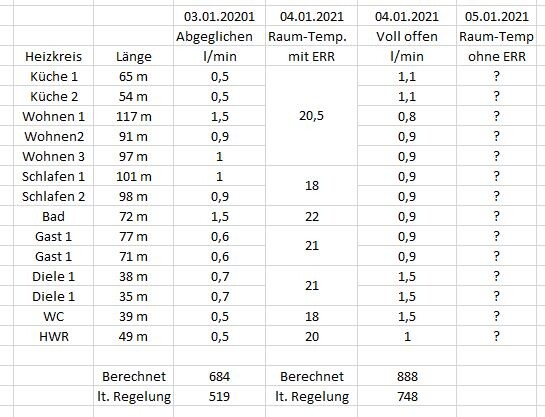
My desired temperatures once the balancing is completed would be:
Living + kitchen = 1 room = about 21°C (70°F)
Bathroom = 22°C (72°F)
Bedroom = preferably 15°C (59°F), but I don’t think this will be achievable; the highest realistic temperature will probably be 18-19°C (64-66°F) since the bathroom is right next door
Guest room = 19-20°C (66-68°F), bathroom right next door, lower temperatures won’t work, see bedroom
Hallway = 20°C (68°F)
Toilet = 15-18°C (59-64°F)
Utility room = 10°C (50°F), the circuit can basically be turned off since the room heats up almost by itself due to the inverter of the photovoltaic system, the heating circuit manifold, washing machine-dryer, and other equipment
So now it’s just a matter of waiting until the system stabilizes...
What I have observed so far (before we wasted 24 hours)
Since I haven't adjusted the heating curve, the target supply temperature remains at 29.5°C (85°F). Currently, the system is barely operating and only reaches a maximum of 26-27°C (79-81°F).
After about half an hour, the outdoor unit freezes up, and during defrosting, the supply temperature drops to around 15°C (59°F). After defrosting, the supply temperature rises again to 26-27°C (79-81°F) before the next defrost cycle begins.
Am I basically just running in circles here by only recovering the energy lost during the defrost phases?
Is this how we get any useful results?
Since I haven't adjusted the heating curve, the target supply temperature remains at 29.5°C (85°F). Currently, the system is barely operating and only reaches a maximum of 26-27°C (79-81°F).
After about half an hour, the outdoor unit freezes up, and during defrosting, the supply temperature drops to around 15°C (59°F). After defrosting, the supply temperature rises again to 26-27°C (79-81°F) before the next defrost cycle begins.
Am I basically just running in circles here by only recovering the energy lost during the defrost phases?
Is this how we get any useful results?