
D
däumchen1121 Dec 2020 17:03Hello everyone,
I’m new here and have been reading a lot.
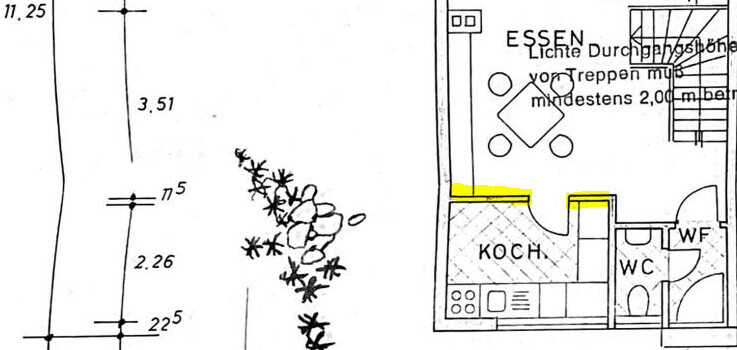
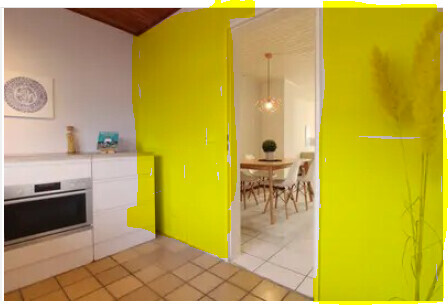
Maybe you can help me or have some ideas. I bought a terraced house and want to open up the kitchen towards the living room. The walls marked in yellow are to be removed.
On the ground floor, there are tiles everywhere: old tiles in the kitchen that definitely need to be replaced, and white tiles in the living room. I’m generally not a fan of tiles, but that’s how it is here now.
My question is: if I have the wall removed, how would you renew the kitchen floor? I don’t think it will be possible to install exactly the same white tiles there, so white tiles would probably always look like an attempt to match the existing ones. Therefore, I thought maybe a different tile color? Or laminate/vinyl flooring with a wood look in the kitchen? That would be the opposite of what you often see (kitchen with tiles, living room with wood look).
Also, the kitchen will become larger once the wall is removed, so the new floor there would extend further into the room. Would it be possible to remove some of the white tiles from the living room?
Thanks for your ideas 🙂
I’m new here and have been reading a lot.
Maybe you can help me or have some ideas. I bought a terraced house and want to open up the kitchen towards the living room. The walls marked in yellow are to be removed.
On the ground floor, there are tiles everywhere: old tiles in the kitchen that definitely need to be replaced, and white tiles in the living room. I’m generally not a fan of tiles, but that’s how it is here now.
My question is: if I have the wall removed, how would you renew the kitchen floor? I don’t think it will be possible to install exactly the same white tiles there, so white tiles would probably always look like an attempt to match the existing ones. Therefore, I thought maybe a different tile color? Or laminate/vinyl flooring with a wood look in the kitchen? That would be the opposite of what you often see (kitchen with tiles, living room with wood look).
Also, the kitchen will become larger once the wall is removed, so the new floor there would extend further into the room. Would it be possible to remove some of the white tiles from the living room?
Thanks for your ideas 🙂
N
nordanney21 Dec 2020 17:17If you’re going to renovate, do it properly. Completely new tiles for the living area and kitchen. You’ll make a lot of mess anyway.

Hello questioner,
As "nordanney" has already mentioned, a comprehensive renovation covering multiple rooms should be carried out here.
Anything less, meaning a patchwork solution, will still appear as patchwork to you in the coming decades – and will annoy you.
My suggestion is as follows:
If you have the wall removed, check the cross-section to see what type of insulation is present in the reveal areas and how thick it was installed back then. Acquire the same amount of insulation needed to cover the area exposed by the removal. Place a PE foil over it, and fill the wall gap with a repair mortar up to the top edge of the existing screed (floor leveling layer).
Completely clear the kitchen and adjacent room of all furniture, then thoroughly clean the old tiled surfaces in both rooms using an alkaline base cleaner. After that, sand them down and remove any dust.
Prime with a dispersion primer suitable for non-absorbent substrates, then level the entire surface with a 2mm (0.08 inch) layer of smoothing compound.
If necessary, apply a preliminary leveling layer or fill deep joints (between the old tiles) first. Otherwise, the old grout pattern might later show through visibly in the new floor covering.
After that, you can install any floor covering you want – although I would advise against laminate!
The door leaves may need to be shortened at the bottom by a carpenter if the overall height does not fit and a door leaf no longer has any clearance "above."
This way, you can completely redesign all rooms (after all, you probably don’t want to carry over the previous owner’s taste in your new home).
You will be limited in floor buildup height if the old ceramic covering is not completely removed (which would free up new buildup height). So essentially, only a 2-3mm (0.08–0.12 inch) thick elastic floor covering remains, which, depending on the manufacturer, is now also available with a convincingly realistic tile look!
Good luck and success: KlaRa
As "nordanney" has already mentioned, a comprehensive renovation covering multiple rooms should be carried out here.
Anything less, meaning a patchwork solution, will still appear as patchwork to you in the coming decades – and will annoy you.
My suggestion is as follows:
If you have the wall removed, check the cross-section to see what type of insulation is present in the reveal areas and how thick it was installed back then. Acquire the same amount of insulation needed to cover the area exposed by the removal. Place a PE foil over it, and fill the wall gap with a repair mortar up to the top edge of the existing screed (floor leveling layer).
Completely clear the kitchen and adjacent room of all furniture, then thoroughly clean the old tiled surfaces in both rooms using an alkaline base cleaner. After that, sand them down and remove any dust.
Prime with a dispersion primer suitable for non-absorbent substrates, then level the entire surface with a 2mm (0.08 inch) layer of smoothing compound.
If necessary, apply a preliminary leveling layer or fill deep joints (between the old tiles) first. Otherwise, the old grout pattern might later show through visibly in the new floor covering.
After that, you can install any floor covering you want – although I would advise against laminate!
The door leaves may need to be shortened at the bottom by a carpenter if the overall height does not fit and a door leaf no longer has any clearance "above."
This way, you can completely redesign all rooms (after all, you probably don’t want to carry over the previous owner’s taste in your new home).
You will be limited in floor buildup height if the old ceramic covering is not completely removed (which would free up new buildup height). So essentially, only a 2-3mm (0.08–0.12 inch) thick elastic floor covering remains, which, depending on the manufacturer, is now also available with a convincingly realistic tile look!
Good luck and success: KlaRa
D
däumchen1122 Dec 2020 09:50Good morning everyone,
thank you – you’re right, the proper solution would probably be to replace the entire floor. However, with almost 70m² (750 sq ft), that’s not going to be cheap, and I don’t really feel confident tackling such a large area myself. I guess I’ll have to give it some serious thought 😀
thank you – you’re right, the proper solution would probably be to replace the entire floor. However, with almost 70m² (750 sq ft), that’s not going to be cheap, and I don’t really feel confident tackling such a large area myself. I guess I’ll have to give it some serious thought 😀
Similar topics