
ᐅ Obtaining an Exemption from the Zoning Plan – How to Proceed?
Created on: 11 Apr 2020 09:58
S
Specki
Hello everyone,
I need some assistance with our project. Since many here have probably gone through something similar, I thought I might get some good advice.
Starting point:
Land plot available
We want to build a single-family house (possibly with a granny flat).
Currently, there are 2 adults with 2 children (2 and 4 years old). The house will be used by us. The plan is to create a small granny flat upstairs that will later be rented out once the children have left home.
The following (relevant) requirements come from the development plan from 1974:
- Ridge orientation East-West
- Strictly single-story
- Knee wall max. 50 cm (20 inches)
- Roof pitch between 22° and 28°
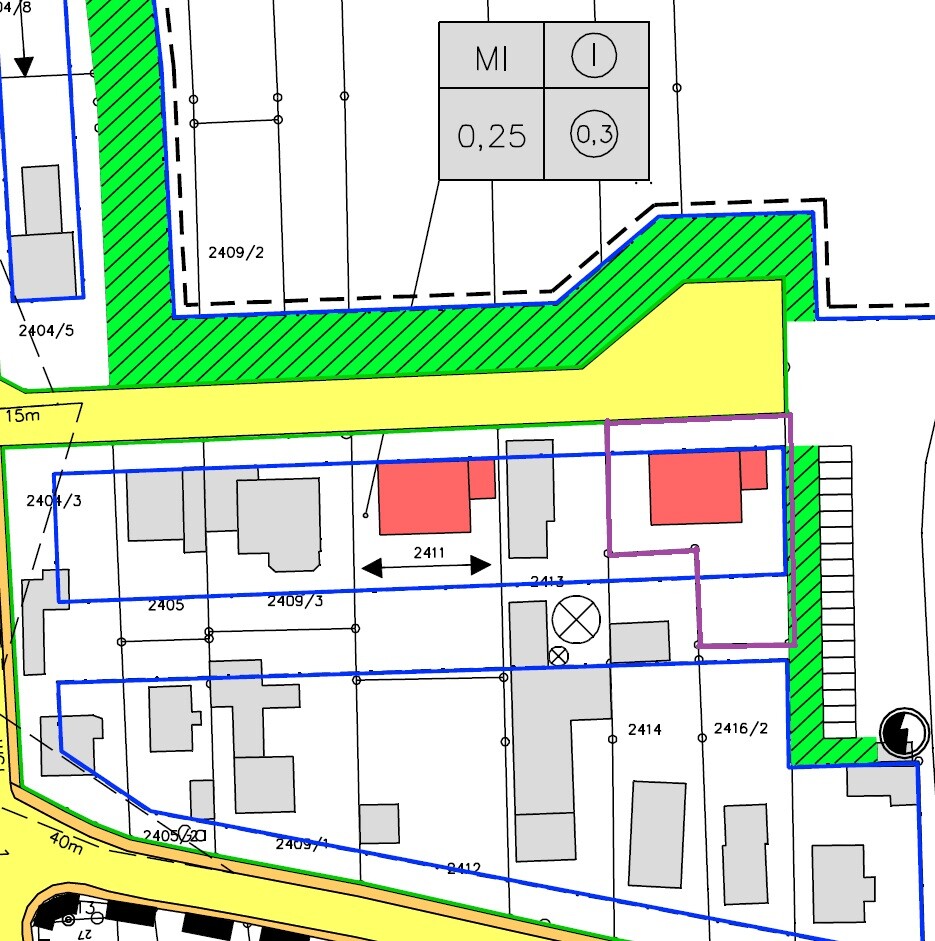
Attached is an excerpt from the development plan. The plot outlined in purple is the one in question. The houses shown in red do not exist; they were just added for planning purposes.
We would like to change the ridge orientation and raise the knee wall to 1 m (3 ft 3 in), or preferably 1.25 m (4 ft 1 in), because otherwise the house would be too small.
I first went to the building authority and spoke with the responsible lady there.
She looked at the plans and said that from her side it is not a problem initially, but I need to speak with the district office (Landratsamt, LRA), as they have to approve it. She gave me the contact details.
I then called the gentleman at the district office. He said it would be difficult and advised me to submit a formal preliminary building inquiry. So, I sent an email to both the gentleman at the district office and the lady at the building authority.
A relatively quick reply came from the district office:
Quote:
“The development plan ‘XXX’ of the city of XXX is certainly somewhat outdated, and nowadays the designated house types would probably look different. However, the development plan still serves as the legal basis for issuing building permits—any planned construction project must therefore comply with the regulations set therein.
Regarding the ridge orientation, this is more of an aesthetic specification for the planned location than a higher-level urban planning objective—subject to approval from the city of Buchloe, a waiver (which needs to be applied for) for changing the ridge orientation can therefore be considered.
It is different with the knee wall specification. This is a requirement based on urban and regional planning reasons. So far, no exemptions have been granted here, so your plans must comply with the existing regulations. The district office of Ostallgäu, after consultation with our legal building advisor, cannot promise an exemption. To achieve a corresponding increase in the knee wall or possibly the creation of a second full storey, the development plan in this area would have to be amended.”
After that, I was pretty discouraged and sent another email asking if at least the roof pitch could be changed. This was about a week ago, and I haven’t received a reply yet.
Two days ago, I met another person from the city’s building department. He was working behind our property on the road planned there.
I chatted with him a bit. He said he understands that we want to deviate from the development plan. However, he has no influence in this matter because it is not his responsibility. I am already dealing with the right people at the district office and the building authority. I just need to talk again to the gentleman at the district office. Perhaps I could get approval from the neighbors or other people in the same building area (marked in blue on the plan) for my deviation.
He also said it wouldn’t be easy because of equal treatment rules and to avoid everyone wanting to deviate.
Changing the development plan would be unrealistic and could take up to two years. I can probably forget about that, especially since there are only three free building plots left in that field anyway.
So, that’s the situation now.
We definitely want to raise the knee wall a bit.
We don’t want to build a bungalow because that would reduce too much garden space.
With a 50 cm (20 inches) knee wall, you can’t really get usable rooms upstairs.
I am grateful for any tips or suggestions on how we could still achieve our goal.
Thanks in advance!
Best regards,
Specki
I need some assistance with our project. Since many here have probably gone through something similar, I thought I might get some good advice.
Starting point:
Land plot available
We want to build a single-family house (possibly with a granny flat).
Currently, there are 2 adults with 2 children (2 and 4 years old). The house will be used by us. The plan is to create a small granny flat upstairs that will later be rented out once the children have left home.
The following (relevant) requirements come from the development plan from 1974:
- Ridge orientation East-West
- Strictly single-story
- Knee wall max. 50 cm (20 inches)
- Roof pitch between 22° and 28°
Attached is an excerpt from the development plan. The plot outlined in purple is the one in question. The houses shown in red do not exist; they were just added for planning purposes.
We would like to change the ridge orientation and raise the knee wall to 1 m (3 ft 3 in), or preferably 1.25 m (4 ft 1 in), because otherwise the house would be too small.
I first went to the building authority and spoke with the responsible lady there.
She looked at the plans and said that from her side it is not a problem initially, but I need to speak with the district office (Landratsamt, LRA), as they have to approve it. She gave me the contact details.
I then called the gentleman at the district office. He said it would be difficult and advised me to submit a formal preliminary building inquiry. So, I sent an email to both the gentleman at the district office and the lady at the building authority.
A relatively quick reply came from the district office:
Quote:
“The development plan ‘XXX’ of the city of XXX is certainly somewhat outdated, and nowadays the designated house types would probably look different. However, the development plan still serves as the legal basis for issuing building permits—any planned construction project must therefore comply with the regulations set therein.
Regarding the ridge orientation, this is more of an aesthetic specification for the planned location than a higher-level urban planning objective—subject to approval from the city of Buchloe, a waiver (which needs to be applied for) for changing the ridge orientation can therefore be considered.
It is different with the knee wall specification. This is a requirement based on urban and regional planning reasons. So far, no exemptions have been granted here, so your plans must comply with the existing regulations. The district office of Ostallgäu, after consultation with our legal building advisor, cannot promise an exemption. To achieve a corresponding increase in the knee wall or possibly the creation of a second full storey, the development plan in this area would have to be amended.”
After that, I was pretty discouraged and sent another email asking if at least the roof pitch could be changed. This was about a week ago, and I haven’t received a reply yet.
Two days ago, I met another person from the city’s building department. He was working behind our property on the road planned there.
I chatted with him a bit. He said he understands that we want to deviate from the development plan. However, he has no influence in this matter because it is not his responsibility. I am already dealing with the right people at the district office and the building authority. I just need to talk again to the gentleman at the district office. Perhaps I could get approval from the neighbors or other people in the same building area (marked in blue on the plan) for my deviation.
He also said it wouldn’t be easy because of equal treatment rules and to avoid everyone wanting to deviate.
Changing the development plan would be unrealistic and could take up to two years. I can probably forget about that, especially since there are only three free building plots left in that field anyway.
So, that’s the situation now.
We definitely want to raise the knee wall a bit.
We don’t want to build a bungalow because that would reduce too much garden space.
With a 50 cm (20 inches) knee wall, you can’t really get usable rooms upstairs.
I am grateful for any tips or suggestions on how we could still achieve our goal.
Thanks in advance!
Best regards,
Specki
Specki schrieb:
If I have a knee wall height of 50 cm (20 inches), and then build a knee wall around 1.20 m (4 feet) high—although 1.50 m (5 feet) would probably be better given the low roof pitch, since at 1.20 m (4 feet) I still need 1.75 m (5 feet 9 inches) to reach a height of 2 m (6 feet 7 inches)—you simply lose about 20 square meters (215 square feet) of floor space. And that means you have to build the house correspondingly larger. But that is so “totally different”… it should actually suit you because you want to do it differently. Everyone else with different building permits/planning permissions has to construct this strange roof that results in lost space in the attic. You don’t have that issue.
Specki schrieb:
I think most people are simply satisfied with 500–600 square meters (5,380–6,460 square feet) and don’t want to maintain too much garden. Where do you get your insight from? Just because we mostly hear from city dwellers here, who live in a completely different setting than villagers? Or because agriculture and animal husbandry aren’t topics here? Does everyone need to put in their avatar how many kilograms of vegetables they harvest in their garden, or how many farm animals they keep? Are those people “different” too?
One thing you definitely have in common with all of us: you think independently. And you are unique, just like every one of us.
Your desire to build a house makes you one of us. Otherwise, you wouldn’t be here. And if it were otherwise, we wouldn’t be able to give you any answer.
ypg schrieb:
but this is so completely “totally different”… it should actually suit you because you want to do it differently. Everyone else with other building plans has to build such a strange roof that creates lost space in the attic. You don’t have that.Interesting point! But you can make such a comment without sarcasm. Maybe just keep it a bit more factual?
How long do you want to keep going over this topic?
I just wanted to point out that our requirements differ from the norm in a few ways.
I think that’s enough now.
What I’m curious about with this "knee wall" topic is how the airtight layer is handled. Does it still go on the exterior wall and the roof, or basically on the roof and then down the knee wall? If it’s still on the roof and exterior wall, you could simply install the knee wall yourself with drywall. And I assume the underfloor heating would only extend up to this point, right?
Maybe someone knows.
Maybe someone knows.

Specki schrieb:
What really bothers me is the huge amount of wasted space. That’s quite unreasonable. I can understand someone trying to make the most efficient use of 250m² (2700 sq ft) in the city. But with 900m² (9700 sq ft), I wouldn’t consider changing the building regulations just because of 20m² (215 sq ft). If space on the plot were that critical, you’d be building a basement.
@kaho674
At first, I thought you had completely taken that sentence out of context, but after rereading my paragraph, I realize it can be misunderstood.
I didn’t mean the plot area, but rather the floor area on the upper floor. So on the sides, where the roof is still very low, space is lost because of the dwarf wall.
I have already mentioned that the 10 to 20 square meters (108 to 215 square feet) of plot area that might be lost due to regulations is not that dramatic.
At first, I thought you had completely taken that sentence out of context, but after rereading my paragraph, I realize it can be misunderstood.
Specki schrieb:
What really hurts me is the massive lost space.
If I have a knee wall height of 50cm (20 inches), and then place a dwarf wall at about 1.20m (4 feet), although 1.50m (5 feet) would probably be better with the shallow roof pitch—because at 1.20m (4 feet) I still only reach 1.75m (5 feet 9 inches) before hitting a ceiling height of 2m (6 feet 7 inches)—you simply lose about 20 square meters (215 square feet) of usable floor area. And for that, I have to build the house proportionally larger.
I didn’t mean the plot area, but rather the floor area on the upper floor. So on the sides, where the roof is still very low, space is lost because of the dwarf wall.
I have already mentioned that the 10 to 20 square meters (108 to 215 square feet) of plot area that might be lost due to regulations is not that dramatic.
Specki schrieb:
But you can also express that without sarcasm. Maybe just stay a bit more factual?No. I'm completely different in that regard. I just can't.Specki schrieb:
How long are you going to keep going on about this topic?
I just wanted to point out that our expectations differ from the standard in a few aspects.But then we wouldn’t be able to provide you with an answer here. The requirements for living areas, kitchen, and bathroom have to be more or less the same for everyone so that we know what we’re talking about. Specki schrieb:
Does it still come at the exterior wall and the roof, or rather at the roof and then down the knee wall?Usually at the exterior wall and the roof, so you can optionally install your knee wall and use the space behind it for storage.Specki schrieb:
If it is still at the roof and the exterior wall, you can easily install the "knee wall" yourself with drywall.Yes, you could finish your entire attic yourself and save money that way.Specki schrieb:
And I suppose the underfloor heating will only go as far as that, right?If you add the knee wall later, the underfloor heating will be installed fully up to the sand-lime brick, unless you plan it differently from the start. It just needs to meet the necessary requirements. Thermal bridges and such...Similar topics