
ᐅ Obtaining an Exemption from the Zoning Plan – How to Proceed?
Created on: 11 Apr 2020 09:58
S
Specki
Hello everyone,
I need some assistance with our project. Since many here have probably gone through something similar, I thought I might get some good advice.
Starting point:
Land plot available
We want to build a single-family house (possibly with a granny flat).
Currently, there are 2 adults with 2 children (2 and 4 years old). The house will be used by us. The plan is to create a small granny flat upstairs that will later be rented out once the children have left home.
The following (relevant) requirements come from the development plan from 1974:
- Ridge orientation East-West
- Strictly single-story
- Knee wall max. 50 cm (20 inches)
- Roof pitch between 22° and 28°
Attached is an excerpt from the development plan. The plot outlined in purple is the one in question. The houses shown in red do not exist; they were just added for planning purposes.
We would like to change the ridge orientation and raise the knee wall to 1 m (3 ft 3 in), or preferably 1.25 m (4 ft 1 in), because otherwise the house would be too small.
I first went to the building authority and spoke with the responsible lady there.
She looked at the plans and said that from her side it is not a problem initially, but I need to speak with the district office (Landratsamt, LRA), as they have to approve it. She gave me the contact details.
I then called the gentleman at the district office. He said it would be difficult and advised me to submit a formal preliminary building inquiry. So, I sent an email to both the gentleman at the district office and the lady at the building authority.
A relatively quick reply came from the district office:
Quote:
“The development plan ‘XXX’ of the city of XXX is certainly somewhat outdated, and nowadays the designated house types would probably look different. However, the development plan still serves as the legal basis for issuing building permits—any planned construction project must therefore comply with the regulations set therein.
Regarding the ridge orientation, this is more of an aesthetic specification for the planned location than a higher-level urban planning objective—subject to approval from the city of Buchloe, a waiver (which needs to be applied for) for changing the ridge orientation can therefore be considered.
It is different with the knee wall specification. This is a requirement based on urban and regional planning reasons. So far, no exemptions have been granted here, so your plans must comply with the existing regulations. The district office of Ostallgäu, after consultation with our legal building advisor, cannot promise an exemption. To achieve a corresponding increase in the knee wall or possibly the creation of a second full storey, the development plan in this area would have to be amended.”
After that, I was pretty discouraged and sent another email asking if at least the roof pitch could be changed. This was about a week ago, and I haven’t received a reply yet.
Two days ago, I met another person from the city’s building department. He was working behind our property on the road planned there.
I chatted with him a bit. He said he understands that we want to deviate from the development plan. However, he has no influence in this matter because it is not his responsibility. I am already dealing with the right people at the district office and the building authority. I just need to talk again to the gentleman at the district office. Perhaps I could get approval from the neighbors or other people in the same building area (marked in blue on the plan) for my deviation.
He also said it wouldn’t be easy because of equal treatment rules and to avoid everyone wanting to deviate.
Changing the development plan would be unrealistic and could take up to two years. I can probably forget about that, especially since there are only three free building plots left in that field anyway.
So, that’s the situation now.
We definitely want to raise the knee wall a bit.
We don’t want to build a bungalow because that would reduce too much garden space.
With a 50 cm (20 inches) knee wall, you can’t really get usable rooms upstairs.
I am grateful for any tips or suggestions on how we could still achieve our goal.
Thanks in advance!
Best regards,
Specki
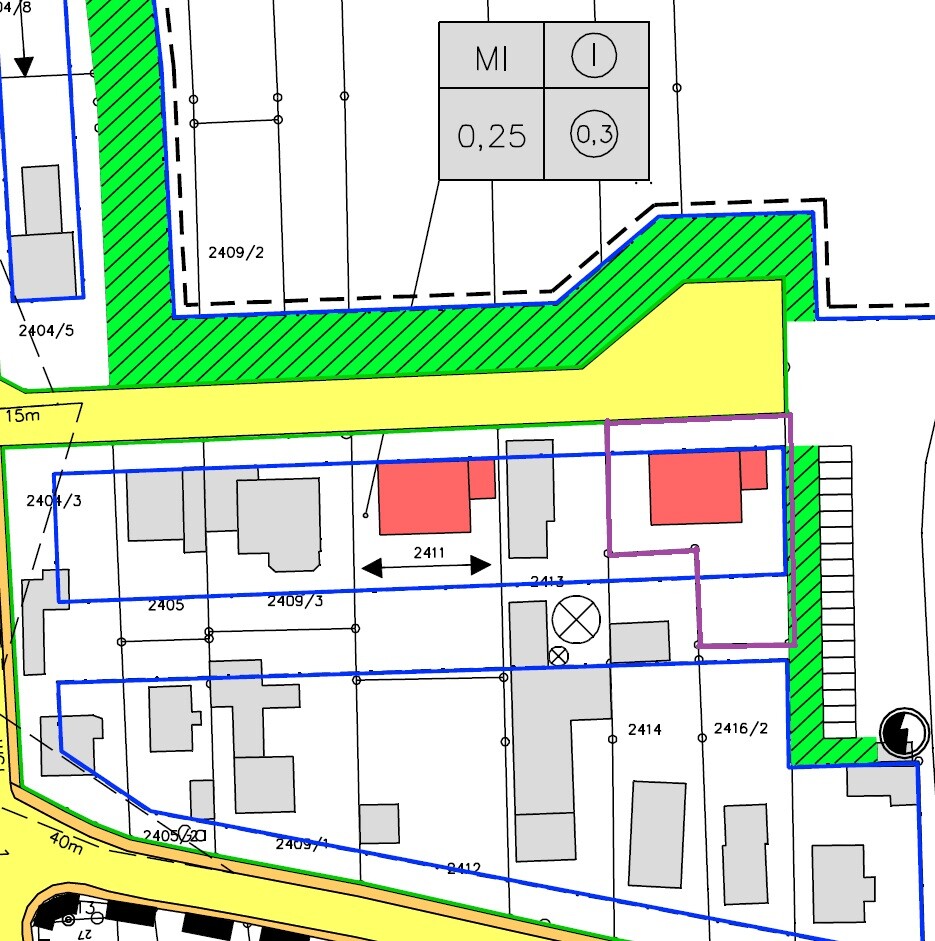
I need some assistance with our project. Since many here have probably gone through something similar, I thought I might get some good advice.
Starting point:
Land plot available
We want to build a single-family house (possibly with a granny flat).
Currently, there are 2 adults with 2 children (2 and 4 years old). The house will be used by us. The plan is to create a small granny flat upstairs that will later be rented out once the children have left home.
The following (relevant) requirements come from the development plan from 1974:
- Ridge orientation East-West
- Strictly single-story
- Knee wall max. 50 cm (20 inches)
- Roof pitch between 22° and 28°
Attached is an excerpt from the development plan. The plot outlined in purple is the one in question. The houses shown in red do not exist; they were just added for planning purposes.
We would like to change the ridge orientation and raise the knee wall to 1 m (3 ft 3 in), or preferably 1.25 m (4 ft 1 in), because otherwise the house would be too small.
I first went to the building authority and spoke with the responsible lady there.
She looked at the plans and said that from her side it is not a problem initially, but I need to speak with the district office (Landratsamt, LRA), as they have to approve it. She gave me the contact details.
I then called the gentleman at the district office. He said it would be difficult and advised me to submit a formal preliminary building inquiry. So, I sent an email to both the gentleman at the district office and the lady at the building authority.
A relatively quick reply came from the district office:
Quote:
“The development plan ‘XXX’ of the city of XXX is certainly somewhat outdated, and nowadays the designated house types would probably look different. However, the development plan still serves as the legal basis for issuing building permits—any planned construction project must therefore comply with the regulations set therein.
Regarding the ridge orientation, this is more of an aesthetic specification for the planned location than a higher-level urban planning objective—subject to approval from the city of Buchloe, a waiver (which needs to be applied for) for changing the ridge orientation can therefore be considered.
It is different with the knee wall specification. This is a requirement based on urban and regional planning reasons. So far, no exemptions have been granted here, so your plans must comply with the existing regulations. The district office of Ostallgäu, after consultation with our legal building advisor, cannot promise an exemption. To achieve a corresponding increase in the knee wall or possibly the creation of a second full storey, the development plan in this area would have to be amended.”
After that, I was pretty discouraged and sent another email asking if at least the roof pitch could be changed. This was about a week ago, and I haven’t received a reply yet.
Two days ago, I met another person from the city’s building department. He was working behind our property on the road planned there.
I chatted with him a bit. He said he understands that we want to deviate from the development plan. However, he has no influence in this matter because it is not his responsibility. I am already dealing with the right people at the district office and the building authority. I just need to talk again to the gentleman at the district office. Perhaps I could get approval from the neighbors or other people in the same building area (marked in blue on the plan) for my deviation.
He also said it wouldn’t be easy because of equal treatment rules and to avoid everyone wanting to deviate.
Changing the development plan would be unrealistic and could take up to two years. I can probably forget about that, especially since there are only three free building plots left in that field anyway.
So, that’s the situation now.
We definitely want to raise the knee wall a bit.
We don’t want to build a bungalow because that would reduce too much garden space.
With a 50 cm (20 inches) knee wall, you can’t really get usable rooms upstairs.
I am grateful for any tips or suggestions on how we could still achieve our goal.
Thanks in advance!
Best regards,
Specki

I wouldn’t automatically dismiss a knee wall of 50 cm (20 inches) in Bavaria – although Buchloe is in the Allgäu region, in Franconia we often see this vacuum cleaner knee wall quite frequently, even in new housing developments featured here in the forum. It’s possible to add a knee wall of 120 cm (47 inches) behind it. Usually, I find combining a knee wall and an additional knee wall unnecessary, but at this size ratio, it might work. I wouldn’t go for a 140 cm (55 inches) knee wall, as in my opinion, that would raise the window sill too high.
https://www.instagram.com/11antgmxde/
https://www.linkedin.com/company/bauen-jetzt/
https://www.instagram.com/11antgmxde/
https://www.linkedin.com/company/bauen-jetzt/
Maybe there is a fundamental flaw in my reasoning...
So, here is what I’m thinking.
If I have a knee wall of 50 cm (20 inches) with a roof pitch of max. 28°, the reasonably usable space upstairs becomes significantly smaller. Then, I can’t fit all the rooms as desired and would have to move, for example, the storage room downstairs. That means 10 m² (108 ft²) more floor space.
This leads to:
- 10 m² (108 ft²) more foundation slab
- 10 m² (108 ft²) more intermediate ceiling
- roughly 10 m² (108 ft²) more roof area
- correspondingly more exterior wall
So it becomes noticeably more expensive.
If I raise the knee wall by 50 cm (20 inches), I can fit all the rooms nicely upstairs and avoid the negative points just listed. But then I have somewhat more exterior wall because it’s 50 cm (20 inches) higher. Overall, though, it should be cheaper, right?
Costs are actually my main concern here.
Otherwise, maybe the slightly larger footprint, but since the lot is big, an extra 10 m² (108 ft²) of floor space doesn’t make much difference.
Am I really missing something here?
Best regards
Specki
So, here is what I’m thinking.
If I have a knee wall of 50 cm (20 inches) with a roof pitch of max. 28°, the reasonably usable space upstairs becomes significantly smaller. Then, I can’t fit all the rooms as desired and would have to move, for example, the storage room downstairs. That means 10 m² (108 ft²) more floor space.
This leads to:
- 10 m² (108 ft²) more foundation slab
- 10 m² (108 ft²) more intermediate ceiling
- roughly 10 m² (108 ft²) more roof area
- correspondingly more exterior wall
So it becomes noticeably more expensive.
If I raise the knee wall by 50 cm (20 inches), I can fit all the rooms nicely upstairs and avoid the negative points just listed. But then I have somewhat more exterior wall because it’s 50 cm (20 inches) higher. Overall, though, it should be cheaper, right?
Costs are actually my main concern here.
Otherwise, maybe the slightly larger footprint, but since the lot is big, an extra 10 m² (108 ft²) of floor space doesn’t make much difference.
Am I really missing something here?
Best regards
Specki
Specki schrieb:
I am quoting again from my original post, specifically from the quote of the email from the LRA:
"The development plan 'XXX' of the city XXX is certainly a bit outdated, and today the specified house types would probably look different." And then:
Specki schrieb:
However, the development plan still forms the legal basis for granting building permits – any planned construction project must therefore comply with the specifications set out there. Specki schrieb:
I don’t have to think only about my current needs, do I? Am I not allowed to consider the needs I will have in old age when the children have moved out and my pension might not be as good as I would like? Let’s not twist the facts: no one, including me, has anything against your thinking about retirement planning, but challenging a development plan just to gain the option for a granny flat and thus access a second KfW subsidy is simply not acceptable. That is my opinion.
My suggestion was and remains:
ypg schrieb:
To build nicely: make the ground floor a bit larger and then put a 1.20m (4 feet) knee wall in the attic. That will make a great house. Specki schrieb:
…because you make a few design changes and maybe build 5m² (54 sq ft) more so you can include a granny flat… If it’s really just about 5m² (54 sq ft), then I ask you whether you really only want to collect the KfW subsidy. You don’t sue or ask other neighbors or dispute over 5m² (54 sq ft).
I also believe the second KfW subsidy is basically gone for good, if such subsidies even still exist. The government has nothing left to give away nowadays. We will have to be very cautious moving forward.

Specki schrieb:
Am I really making a mistake in my thinking?In my opinion, yes. What you need extra in concrete and small stones for a larger ground floor, because otherwise the upper floor would be too small, you actually stack on top when you raise the knee wall and reduce the floor area. The slightly more concrete for the slab and ceiling usually doesn't make much difference, unless you’re planning a pile foundation in marshland. If you’re short on money, you probably can’t build anyway.
And regarding the interior finishes, it doesn’t really matter to me because the usable area doesn’t change.
ypg schrieb:
Let's not twist the facts: no one, including me, is against your idea of retirement planning, but challenging the development plan just to qualify for the second KFW loan by adding a secondary apartment is simply not acceptable. That’s my opinion. I think you misunderstood.
This is all independent of the secondary apartment. It would also be possible to add a small secondary apartment upstairs if the ground floor is large enough, even with a low knee wall.
Either way, we would want to raise the knee wall if possible.
Once we know how we can build, we will consider, regardless of whether the knee wall is raised or not, whether it makes sense for us to include a secondary apartment. For the two reasons mentioned earlier.
So no twisting of facts here...
ypg schrieb:
If it’s only about 5 sqm (54 sq ft), then I ask you if you really just want to get the KFW loan. No one sues over 5 sqm (54 sq ft), doesn’t ask the neighbors, and doesn’t argue either. I would appreciate it if you would finally stop making assumptions about me.
You don’t know me. I think differently than most people. I always try to save money where possible, but without cutting on quality that matters to me. However, my idea of quality is often different from others'. I work as an engineer, but only a three-quarter position, so 30 hours per week. Right now, I’m still paying off our two-family house with 1600 sqm (17,222 sq ft) of land. It all works if you live accordingly. Many don’t understand that, but for me/us it works well. So I want to keep this project as cost-efficient as possible, which is why even 5 sqm (54 sq ft) matter if we can do without them without losing comfort that is important to ME. So I just have different priorities than most people.
And again, since you seem to read very selectively: I do not want to sue!
Why it is wrong to knock on neighbors’ doors to ask if they have deviated from the development plan and whether they would have a problem if I build 50 cm (20 inches) higher is really beyond me. I wonder why this is such a big deal for you?
We seem to live in different worlds with different perspectives. Please try to view me more neutrally and not only from your apparently very different point of view.
I would appreciate that, thank you.
kaho674 schrieb:
What you need more of in concrete and stone for a bigger ground floor, because otherwise the upper floor would be too small, you simply stack on top when you raise the knee wall and reduce the footprint. The bit more concrete for the slab and ceiling usually does not matter much, unless you’re planning a pile foundation in a bog. If you’re short on money, you probably couldn’t build anyway. Thanks, I will think about that some more and talk to the contractors.
It will be a timber frame house. The slab probably won’t be cheap either, since it will be KFW40 standard.
It’s not that I am short on money, but I want to build cost-optimally.
kaho674 schrieb:
If the plot is restored to the required condition, that’s great. When it comes to garden size, it doesn’t really matter whether your house has a footprint of 120 or 100 sqm (1,292 or 1,076 sq ft). Yes, it doesn’t make a big difference. Still, every square meter of garden is valuable to me.
Currently, the whole plot includes 220 sqm (2,368 sq ft) chicken run, 110 sqm (1,184 sq ft) vegetable garden, wood storage, fruit trees, many berry bushes, shelter for two trailers, a large rabbit enclosure and quite a bit of green space for the kids to practice archery, set up a bouncy castle, and play around.
So, as you can see, the garden is very important to us.
But you are right. 20 sqm (215 sq ft) here or there won’t make much difference.
I think I will simply call the local authority again to check if there really is no possibility and mention the first house in the street again.
If I get a rejection, then I will see with the contractors how we can make the best of it.
Similar topics