
ᐅ How to Insulate an Attic or Loft: What Is the Best Approach?
Created on: 5 Sep 2018 19:58
M
Maximo1975M
Maximo19755 Sep 2018 19:58Hello,
we are currently renovating an inherited house built in 1958.
The attic will initially be used for storage and might be converted into a living space later.
The electrical wiring is already being prepared for this.
Insulation will be installed between the rafters in the attic along with a vapor barrier, but that is not the main focus right now!
The main issue is the floor. As shown in the picture, it is filled with about 8cm (3 inches) of rubble/stones/debris resting on the wooden decking (which is visible from the floor below) because the old ceiling with fiberboard panels was completely removed.
What is the best approach to insulating the floor here? Should wooden boards be evenly laid out and screwed down, followed by a vapor barrier and then walkable insulation panels?
I would appreciate any advice! :-)
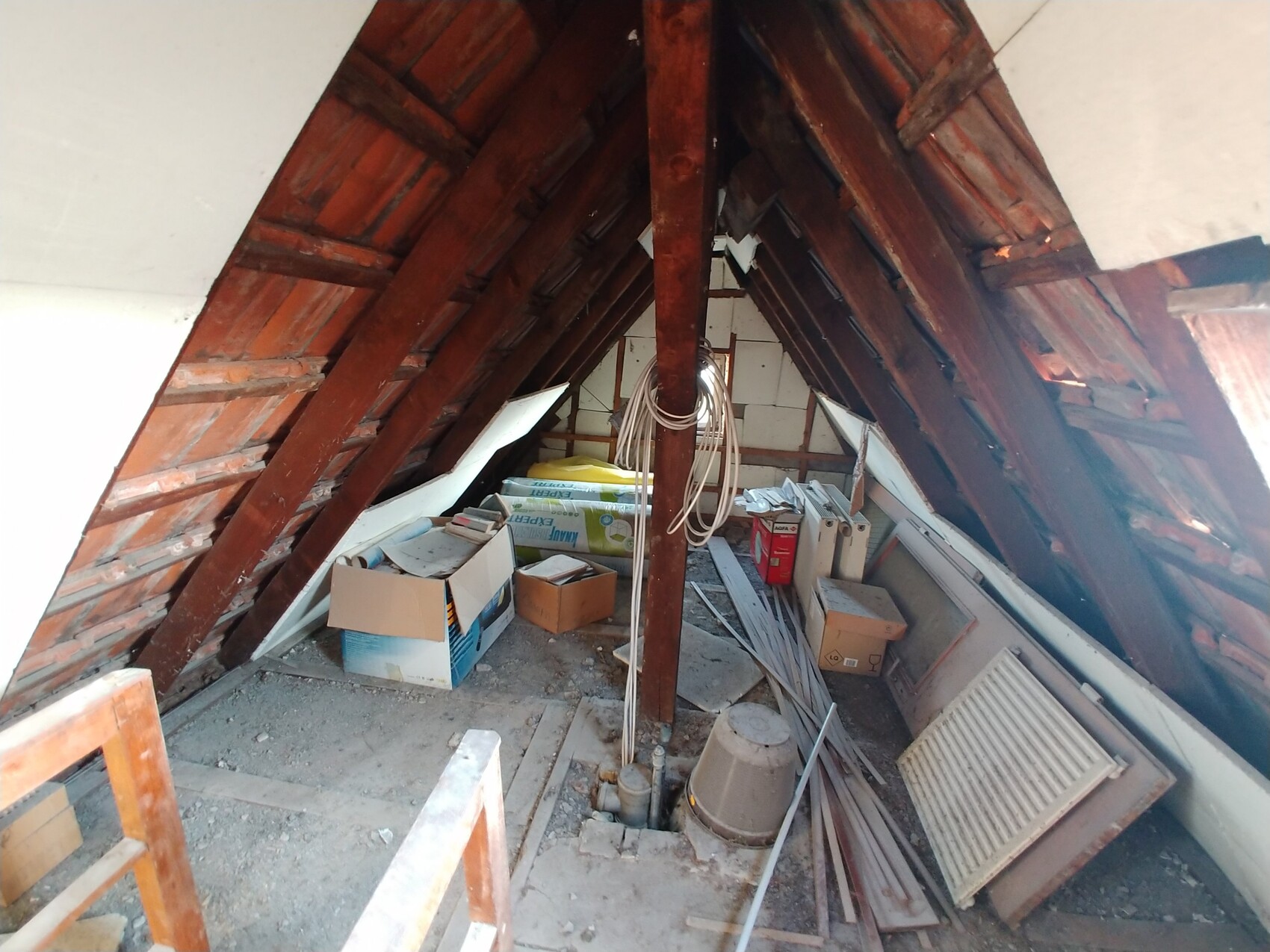
we are currently renovating an inherited house built in 1958.
The attic will initially be used for storage and might be converted into a living space later.
The electrical wiring is already being prepared for this.
Insulation will be installed between the rafters in the attic along with a vapor barrier, but that is not the main focus right now!
The main issue is the floor. As shown in the picture, it is filled with about 8cm (3 inches) of rubble/stones/debris resting on the wooden decking (which is visible from the floor below) because the old ceiling with fiberboard panels was completely removed.
What is the best approach to insulating the floor here? Should wooden boards be evenly laid out and screwed down, followed by a vapor barrier and then walkable insulation panels?
I would appreciate any advice! :-)
Maximo1975 schrieb:
What is the best way to insulate the floor here??If you want to convert the attic into living space, you don’t need to insulate the floor thermally, only for soundproofing.
If you want to save effort and everything is solid, you can leave the loose fill in place, lay OSB boards on top, and then laminate/wood flooring with good impact sound insulation in between. You don’t need a vapor barrier on the floor if there is also living space below.
BUT: Are you sure you want to use it as living space? It looks like about 2.5 meters (8 feet) wide and 2.2-2.5 meters (7.2-8.2 feet) high at the ridge, plus the supports in the middle. I could only imagine this as an extension for a child’s room or a sleeping nook.
The rafters appear to be about 14 cm (5.5 inches) thick and you don’t have an underlay beneath the roof tiles, which also don’t look sealed with mortar. This means they are not waterproof against driving rain or snow, and you will get occasional moisture entry.
This rules out proper insulation between the rafters since it will be damaged over time.
You need ventilation behind the roof tiles and a waterproof layer beneath them. That is difficult to achieve from the inside. There are solutions that reduce insulation thickness, and you should use moisture-resistant insulation (e.g., sheep wool/jute) in that case—this is more expensive and less effective compared to mineral wool, for example.
In addition, with the 14 cm (5.5 inch) rafters, you will only reach a mediocre U-value of about 0.3-0.4 W/m²K and low thermal mass. It will be quite warm in summer as a sleeping space. Adding insulation below the rafters or increasing their depth from the inside is possible, but will reduce your living height. When doing both between- and under-rafter insulation, don’t forget the vapor barrier on the INSIDE!
My advice: Unless you are planning to reroof or install a dormer anyway, consider carefully whether expanding here makes sense. Check if the space inside the house is sufficient and use the attic as an unheated room. Insulate the floor with 20-24 cm (8-9.5 inches) mineral wool mats, adding a vapor barrier underneath.
Oh, and what about heating? That needs to be planned too.
M
Maximo19756 Sep 2018 19:44I think the idea of using OSB for the attic/storage area is good, as it allows for easy placement and storage of various items! The loose fill insulation will remain in place.
Whether the space will be fully finished is still very uncertain since the room is quite small, and the planned addition of a second layer to the rafters plus a vapor barrier, increasing from the current 12cm (5 inches) to about 19cm (7.5 inches), will further reduce the available space. So, actually, this is not a topic for the near future!
In the living space below the attic (3 rooms) which already has sloped ceilings, all the old fiberboard panels and drywall have been removed. The rafters have been doubled up and fitted with insulation below the rafters and a vapor barrier, all sealed airtight. There is about 3cm (1 inch) of air space between the tiles and the insulation.
The currently missing underlay membrane is a bit concerning, as it is not yet clear when the roof will be re-covered. However, I have the impression that everything is very well sealed, even without the waterproof layer. When the gutting started in spring, everything appeared very dry in the rafter area and throughout other parts of the roof. I’m watching it closely, but I’m not a professional who can assess this 100%. Maybe it’s because the roof is very steep and rainwater can run off quickly. All the rafters and battens on the roof seem to be in very good condition.
In the long term, though, not having a new underlay membrane could definitely be problematic, right?
Whether the space will be fully finished is still very uncertain since the room is quite small, and the planned addition of a second layer to the rafters plus a vapor barrier, increasing from the current 12cm (5 inches) to about 19cm (7.5 inches), will further reduce the available space. So, actually, this is not a topic for the near future!
In the living space below the attic (3 rooms) which already has sloped ceilings, all the old fiberboard panels and drywall have been removed. The rafters have been doubled up and fitted with insulation below the rafters and a vapor barrier, all sealed airtight. There is about 3cm (1 inch) of air space between the tiles and the insulation.
The currently missing underlay membrane is a bit concerning, as it is not yet clear when the roof will be re-covered. However, I have the impression that everything is very well sealed, even without the waterproof layer. When the gutting started in spring, everything appeared very dry in the rafter area and throughout other parts of the roof. I’m watching it closely, but I’m not a professional who can assess this 100%. Maybe it’s because the roof is very steep and rainwater can run off quickly. All the rafters and battens on the roof seem to be in very good condition.
In the long term, though, not having a new underlay membrane could definitely be problematic, right?
Maximo1975 schrieb:
In the long run, this could definitely be problematic without a new underlayment membrane, right??The installation guidelines for clay tiles require that, under higher demands—especially for roofs of residential buildings—always a second waterproof layer is installed, even if the attic is not being finished. This is particularly important when insulation is installed between the rafters.
That is the official regulation; practice is different. There are thousands of roof structures without an underlayment membrane, and not all of them have experienced water damage yet.
If your roof has a sufficient pitch (the pictures appear quite steep) and everything is properly installed and intact, the roof should be resistant to driving rain—snow tightness is a different matter. Snow can be blown horizontally or even upwards by the wind.
Insulation placed directly under the tiles can also work well, but there is no safety net if something does go wrong. One tile broken or displaced combined with a strong rainfall, and you could have a wet wall and insulation.
For the sloped ceilings in the living area, this is the current state. For the attic floor, I would recommend floor insulation with chipboard on top, or, if it’s not a walkable space, hydrophobic glass wool mats with a water-repellent fleece facing. That way, if a few snowflakes pass through the tiles, it’s not so critical up there because everything can dry out again.
In the medium term, however, you should definitely install an underlayment membrane on the roof.
M
Maximo19757 Sep 2018 19:46My parents-in-law still have a lot of under-rafter insulation wool and a vapor retarder left over, which should be enough for an attic.
The rafters are supposed to be doubled up like one floor below... well, it’s going to be a lot of work! Then it should be sufficient for the attic floor to have OSB boards installed. From what I understand, that would actually have been enough.
The rafters are supposed to be doubled up like one floor below... well, it’s going to be a lot of work! Then it should be sufficient for the attic floor to have OSB boards installed. From what I understand, that would actually have been enough.
K
Knallkörper7 Sep 2018 20:53Hello. I would have installed 20cm (8 inches) of walkable insulation in the attic, for example using wood fiber boards. If you only lay OSB, the ceilings of the rooms below won’t be sufficiently insulated.
Have you installed the vapor retarder continuously on the upper floor, meaning from the knee wall over the slopes and across the ceiling?
Have you installed the vapor retarder continuously on the upper floor, meaning from the knee wall over the slopes and across the ceiling?
Similar topics