
Q
quattro12329 Jul 2020 18:56Hello,
I am currently at the shell construction stage and the rough-in plumbing is completed. Now the installations are being covered with OSB and drywall.
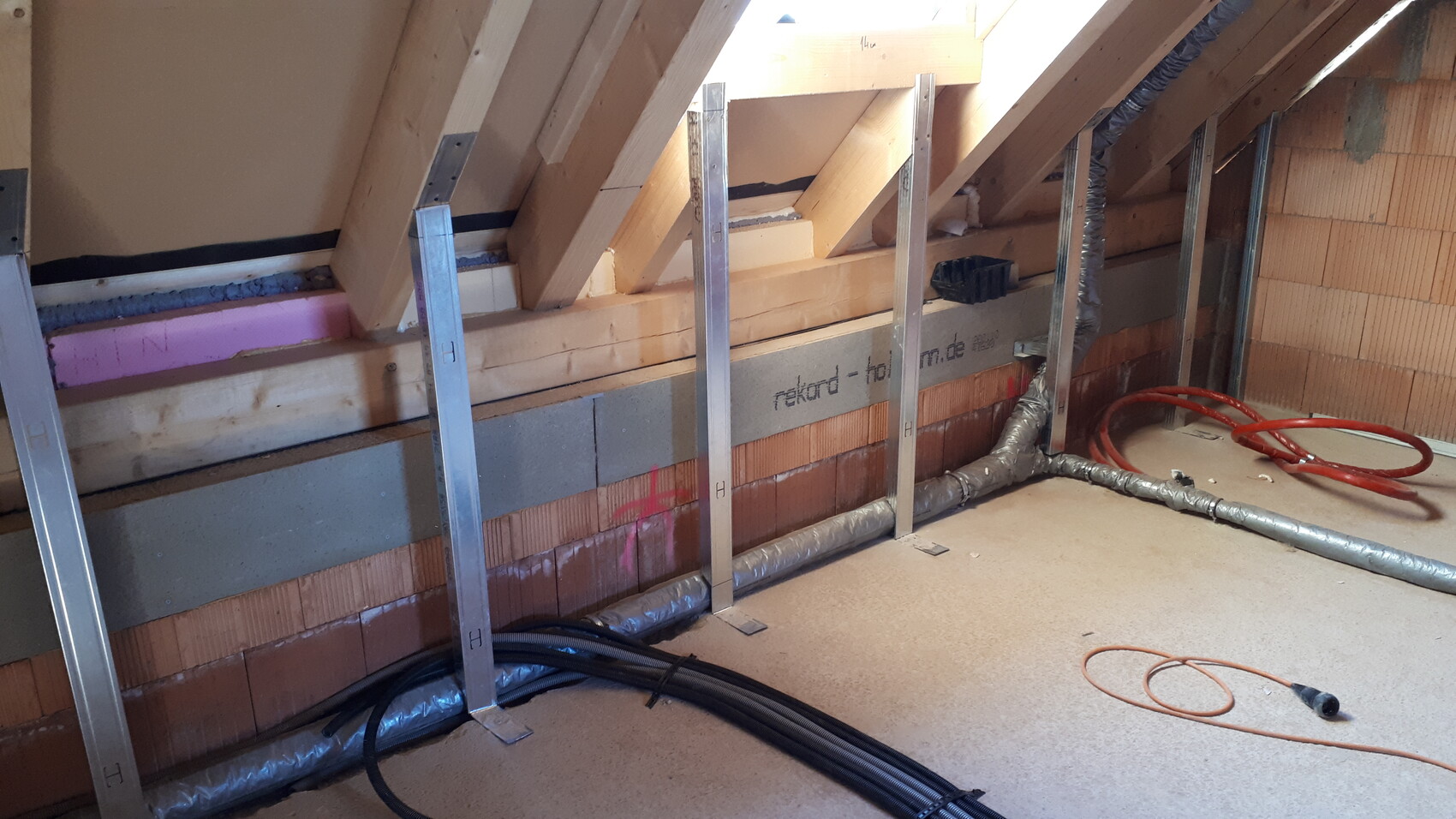
In the attic, the bricklayer hasn’t built up to the top of the knee wall. This is supposed to be finished with drywall construction. Profiles like the ones shown in the picture below have been installed, and the space behind them will be insulated with mineral wool. The vapor barrier will then be applied along the profiles down to the floor.
Question: Is this an acceptable method? I am used to the vapor barrier running down to and being fixed at the ring beam. Will this cause any issues with thermal bridges?
Best regards
I am currently at the shell construction stage and the rough-in plumbing is completed. Now the installations are being covered with OSB and drywall.
In the attic, the bricklayer hasn’t built up to the top of the knee wall. This is supposed to be finished with drywall construction. Profiles like the ones shown in the picture below have been installed, and the space behind them will be insulated with mineral wool. The vapor barrier will then be applied along the profiles down to the floor.
Question: Is this an acceptable method? I am used to the vapor barrier running down to and being fixed at the ring beam. Will this cause any issues with thermal bridges?
Best regards
 Vicky Pedia29 Jul 2020 20:00
The membrane is extended up to the ring beam and sealed there. A special adhesive from a cartridge is used for this. The penetrations of the drywall profiles are sealed with the corresponding tape. The membrane has nothing to do with thermal bridges.
Q
quattro12329 Jul 2020 20:09Ok, thanks for the response.
That was exactly my question: is it technically correct or unproblematic if I don’t extend the vapor barrier onto the ring beam but instead run it along the stud profiles, as you can see in the picture?
Everything behind this will be insulated, and then, as usual, battens/drywall will be installed onto the stud profiles.
That was exactly my question: is it technically correct or unproblematic if I don’t extend the vapor barrier onto the ring beam but instead run it along the stud profiles, as you can see in the picture?
Everything behind this will be insulated, and then, as usual, battens/drywall will be installed onto the stud profiles.
Q
quattro12329 Jul 2020 20:20I should also add that the vapor barrier will be glued to the raw concrete floor, and then the screed will be applied on top. So, there will already be an airtight seal at that point.
Q
quattro12318 Aug 2020 13:59I want to explain this again using a different image.
My plan/question is the following: I would install the insulation wool (as usual) between the rafters. In the entire space between the insulation wool and the drywall profiles on the right side, I would fill the gap with Styrodur/Styrofoam and seal the joints. Then, I would attach the vapor barrier on the drywall profiles from the inside and extend it down to the floor. Later, the screed would be applied over the floor edge.
This will likely create some air gaps between the insulation wool and the vapor barrier, but it would still provide a sealed barrier between the interior living space and the insulation materials.
Is this an acceptable approach? Or would you strongly advise against it? I would appreciate any advice.
If this is not recommended, how would you proceed? There is a step between the ring beam and the wall plate. Should I definitely build this up with masonry? Or could I simply fill the step flush with the wall plate using Styrodur and then attach the vapor barrier to the Styrodur?
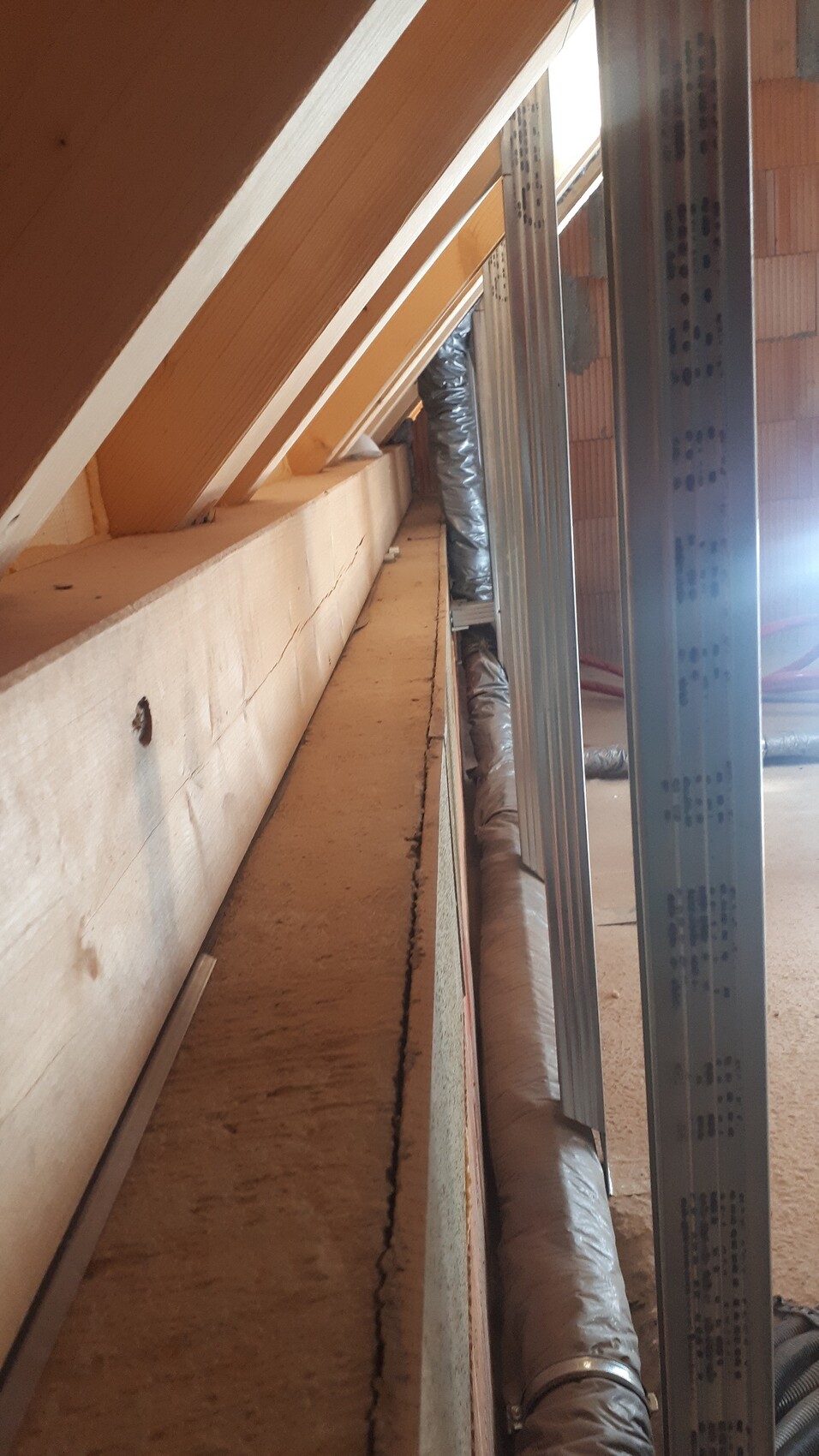
My plan/question is the following: I would install the insulation wool (as usual) between the rafters. In the entire space between the insulation wool and the drywall profiles on the right side, I would fill the gap with Styrodur/Styrofoam and seal the joints. Then, I would attach the vapor barrier on the drywall profiles from the inside and extend it down to the floor. Later, the screed would be applied over the floor edge.
This will likely create some air gaps between the insulation wool and the vapor barrier, but it would still provide a sealed barrier between the interior living space and the insulation materials.
Is this an acceptable approach? Or would you strongly advise against it? I would appreciate any advice.
If this is not recommended, how would you proceed? There is a step between the ring beam and the wall plate. Should I definitely build this up with masonry? Or could I simply fill the step flush with the wall plate using Styrodur and then attach the vapor barrier to the Styrodur?
Similar topics