
Hello, we own a 20-year-old house with a wall-mounted boiler.
Model: Sieger HG11.
Since our exhaust gases are vented through a wall connection rather than through the roof, the boiler’s hot water output was limited to a maximum of 24 kW.
Now our boiler is nearing the end of its service life, and before requesting multiple quotes, I wanted to kindly ask here what the cost might be.
A new wall-mounted unit is to be installed, preferably again with a wall vent. The local chimney inspector has approved this.
Our house has a heated area or living space of 110 m3 (3,885 ft3).
Annual gas consumption is approximately 11,000 kW.
Model: Sieger HG11.
Since our exhaust gases are vented through a wall connection rather than through the roof, the boiler’s hot water output was limited to a maximum of 24 kW.
Now our boiler is nearing the end of its service life, and before requesting multiple quotes, I wanted to kindly ask here what the cost might be.
A new wall-mounted unit is to be installed, preferably again with a wall vent. The local chimney inspector has approved this.
Our house has a heated area or living space of 110 m3 (3,885 ft3).
Annual gas consumption is approximately 11,000 kW.
D
Deliverer6 Feb 2022 09:40Isn’t anyone really interested in something like the future? Everyone over 80? No children?
I also don’t quite understand why people always talk about “ideology” when this topic is brought up. It’s hard to find anything less ideological than climate change.
I also don’t quite understand why people always talk about “ideology” when this topic is brought up. It’s hard to find anything less ideological than climate change.


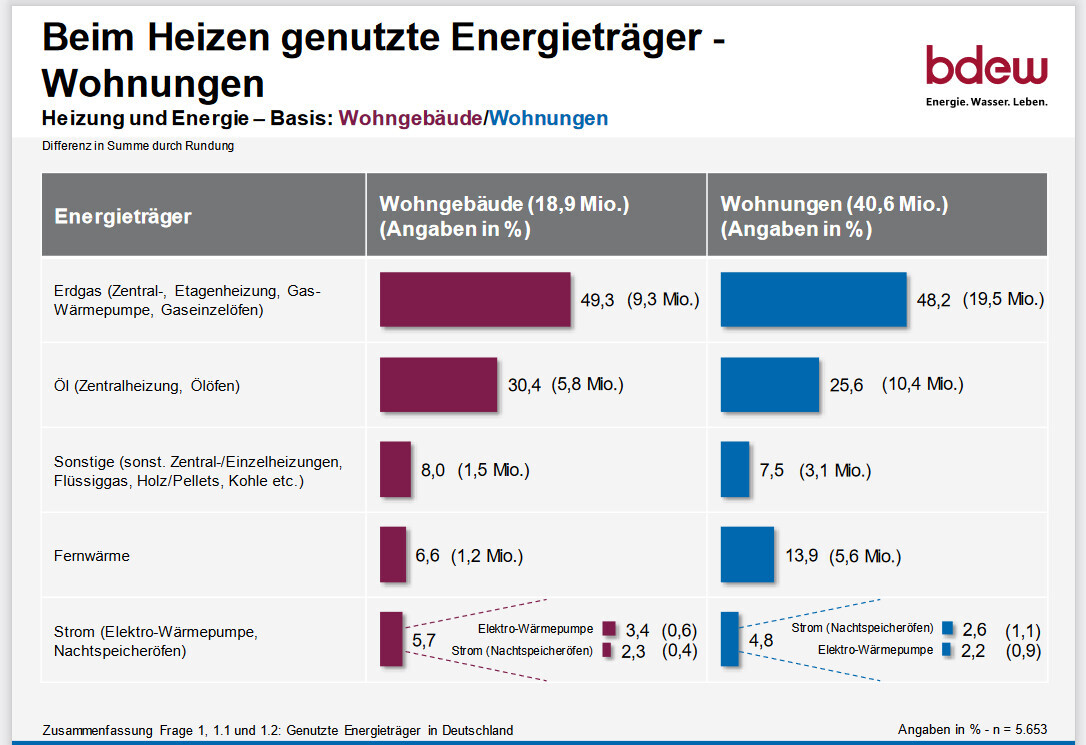
Completely free of ideology? I always take a pragmatic approach. Gas will still be an essential part of Germany’s energy mix in 10, 15, and even 20 years. Nearly half of all households heat with gas. It is the number one energy source for heating systems. You simply cannot ignore that. According to operators, most systems were installed within the last 10 to 20 years. So they will continue to be used until the end.
KingJulien schrieb:The infrastructure says so. A complete transition won’t be possible in either 5 or 10 years. Heat pumps haven’t been around just since yesterday either. Despite subsidies and mature technology, we have barely reached the ~5% mark—and not even fully.
Who says that gas will still be reliably available and affordable in 10 or even just 5 years?
KingJulien schrieb:At the moment, we are experiencing a hiccup. That will pass.
Given gas and the current prevailing mindset, I think that’s a risky bet.
KingJulien schrieb:Which, in turn, means investments that—let’s be honest—will only be recouped over decades, even at today’s high gas prices. Plus, not everyone can install enough panels on their roof to make it economically viable.
Besides, I can always easily produce and store electricity myself,
Deliverer schrieb:Of course we do, but without fanaticism.
Does nobody really care about the future?
D
Deliverer6 Feb 2022 10:14Obviously, some people do not fully understand the extent of the problem.
But that’s fine. By now, the original poster has likely considered both perspectives and the possible options for heating the living space. The decision is ultimately up to them. We will certainly be happy to help again when it comes to implementation questions.
I wish you good luck and a warm home.
Edit: @Mycraft, basically we agree, we just draw different conclusions.
But that’s fine. By now, the original poster has likely considered both perspectives and the possible options for heating the living space. The decision is ultimately up to them. We will certainly be happy to help again when it comes to implementation questions.
I wish you good luck and a warm home.
Edit: @Mycraft, basically we agree, we just draw different conclusions.
A
altoderneu6 Feb 2022 10:58Deliverer schrieb:
No, seriously: we need to be climate neutral within 15 years. That won’t work with gas.Who do you mean by "we"?See
Tagesschau
22.09.2021
"Xi emphasized in his speech that the People’s Republic aims to be a climate-neutral country by 2060. China will also strive to reduce CO2 emissions for the first time by 2030 at the latest. Until then, however, carbon dioxide emissions in the People’s Republic will continue to rise year after year. New coal power plants will also still be built in China."
IF you want to make a difference and save the world:
then go to China and hold a vigil in front of Xi’s presidential palace!
@Deliverer
Of course, we agree. I just see that transitioning old polluting systems (gas, oil, and other fuels) to modern gas systems and heat pumps is the way forward, always with the understanding that if a heat pump is practical and cost-effective, it should be preferred. The approach should be sensible and thoughtful, not forced.
However, this is hardly feasible in multi-family buildings and also for many new homeowners... not everyone can afford a house where a heat pump truly makes sense. Let’s be realistic. Large housing cooperatives, for example, only build according to the building energy regulations (building permit / planning permission), and while standards like 40+ are possible, they are not necessarily desired or affordable for the buyers. Sure, some might argue that they simply shouldn’t build a house at all, but who are we to dictate that?
Also, installing a heat pump in a house not designed or prepared for it (which applies to most existing buildings) can be problematic and sometimes counterproductive, because then the electric backup heater runs more often than preferred. After all, no one wants to be cold.
But certainly, when the heat demand is 55 or less, it makes sense to consider and choose a heat pump. Actually, even from 70 onward it can be worth considering; there is no strict cutoff, and each case must be evaluated individually.
Other countries are still far behind and regard heat pumps as something fantastic and advanced (as the main heating system for houses and apartments). Even the condensing boiler, which is well established here, is considered futuristic there and is rarely installed because conventional boilers (which we have long considered obsolete) remain the preferred option.
Of course, we agree. I just see that transitioning old polluting systems (gas, oil, and other fuels) to modern gas systems and heat pumps is the way forward, always with the understanding that if a heat pump is practical and cost-effective, it should be preferred. The approach should be sensible and thoughtful, not forced.
However, this is hardly feasible in multi-family buildings and also for many new homeowners... not everyone can afford a house where a heat pump truly makes sense. Let’s be realistic. Large housing cooperatives, for example, only build according to the building energy regulations (building permit / planning permission), and while standards like 40+ are possible, they are not necessarily desired or affordable for the buyers. Sure, some might argue that they simply shouldn’t build a house at all, but who are we to dictate that?
Also, installing a heat pump in a house not designed or prepared for it (which applies to most existing buildings) can be problematic and sometimes counterproductive, because then the electric backup heater runs more often than preferred. After all, no one wants to be cold.
But certainly, when the heat demand is 55 or less, it makes sense to consider and choose a heat pump. Actually, even from 70 onward it can be worth considering; there is no strict cutoff, and each case must be evaluated individually.
Other countries are still far behind and regard heat pumps as something fantastic and advanced (as the main heating system for houses and apartments). Even the condensing boiler, which is well established here, is considered futuristic there and is rarely installed because conventional boilers (which we have long considered obsolete) remain the preferred option.
Similar topics