
Hello everyone,
We are currently planning our floor layout and have come across differing recommendations regarding the amount of window area needed, depending on whether you:
Of course, we understand that calculating illuminance (lux) is much more complex than just a simple rule of thumb, but for budgeting purposes, we want to estimate a reasonable number of windows upfront to avoid being caught off guard later when we might need to add windows costing an additional $10,000–15,000.
So, we are wondering how a roughly 20m² (215 sq ft) room in a 1.5-story house could possibly meet a 20% window-to-floor area ratio. Even with two skylights (Velux) providing an effective window area of 1.16m² (12.5 sq ft) and a 160 x 140 cm (63 x 55 inches) double window (estimated at about 100 x 110 cm (39 x 43 inches) effective window area after accounting for frames, etc.), we only reach 17.3%! The same applies to the closed kitchen downstairs, where two windows each measuring 120 x 100 cm (47 x 39 inches), estimated at about 90 x 70 cm (35 x 28 inches) effective window area after frame deductions, wouldn’t even reach 10% – somehow it feels like we might be missing something here.
So the question is: how much window area (as a rule of thumb) should you really aim for? Where is the sweet spot so that you don’t have to install two floor-to-ceiling windows and 10 skylights in every room? As mentioned, we just want to understand whether 20-25% is a realistic guideline to aim for, or if it’s mostly marketing hype — especially since Velux tends to promote these figures heavily on their websites. We want to avoid building a dark, poorly lit home, and retrofitting windows later sounds like a real hassle.
Thanks a lot!
We are currently planning our floor layout and have come across differing recommendations regarding the amount of window area needed, depending on whether you:
- follow the national building code – according to information online, this would suggest having about 10-12% of the floor area as window area
- follow newer guidelines such as DIN EN 17037, which recommend 20-25% as a rough rule of thumb
Of course, we understand that calculating illuminance (lux) is much more complex than just a simple rule of thumb, but for budgeting purposes, we want to estimate a reasonable number of windows upfront to avoid being caught off guard later when we might need to add windows costing an additional $10,000–15,000.
So, we are wondering how a roughly 20m² (215 sq ft) room in a 1.5-story house could possibly meet a 20% window-to-floor area ratio. Even with two skylights (Velux) providing an effective window area of 1.16m² (12.5 sq ft) and a 160 x 140 cm (63 x 55 inches) double window (estimated at about 100 x 110 cm (39 x 43 inches) effective window area after accounting for frames, etc.), we only reach 17.3%! The same applies to the closed kitchen downstairs, where two windows each measuring 120 x 100 cm (47 x 39 inches), estimated at about 90 x 70 cm (35 x 28 inches) effective window area after frame deductions, wouldn’t even reach 10% – somehow it feels like we might be missing something here.
So the question is: how much window area (as a rule of thumb) should you really aim for? Where is the sweet spot so that you don’t have to install two floor-to-ceiling windows and 10 skylights in every room? As mentioned, we just want to understand whether 20-25% is a realistic guideline to aim for, or if it’s mostly marketing hype — especially since Velux tends to promote these figures heavily on their websites. We want to avoid building a dark, poorly lit home, and retrofitting windows later sounds like a real hassle.
Thanks a lot!
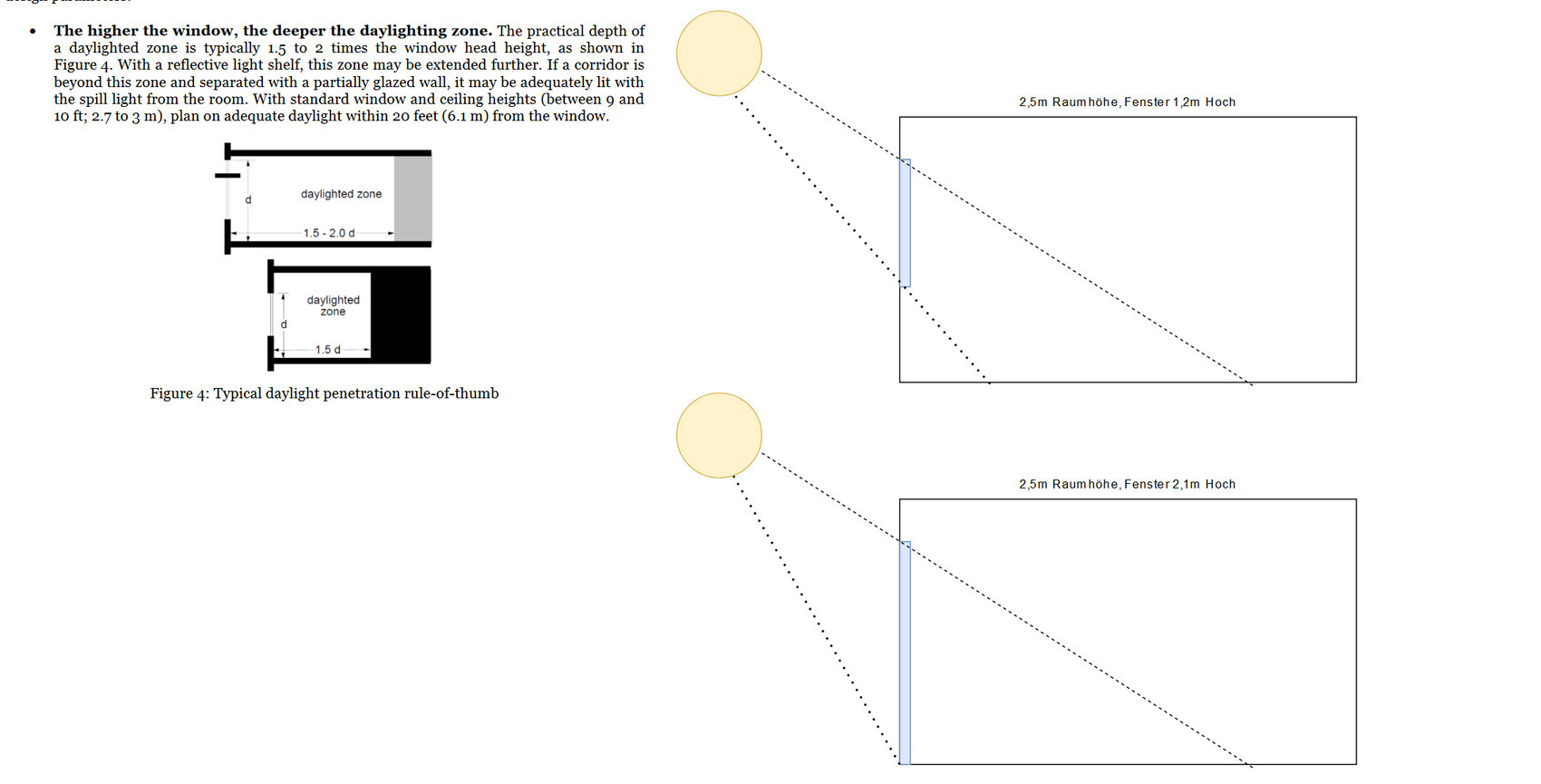
Out of pure curiosity, I researched a bit more and found a paper on daylighting published by the U.S. Department of Energy (search for "osti 1167562"). Here is an excerpt and a diagram I created showing how much daylight is lost with windows that are not floor-to-ceiling. Height is therefore more important than depth. However, please don’t underestimate that more light is lost through reflection from the floor with non-floor-to-ceiling windows than shown here. Still, the benefit of floor-to-ceiling windows seems relatively small, especially if you can alternatively go wider and taller.
P.S.: Yes, I know, this might be nerdy and I’m still not an expert on the topic (so please don’t take the diagram as absolute truth — it’s only an approximation). I just wanted to share this basic info in case someone else is thinking about it. That’s probably the programmer in me coming through 🙂 For myself, I’ve now confirmed that it’s not a big loss for us not to have floor-to-ceiling windows.
P.S.: Yes, I know, this might be nerdy and I’m still not an expert on the topic (so please don’t take the diagram as absolute truth — it’s only an approximation). I just wanted to share this basic info in case someone else is thinking about it. That’s probably the programmer in me coming through 🙂 For myself, I’ve now confirmed that it’s not a big loss for us not to have floor-to-ceiling windows.

I’m not going to add a like here because, despite the otherwise commendable parts of the information provided, I’m cautious about encouraging the feeding of nerdy bystanders. If the foundation slab is positioned incorrectly, all the learned theoretical trivia won’t help.
Oh, programmer… then my explanations about the importance of clean code in house planning probably wouldn’t have been necessary after all ;-)
https://www.instagram.com/11antgmxde/
https://www.linkedin.com/company/bauen-jetzt/
roookeee schrieb:
That programmer side of me must be coming through
Oh, programmer… then my explanations about the importance of clean code in house planning probably wouldn’t have been necessary after all ;-)
https://www.instagram.com/11antgmxde/
https://www.linkedin.com/company/bauen-jetzt/
Similar topics