
Hello, I am currently wondering if our lighting is sufficient, or rather, I’m curious about what kind of lighting you have in your living room, whether hanging or standing.
Our open-plan living and dining area is about 35 square meters (375 square feet). On one side, there is a tunable white LED strip in a cove with 3600 lumens indirect light, and with an opal cover, it emits about 2800 lumens. Opposite that, we have spotlights illuminating the cabinets with a total of 2000 lumens. This forms the basic lighting. Do you think this is enough, or would it feel too dark? I specifically bought a floor lamp for the couch. Of course, there is also the lighting of the media wall.
Now I’m wondering whether to switch on the ceiling outlet above the sofa, but that would mean quite a lot of lamps.
How much light do you have around your sofa?
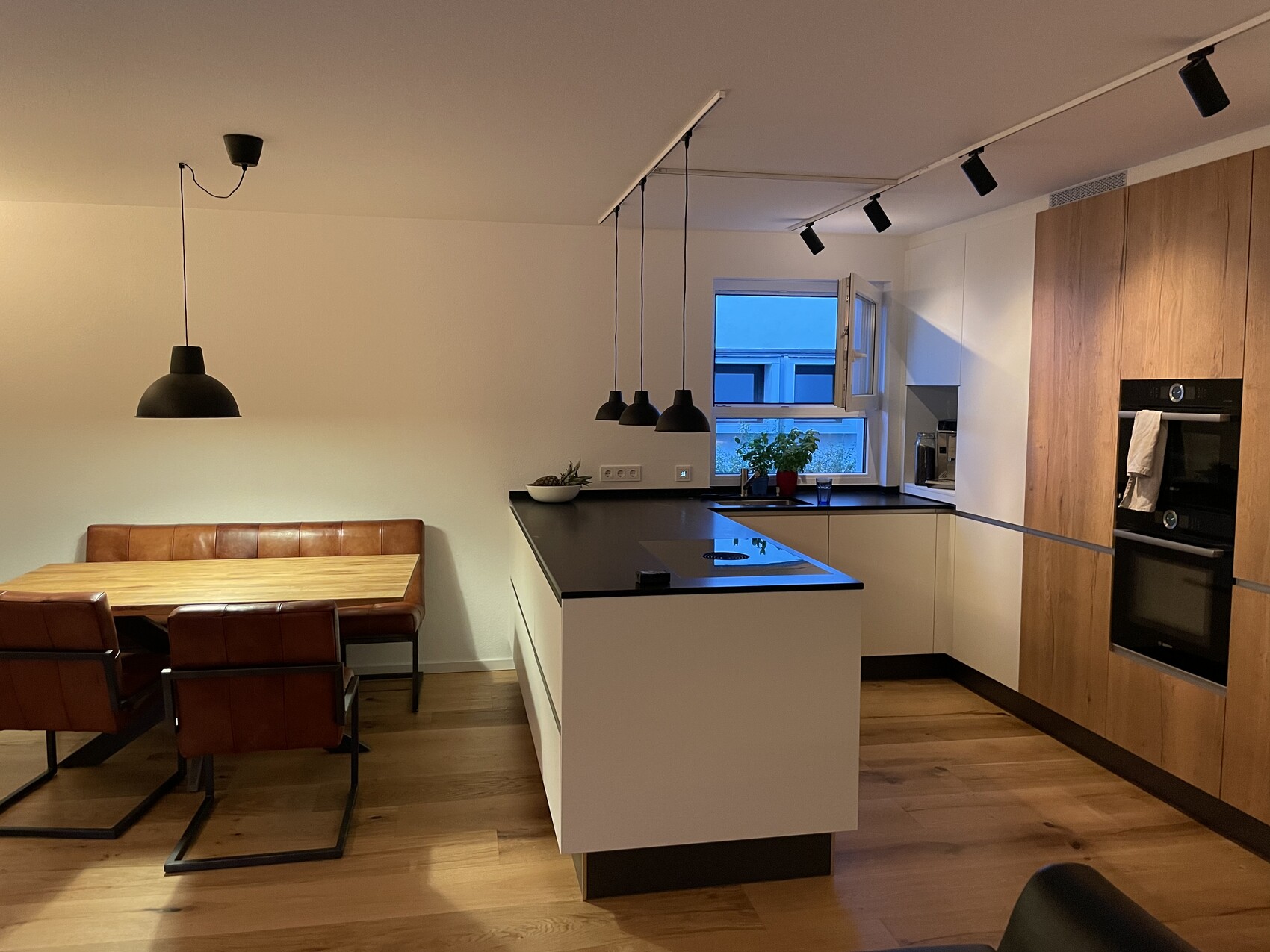
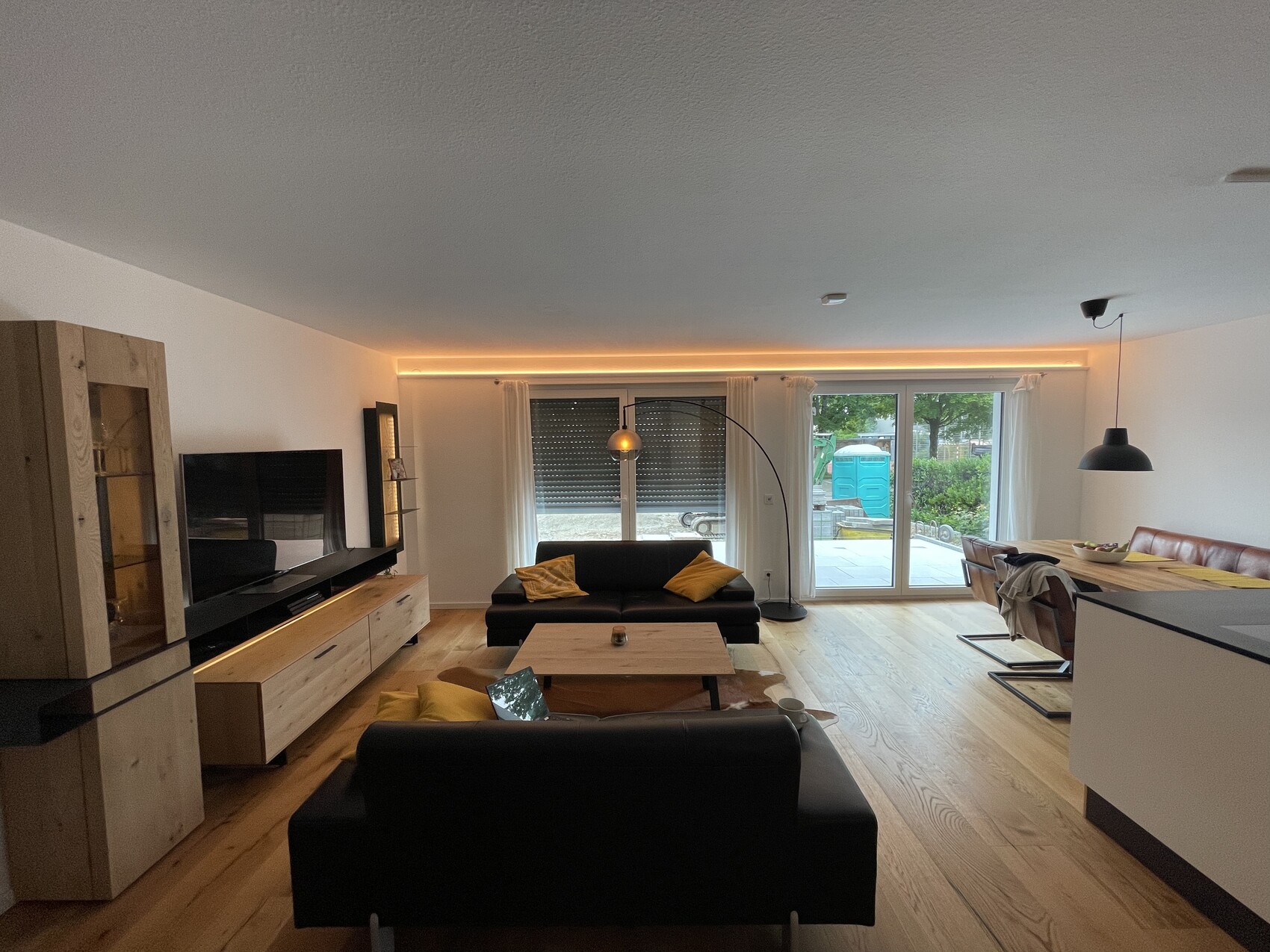
Our open-plan living and dining area is about 35 square meters (375 square feet). On one side, there is a tunable white LED strip in a cove with 3600 lumens indirect light, and with an opal cover, it emits about 2800 lumens. Opposite that, we have spotlights illuminating the cabinets with a total of 2000 lumens. This forms the basic lighting. Do you think this is enough, or would it feel too dark? I specifically bought a floor lamp for the couch. Of course, there is also the lighting of the media wall.
Now I’m wondering whether to switch on the ceiling outlet above the sofa, but that would mean quite a lot of lamps.
How much light do you have around your sofa?

We have chosen our lamps with E14/E27 sockets; the LED lights are available in different wattages and color temperatures, and they can also be dimmed in 3 stages. This allows us to switch between 100/50/10% lighting levels (without having to search for the phone), which is completely sufficient for us. The maximum output for an area of 55m² (about 590 sq ft) is approximately 7000 lumens.
H
hampshire5 Jul 2021 07:43The point I want to emphasize is this: If you use the lumen rating as a rough guide when choosing lighting, you still don’t know how bright different areas of the room will be. Disappointments are almost inevitable.
Lumens = luminous flux, the total amount of light emitted.
Candela / Lux = luminous intensity, the brightness of the light (from the source or reflected off surfaces).
Watt measures energy consumption, allowing efficiency to be calculated – lumens per watt. With incandescent bulbs, efficiency differences were minimal, so wattage directly corresponded to luminous flux and, since the bulb emits light in all directions, also to brightness relative to the light source. That was nice and simple!
The relationship:
When light from a source is focused, the luminous flux remains constant.
Luminous intensity increases as the illuminated area decreases.
Luminous intensity decreases with distance (light dispersion losses).
Here we are talking about living room lighting – let’s take the living room table and the question of a ceiling light above it. The lumen value of the fixture gains meaning through the beam angle (let’s put aside reflector characteristics and diffusers for simplicity). The technical diagram below of an Ansorg fixture (Coray) illustrates this well:
![Light distribution diagram with polar plots (MFL/WFL) and 3D beam distribution, I[0].](/attachments/63345/)
The double FWHM angle is roughly what is generally referred to as the beam angle. The upper fixture has a beam angle of 45°, the lower one 110°.
At a 2m (6.5 ft) distance from the ceiling light to the living room table, with the upper fixture (positioned directly above) and a luminous flux of 1000 lumens, the brightness measured on the table surface would be 1265 lux (candela) – which would be very glaring. With the lower fixture, brightness would be 332 lux (still quite bright).
So it’s not that simple. It makes sense to use dimmers and see firsthand what you like and don’t like, because there are many other parameters that a good lighting designer takes into account—and that not everyone wants to deal with.
Schimi1791 schrieb:Lumens are indeed an important measure for lighting. Understanding what they actually mean can be helpful. I’ll try to make it more tangible:
For traditional light sources, ‘lumens’ are always considered when assessing brightness. Ideally, for similar geometries.
Lumens = luminous flux, the total amount of light emitted.
Candela / Lux = luminous intensity, the brightness of the light (from the source or reflected off surfaces).
Watt measures energy consumption, allowing efficiency to be calculated – lumens per watt. With incandescent bulbs, efficiency differences were minimal, so wattage directly corresponded to luminous flux and, since the bulb emits light in all directions, also to brightness relative to the light source. That was nice and simple!
The relationship:
When light from a source is focused, the luminous flux remains constant.
Luminous intensity increases as the illuminated area decreases.
Luminous intensity decreases with distance (light dispersion losses).
Here we are talking about living room lighting – let’s take the living room table and the question of a ceiling light above it. The lumen value of the fixture gains meaning through the beam angle (let’s put aside reflector characteristics and diffusers for simplicity). The technical diagram below of an Ansorg fixture (Coray) illustrates this well:
The double FWHM angle is roughly what is generally referred to as the beam angle. The upper fixture has a beam angle of 45°, the lower one 110°.
At a 2m (6.5 ft) distance from the ceiling light to the living room table, with the upper fixture (positioned directly above) and a luminous flux of 1000 lumens, the brightness measured on the table surface would be 1265 lux (candela) – which would be very glaring. With the lower fixture, brightness would be 332 lux (still quite bright).
So it’s not that simple. It makes sense to use dimmers and see firsthand what you like and don’t like, because there are many other parameters that a good lighting designer takes into account—and that not everyone wants to deal with.
H
hampshire5 Jul 2021 07:45Nida35a schrieb:
We chose our lamps with E14/E27 sockets; the LED lights come in various power ratings and color temperatures, and they are also dimmable in 3 steps. This is a pragmatically flexible approach: adjusting brightness and color temperature settings on site according to preference.
 Schimi17915 Jul 2021 08:07
hampshire schrieb:
...
If you use the value given in "lumens" as a guideline when making your choice, you still don’t know how bright it will actually be in different parts of the room.
...The room’s furnishings definitely play an important role here – whether it’s bright or rather dark, smooth or rough surfaces, and so on.hampshire schrieb:
...
This is about living room lighting – let’s take the living room table and the question of a ceiling light above it.
...Here is another important point. Two identical light sources will look completely different depending on the surfaces the light hits. For example, a glossy table compared to a matte table.---
And finally: even if defined light sources are installed in a defined environment – a room – there can be two observers who judge the lighting differently. This already starts with color temperature, which hasn’t even been discussed yet 🙂
hampshire schrieb:
...
So it’s not that simple,
...Agreed 🙂N
NoggerLoger5 Jul 2021 09:29Fortunately, I was able to adjust the color temperature. My wife prefers a warm and cozy atmosphere. In our old one-room apartment, we had a ceiling spotlight that was never turned on because it was too cold and patchy. A floor lamp by the bed was enough for us. I will definitely check if the light is sufficient, but I don’t want to install more lamps. So far, it has always been bright enough for all tasks.
I also like the Medo 40 lamps, which we have in the hallway, bathroom, and guest toilet. I converted all of them to DALI with the Osram OTI driver, and now their dimming behavior is perfect without PWM. No flickering at all; they dim to 1% at night and up to 70% during the day. Unfortunately, they are not available as tunable white versions.
I also like the Medo 40 lamps, which we have in the hallway, bathroom, and guest toilet. I converted all of them to DALI with the Osram OTI driver, and now their dimming behavior is perfect without PWM. No flickering at all; they dim to 1% at night and up to 70% during the day. Unfortunately, they are not available as tunable white versions.
Similar topics