
Hello everyone,
I am currently planning a semi-detached house on a sloped site and have run into a major problem that is causing me a lot of frustration. Maybe someone here can help me understand it better.
Here are the key details:
My architect strictly refuses to enlarge the balcony, saying that this would exceed the maximum allowable living area. However, he does not explain in detail how this limit on the maximum living area is calculated. There seems to be an absolute limit that, according to him, must not be exceeded. I understand that the ground floor footprint is clearly restricted by the floor area ratio (97.65 m² (1051 sq ft)). But how is the maximum possible living area in the attic calculated? The eaves height, ridge height, and roof pitch naturally limit the usable space—but what is the basis for determining this maximum area? I haven’t received any convincing explanations from my architect on this.
I am currently quite at a loss and would appreciate any help to better understand this or any advice on how to proceed. Thank you very much in advance!
I am currently planning a semi-detached house on a sloped site and have run into a major problem that is causing me a lot of frustration. Maybe someone here can help me understand it better.
Here are the key details:
- Plot size: 217 m² (2337 sq ft), floor area ratio: 0.45 → maximum buildable footprint of 97.65 m² (1051 sq ft).
- No floor space index specified.
- 1 full storey allowed, with a gable roof at 35° pitch (eaves height max. 4.50 m (14.8 ft), ridge height max. 9.00 m (29.5 ft)).
- Currently planned living area: 131 m² (1410 sq ft) (ground floor and attic).
- Balcony: 7.5 m² (81 sq ft); I wanted to make it a bit larger.
My architect strictly refuses to enlarge the balcony, saying that this would exceed the maximum allowable living area. However, he does not explain in detail how this limit on the maximum living area is calculated. There seems to be an absolute limit that, according to him, must not be exceeded. I understand that the ground floor footprint is clearly restricted by the floor area ratio (97.65 m² (1051 sq ft)). But how is the maximum possible living area in the attic calculated? The eaves height, ridge height, and roof pitch naturally limit the usable space—but what is the basis for determining this maximum area? I haven’t received any convincing explanations from my architect on this.
I am currently quite at a loss and would appreciate any help to better understand this or any advice on how to proceed. Thank you very much in advance!
B
baulaie8911 Jan 2025 19:36I spoke with the architect again. He said that the maximum allowed exceedance of the floor area ratio has been fully used, which is why we cannot make our balcony any wider.
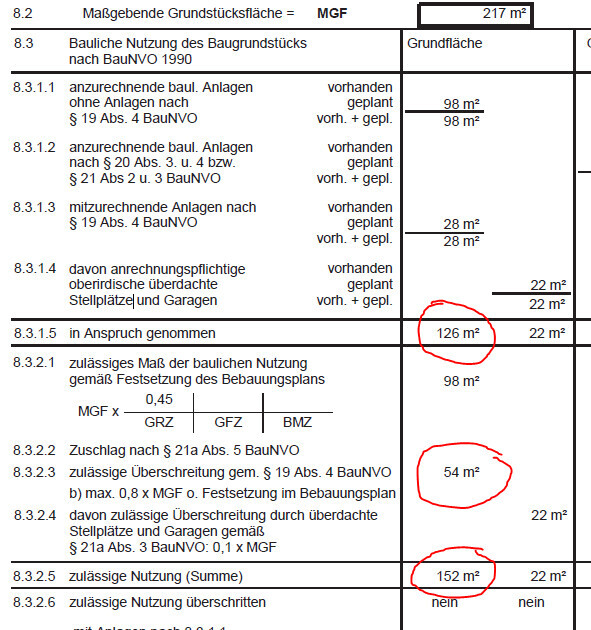
However, when I look at the calculations in the site plan, I see that the floor area ratio for residential areas is fully used, but not for accessory structures (54 m² (581 square feet)).
I just don’t understand. What my architect says and what is on paper do not match.
Here is the representation of the credited and allowed floor areas.
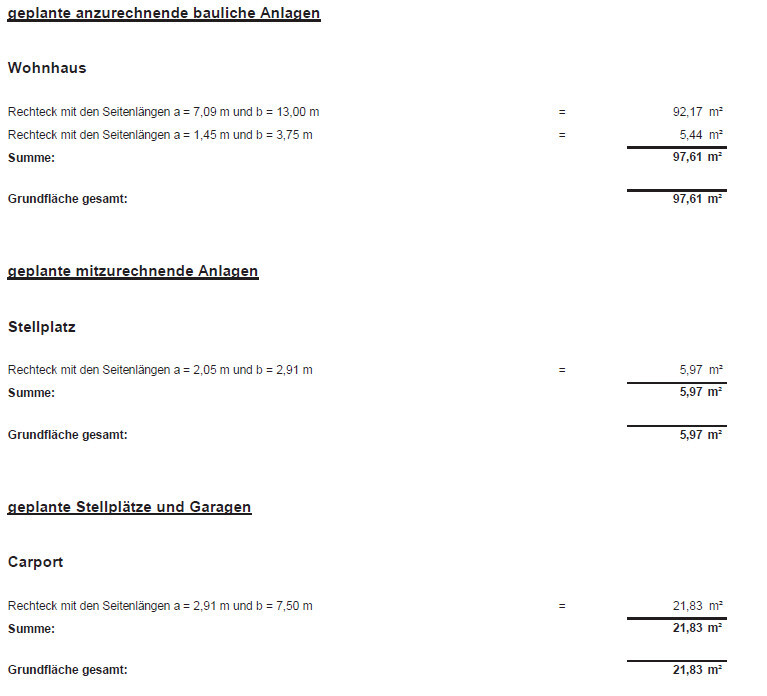
And here is the summary of that. The balcony is counted as part of the dwelling (1.45 m x 3.75 m (4.8 ft x 12.3 ft)). Why not as an accessory structure?
I’m at a loss 🙂
Can someone please clarify this for me? I hope to find out that I’m just missing something and that my architect did everything correctly.
It would be unfortunate if there was an option we could use but miss due to a mistake.
However, when I look at the calculations in the site plan, I see that the floor area ratio for residential areas is fully used, but not for accessory structures (54 m² (581 square feet)).
I just don’t understand. What my architect says and what is on paper do not match.
Here is the representation of the credited and allowed floor areas.
And here is the summary of that. The balcony is counted as part of the dwelling (1.45 m x 3.75 m (4.8 ft x 12.3 ft)). Why not as an accessory structure?
I’m at a loss 🙂
Can someone please clarify this for me? I hope to find out that I’m just missing something and that my architect did everything correctly.
It would be unfortunate if there was an option we could use but miss due to a mistake.
I don’t think you can draw any conclusions based solely on this adjusted calculation. There is clearly no site plan provided to properly assess the balcony or to verify the other figures. Perhaps I am just lacking the patience to carefully review the legal regulations in order to apply them to a design that doesn’t exist.
Maybe my assumption helps: the balcony simply maxes out or even exceeds the official floor area ratio. The second floor area ratio, which applies to additional structures, or the permitted exceedance, cannot be applied here because the balcony is part of the house and not related to driveways, garages, or auxiliary buildings.
Maybe my assumption helps: the balcony simply maxes out or even exceeds the official floor area ratio. The second floor area ratio, which applies to additional structures, or the permitted exceedance, cannot be applied here because the balcony is part of the house and not related to driveways, garages, or auxiliary buildings.
B
baulaie8911 Jan 2025 22:50ypg schrieb:
I don't think you can draw any conclusions based solely on the calculation provided here. The site plan is clearly missing, which is necessary to evaluate the balcony or to make sense of the other figures at all. Maybe I just lack the patience to thoroughly review the legal paragraphs and apply them without an existing plan.
Perhaps my assumption helps: the balcony simply maximizes or even exceeds the official floor area ratio.
The second floor area ratio, which is the additional allowance for auxiliary structures, cannot be applied because the balcony belongs to the house and not to paths, garages, or auxiliary buildings.Thanks. Does this help? 🙂 This is the ground floor.
Here is the upper floor
7.09 x 13 = 92.17
92.17 + 7.5 = 99.67
Then there is the corner of the upper balcony that extends over the lower balcony and contributes to the sealing area
approx. 1.20 x 1.45 = 1.74
99.67 + 1.74 = 101.41
But I am not an architect. Still, I am almost certain that both balcony elements are included 1:1 in the floor area ratio calculation. (For living space calculations, however, they are only counted at 25%.)
92.17 + 7.5 = 99.67
Then there is the corner of the upper balcony that extends over the lower balcony and contributes to the sealing area
approx. 1.20 x 1.45 = 1.74
99.67 + 1.74 = 101.41
But I am not an architect. Still, I am almost certain that both balcony elements are included 1:1 in the floor area ratio calculation. (For living space calculations, however, they are only counted at 25%.)
B
baulaie8911 Jan 2025 23:18ypg schrieb:
7.09 x 13 = 92.17
92.17 + 7.5 = 99.67
Then there is the one corner of the upper balcony that extends over the lower balcony and contributes to the impermeabilization,
approx. 1.20 x 1.45 = 1.74
99.67 + 1.74 = 101.41
But I’m not an architect. Still, I am almost certain that both balcony elements are counted 1:1 in the floor area ratio calculation. (For living area calculation, however, they are only counted at 25%)
Thanks. According to the architect, the balcony is calculated at 50%. Is it true that balconies are included in the “counted building structures,” that is, as part of the main building, and not as ancillary structures?
Or rather, when is a balcony considered part of the main structure versus an ancillary structure?
He also mentioned that he had to remove the roof cover (see example photo below) of the outdoor entrance area because it was no longer permitted due to the floor area ratio restrictions.
ypg schrieb:
I find the design quite tidy and nice. But what I don’t understand: where will the technical facilities go? Or are you planning a basement? Yes, there is also a basement. The house is built on a slope, so the basement opens out to the garden at the front 🙂
Similar topics