
Hello everyone,
Our heating system consumed about 8,700 kWh of natural gas between 12/16 and 06/17, even though the house is still being renovated and unoccupied. All radiators were set to frost protection only, and no domestic hot water was used.
The system was installed in 12/15 by the previous owners and mainly consists of:
This summer, I noticed that the pipe from the solar collector (supply line) was only hot up to the pump, while the return line was almost cold. From this, I concluded that the pump was not running. At the same time, the controller showed 999°C (1,830°F) for the temperature sensor mounted at the top of the collector, which the technician said is the maximum display value indicating no plausible reading.
Testing the temperature sensor (a PT1000) was successful, so the technician concluded that the controller itself must be defective (he believed the pump was still operational).
So, a new controller was ordered, which I am still waiting for as of today, but that’s another story...
Now, with the cold season approaching, we have temporarily installed some radiators to heat the construction site a little and, most importantly, to ensure frost protection.
I was able to reduce the natural gas consumption by lowering the target temperature for domestic hot water to 10°C (50°F); however, I would say the consumption is still quite high (since Saturday, so in 4 days, about 30 m³ [1,059 ft³]... :O).
Is it possible that due to the defective controller, the 800-liter (210-gallon) water volume of the solar thermal system is being kept warm using natural gas, and usually the ESR 31, depending on whether heat is available from the roof or not, activates or deactivates a heat exchanger between the domestic hot water tank and the solar thermal water system, which in our case might currently always be open or something like that?
Maybe someone, even as a layperson, can explain how a combined stratified storage tank works or is constructed?
Many thanks in advance!
Best regards
PS: The heating technician is hard to reach; unfortunately, I have to work with him since this is obviously a warranty case. Once this issue is resolved, he definitely won’t touch our heating system again… -.-
Our heating system consumed about 8,700 kWh of natural gas between 12/16 and 06/17, even though the house is still being renovated and unoccupied. All radiators were set to frost protection only, and no domestic hot water was used.
The system was installed in 12/15 by the previous owners and mainly consists of:
- Viessmann Vitodens 200 gas condensing wall unit 19 kW
- Austria Email KWS 800 combined stratified storage tank
- Flat plate solar collectors 9.36 m² (100.8 ft²)
- ESR 31 solar controller
- Delphis solar station FV 70 (with Grundfos circulation pump on the supply side)
This summer, I noticed that the pipe from the solar collector (supply line) was only hot up to the pump, while the return line was almost cold. From this, I concluded that the pump was not running. At the same time, the controller showed 999°C (1,830°F) for the temperature sensor mounted at the top of the collector, which the technician said is the maximum display value indicating no plausible reading.
Testing the temperature sensor (a PT1000) was successful, so the technician concluded that the controller itself must be defective (he believed the pump was still operational).
So, a new controller was ordered, which I am still waiting for as of today, but that’s another story...
Now, with the cold season approaching, we have temporarily installed some radiators to heat the construction site a little and, most importantly, to ensure frost protection.
I was able to reduce the natural gas consumption by lowering the target temperature for domestic hot water to 10°C (50°F); however, I would say the consumption is still quite high (since Saturday, so in 4 days, about 30 m³ [1,059 ft³]... :O).
Is it possible that due to the defective controller, the 800-liter (210-gallon) water volume of the solar thermal system is being kept warm using natural gas, and usually the ESR 31, depending on whether heat is available from the roof or not, activates or deactivates a heat exchanger between the domestic hot water tank and the solar thermal water system, which in our case might currently always be open or something like that?
Maybe someone, even as a layperson, can explain how a combined stratified storage tank works or is constructed?
Many thanks in advance!
Best regards
PS: The heating technician is hard to reach; unfortunately, I have to work with him since this is obviously a warranty case. Once this issue is resolved, he definitely won’t touch our heating system again… -.-
First of all, thank you for your explanations!
However, you are referring to a properly functioning system, right?
If, as in my case, the controller mistakenly "thinks" that heat is available from the roof and activates the circulation pump accordingly, the cold water coming from the generator is then heated using gas, correct?!
I assume that a combined stratified storage tank consists of two tanks: one large tank (in my case probably 800 liters (210 gallons)) to store the hot water from the solar thermal system and a smaller domestic hot water tank (probably around 150-200 liters (40-53 gallons)). Now I am wondering how it is prevented, during periods without significant solar radiation, that the large tank is kept warm by the heating system? There is presumably a heat exchanger controlled by the solar thermal system controller to prevent exactly this, right?
Thanks!
Regards
However, you are referring to a properly functioning system, right?
If, as in my case, the controller mistakenly "thinks" that heat is available from the roof and activates the circulation pump accordingly, the cold water coming from the generator is then heated using gas, correct?!
I assume that a combined stratified storage tank consists of two tanks: one large tank (in my case probably 800 liters (210 gallons)) to store the hot water from the solar thermal system and a smaller domestic hot water tank (probably around 150-200 liters (40-53 gallons)). Now I am wondering how it is prevented, during periods without significant solar radiation, that the large tank is kept warm by the heating system? There is presumably a heat exchanger controlled by the solar thermal system controller to prevent exactly this, right?
Thanks!
Regards

No, you have a standard stratified storage tank with a large tank of 800 liters (210 gallons), not a smaller additional one inside.
See:
The combined stratified storage tank KWS is a buffer tank with a layering system for the energy-efficient stratification of heating water and an integrated heat exchanger for the direct heating of domestic hot water using a flow-through system. Depending on the model, the tank is equipped with one (model KWS) or two (model KWS R2) heat exchangers for connection to one or two additional heat sources, such as a solar system.
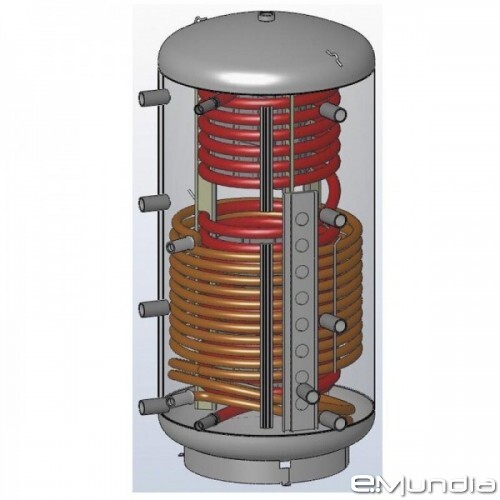
See:
The combined stratified storage tank KWS is a buffer tank with a layering system for the energy-efficient stratification of heating water and an integrated heat exchanger for the direct heating of domestic hot water using a flow-through system. Depending on the model, the tank is equipped with one (model KWS) or two (model KWS R2) heat exchangers for connection to one or two additional heat sources, such as a solar system.

Hello,
Your approximately 30 m³ (39 yd³) over four days corresponds to about 7 liters (1.85 gallons) of heating oil per day. Whether this is a lot or a little depends on the building’s energy demand.
The pump in a solar heating system is installed in the return line; if installed in the supply line, the high temperatures in summer could damage it.
Regarding the 999 reading on the controller, I would suspect the sensor. As the technician already said, "if nothing plausible is measured" = sensor defect.
PT 1000 = at 0°C (32°F) 1000 ohms, at +10°C (50°F) about 1040 ohms, at -10°C (14°F) 960 ohms.
As an electrical engineer, you can probably check that yourself.
Olli
Your approximately 30 m³ (39 yd³) over four days corresponds to about 7 liters (1.85 gallons) of heating oil per day. Whether this is a lot or a little depends on the building’s energy demand.
The pump in a solar heating system is installed in the return line; if installed in the supply line, the high temperatures in summer could damage it.
Regarding the 999 reading on the controller, I would suspect the sensor. As the technician already said, "if nothing plausible is measured" = sensor defect.
PT 1000 = at 0°C (32°F) 1000 ohms, at +10°C (50°F) about 1040 ohms, at -10°C (14°F) 960 ohms.
As an electrical engineer, you can probably check that yourself.
Olli
wrobel schrieb:
Your roughly 30 m3 over four days corresponds to about 7 liters of heating oil per day. Whether that is a lot or a little depends on the building’s energy demand. Well, there are only 7 radiators connected on the ground floor, and these are set to frost protection mode because the site is still under construction and unoccupied. However, the newly refilled domestic hot water had to be heated first, but I will definitely monitor the consumption.
[QUOTE=wrobel]The pump in a solar thermal system is installed on the return line; installing it on the supply line would damage it due to the high temperatures in summer.[/QUOTE]
True, thanks for the hint! I thought it was the supply line because it’s the right pipe, but for idiots the mixing valves have red and blue colors... -.- (so the return is on the right and the blue side has the pump)
[QUOTE=wrobel]Regarding the 999 error on the controller, I would suspect the sensor. As the technician already said, “if nothing is measured plausibly” = defective sensor.
PT 1000 = 1000 Ohms at 0°C (32°F), approximately 1040 Ohms at +10°C (50°F), and 960 Ohms at -10°C (14°F).
As an electrical technician, you can surely check that yourself.[/QUOTE]
Both sensors (sensor 1 is on the roof and sensor 2 is in the storage tank) are fine. Of course, I measured them myself again!
Yesterday the new control unit finally arrived, I installed and connected it immediately, and voilà: sensors 1 and 2 now show plausible values! What I don’t understand is why I cannot manually switch the pump on via the controller?! According to the ESR 31 manual, this should be possible...
One more question: Can someone tell me what these “mini junction boxes” are called, where you can accommodate a terminal block with 2+2 wires connected? Unfortunately, the heating technician only installed one such “box” and the remaining connection points are flying terminals… :O
As an electrician, this obviously bothers me a lot!
ShawN46 schrieb:
Yesterday the new controller finally arrived, was installed and connected right away, and voilà: Sensors 1 and 2 now show plausible readings! What I don’t understand is why I can’t manually run the pump through the controller?! (According to the ESR 31 manual, this should be possible...) How can I check if the pump is running? According to the ESR 31, the pump is being activated, but I can neither hear nor feel anything at the pump?!
However, I noticed that our "normal" circulation pump in the heating circuit (Wilo) runs almost silently and vibration-free as well, but conveniently has a display showing the current pumping performance! So is it really possible that the pump is running without any sound or vibration? (Ear DIRECTLY at the pump...!) The pump in question is a Grundfos Solar PM2 15-105.
Thanks in advance!
K
kkk27272930 Jan 2018 13:50Clamp meter?
Could the circulation possibly also occur by gravity?
Could the circulation possibly also occur by gravity?
Similar topics