
ᐅ How to Integrate a Utility Room in the Basement Effectively Within the Thermal Envelope?
Created on: 2 May 2020 13:59
V
voicepoint
Hello everyone,
We are currently in the planning phase.
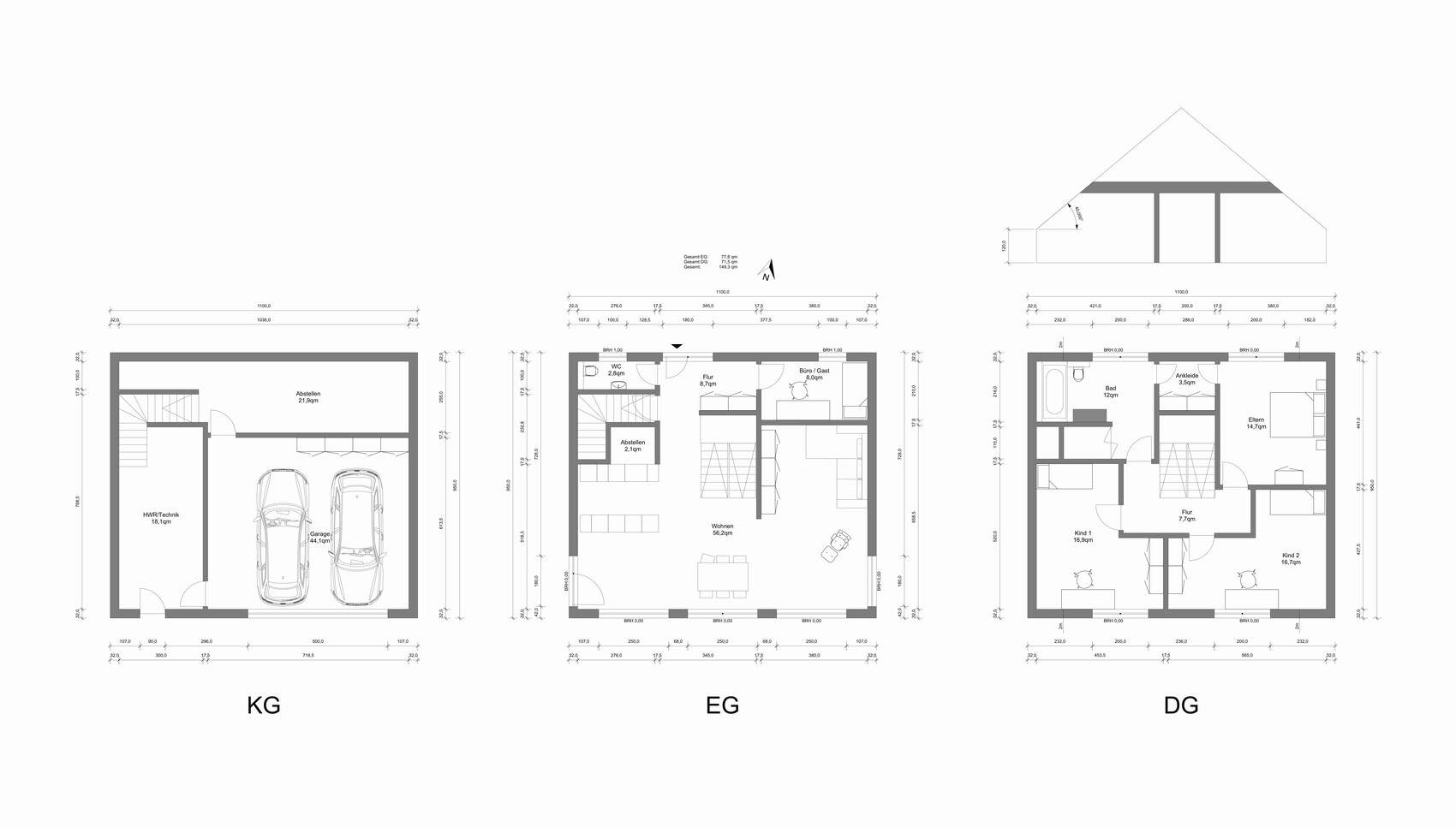
We are planning to build a single-family house with a basement. The ground floor (GF) and upper floor (UF) will be constructed using wood frame construction, while the basement will be either masonry or precast concrete (partially underground due to the sloped site).
The GF and UF will meet the KFW 40 standard as built. Accordingly, a (partial) inclusion of the basement in the thermal envelope would probably make sense. Depending on the decision regarding the 52 GW ceiling, it might also become a 40+ house (a ventilation system will be installed in any case).
The basement is planned to have a utility/technical room, and the rest of the basement will be used as a garage. The heating system will be installed in the utility room, so this room must be included in the building’s thermal envelope.
Currently, I see five possible options to implement this (options 1-3 could be simplified to meet KFW 55):
1) Include only the utility room in the thermal envelope
2) Include the entire basement in the thermal envelope (garage door?!)
3) Create a small, separate room in the basement for the heating system, leaving the rest outside the thermal envelope
4) Skip all measures and not use the KFW loans and funding
5) Extend the ground floor with a technical room exclusively for the heating system (electricity, ventilation, etc. would remain in the basement)
All options obviously differ in costs but also allow for higher levels of funding.
So far, we have been offered a 20cm (8 inch) thick slab in C20/25 concrete, masonry or concrete for the basement floor, external basement wall insulation of 120mm (5 inches), and a screed with 50mm (2 inches) insulation in the utility room. It was noted that additional insulation might be necessary (perimeter insulation).
Which approach would you choose, or what would you consider most sensible? Is there a better solution we might have overlooked?
Thank you very much and best regards,
Noel
We are currently in the planning phase.
We are planning to build a single-family house with a basement. The ground floor (GF) and upper floor (UF) will be constructed using wood frame construction, while the basement will be either masonry or precast concrete (partially underground due to the sloped site).
The GF and UF will meet the KFW 40 standard as built. Accordingly, a (partial) inclusion of the basement in the thermal envelope would probably make sense. Depending on the decision regarding the 52 GW ceiling, it might also become a 40+ house (a ventilation system will be installed in any case).
The basement is planned to have a utility/technical room, and the rest of the basement will be used as a garage. The heating system will be installed in the utility room, so this room must be included in the building’s thermal envelope.
Currently, I see five possible options to implement this (options 1-3 could be simplified to meet KFW 55):
1) Include only the utility room in the thermal envelope
2) Include the entire basement in the thermal envelope (garage door?!)
3) Create a small, separate room in the basement for the heating system, leaving the rest outside the thermal envelope
4) Skip all measures and not use the KFW loans and funding
5) Extend the ground floor with a technical room exclusively for the heating system (electricity, ventilation, etc. would remain in the basement)
All options obviously differ in costs but also allow for higher levels of funding.
So far, we have been offered a 20cm (8 inch) thick slab in C20/25 concrete, masonry or concrete for the basement floor, external basement wall insulation of 120mm (5 inches), and a screed with 50mm (2 inches) insulation in the utility room. It was noted that additional insulation might be necessary (perimeter insulation).
Which approach would you choose, or what would you consider most sensible? Is there a better solution we might have overlooked?
Thank you very much and best regards,
Noel
V
voicepoint2 May 2020 20:02Thank you hanse987 for the link, I was not familiar with that post yet.
This all seems very complex, especially since subsidies always come with additional costs. It’s difficult for me to find a financially worthwhile approach upfront.
If the extra insulation in our case would cost a maximum of €6,000 (about $6,600), the higher standard could basically be achieved at no additional cost due to the increased subsidy.
The example mentioned is always helpful to better assess something like this. So please, feel free to share more!
This all seems very complex, especially since subsidies always come with additional costs. It’s difficult for me to find a financially worthwhile approach upfront.
If the extra insulation in our case would cost a maximum of €6,000 (about $6,600), the higher standard could basically be achieved at no additional cost due to the increased subsidy.
The example mentioned is always helpful to better assess something like this. So please, feel free to share more!
Have you ever considered that all those points are complete nonsense...?
The Energy Saving Ordinance 2014/16 provides clarification on this.
The building envelope refers to the entire building; even according to DIN EN 18599, nothing can be excluded because the design itself does not allow for the creation of an additional zone.
The KfW assumes compliance with the Energy Saving Ordinance, so this has nothing to do with the KfW.
I already feel sorry for the colleague who has to do the calculations...
The Energy Saving Ordinance 2014/16 provides clarification on this.
The building envelope refers to the entire building; even according to DIN EN 18599, nothing can be excluded because the design itself does not allow for the creation of an additional zone.
The KfW assumes compliance with the Energy Saving Ordinance, so this has nothing to do with the KfW.
I already feel sorry for the colleague who has to do the calculations...
K
knalltüte4 May 2020 22:58... since I was quoted: We expect to receive the plans and detailed information on how this can be implemented within the next few weeks (hopefully finally). I will gladly share this information then.
There are only two options. Either the external building is insulated to a very high standard (like the rest of the house) and counts towards the thermal envelope despite the distance, or there are exceptions?
There are only two options. Either the external building is insulated to a very high standard (like the rest of the house) and counts towards the thermal envelope despite the distance, or there are exceptions?
@Pinky0301
For existing buildings, there are no exceptions regarding the building envelope. The KfW strictly applies the Energy Saving Ordinance here.
For KfW55 in existing buildings, thermal bridges must also be documented.
@superzapp
If there is a separate external building, it is considered an independent building and is therefore not included. A combined heat and power unit is often located in an external building, which simply does not count as a residential building.
---
However, the floor plan shows a basement staircase, so an external technical room is of limited use, as the basement ceiling cannot be continuously insulated or sealed.
For existing buildings, there are no exceptions regarding the building envelope. The KfW strictly applies the Energy Saving Ordinance here.
For KfW55 in existing buildings, thermal bridges must also be documented.
@superzapp
If there is a separate external building, it is considered an independent building and is therefore not included. A combined heat and power unit is often located in an external building, which simply does not count as a residential building.
---
However, the floor plan shows a basement staircase, so an external technical room is of limited use, as the basement ceiling cannot be continuously insulated or sealed.

Similar topics