
ᐅ House without a garage and basement? Converting the attic? Vent pipe?
Created on: 24 Jun 2015 19:59
G
Grym
We have been considering the following:
If we want to build without a basement and without a garage, preferably with just a carport, does it make sense – and what would the cost difference be – to convert the attic instead?
We plan to build a structure approximately 10.50 meters x 8.50 meters (34.4 ft x 27.9 ft) along the street. On top, a gable roof with a 45-degree pitch (alternatively: only 40 degrees), and the knee wall on the first floor should be about 1.40 meters (4.6 ft) high. At the highest point, the interior height would probably be around 2.80 meters (9.2 ft).
Instead of insulating the top floor ceiling, we would insulate the roof. For cost reasons, the top floor ceiling would remain a wooden beam construction (I assume?). The attic would be an unheated secondary space but equipped with at least one ventilation opening.
The staircase up to the attic should be reasonably comfortable. What is the cost of a standard residential staircase? We might simply extend the living area staircase to the attic if the additional cost is not too high.
In the medium term, we want a wood-and-metal design carport for two cars next to the house, with bike racks in the rear area (which in my opinion looks much better than a concrete and steel garage box). The bikes would be weather-protected but quickly accessible. Necessary garden tools will be stored in the utility room; unnecessary items, seasonal goods, heirlooms, etc., will go into the attic (within the thermal envelope and ventilated by a controlled residential ventilation system). Likewise, winter storage of the garden chairs would be in the attic; in summer, they will remain outside permanently.
It is also unclear whether and what kind of equipment could be located in the utility room (ground or air source heat pump, controlled residential ventilation system, hot water hygiene storage tank, etc.).
Another question is what the cost impact would be for this kind of attic conversion (planned from the start and carried out by the general contractor) compared to the standard option (insulating the top floor ceiling, insulated pull-down stairs to the unheated attic space).
If we want to build without a basement and without a garage, preferably with just a carport, does it make sense – and what would the cost difference be – to convert the attic instead?
We plan to build a structure approximately 10.50 meters x 8.50 meters (34.4 ft x 27.9 ft) along the street. On top, a gable roof with a 45-degree pitch (alternatively: only 40 degrees), and the knee wall on the first floor should be about 1.40 meters (4.6 ft) high. At the highest point, the interior height would probably be around 2.80 meters (9.2 ft).
Instead of insulating the top floor ceiling, we would insulate the roof. For cost reasons, the top floor ceiling would remain a wooden beam construction (I assume?). The attic would be an unheated secondary space but equipped with at least one ventilation opening.
The staircase up to the attic should be reasonably comfortable. What is the cost of a standard residential staircase? We might simply extend the living area staircase to the attic if the additional cost is not too high.
In the medium term, we want a wood-and-metal design carport for two cars next to the house, with bike racks in the rear area (which in my opinion looks much better than a concrete and steel garage box). The bikes would be weather-protected but quickly accessible. Necessary garden tools will be stored in the utility room; unnecessary items, seasonal goods, heirlooms, etc., will go into the attic (within the thermal envelope and ventilated by a controlled residential ventilation system). Likewise, winter storage of the garden chairs would be in the attic; in summer, they will remain outside permanently.
It is also unclear whether and what kind of equipment could be located in the utility room (ground or air source heat pump, controlled residential ventilation system, hot water hygiene storage tank, etc.).
Another question is what the cost impact would be for this kind of attic conversion (planned from the start and carried out by the general contractor) compared to the standard option (insulating the top floor ceiling, insulated pull-down stairs to the unheated attic space).

Space-saving layout of 9.86 x 8.86 meters (32.4 x 29.1 feet) minimizing hallway area:
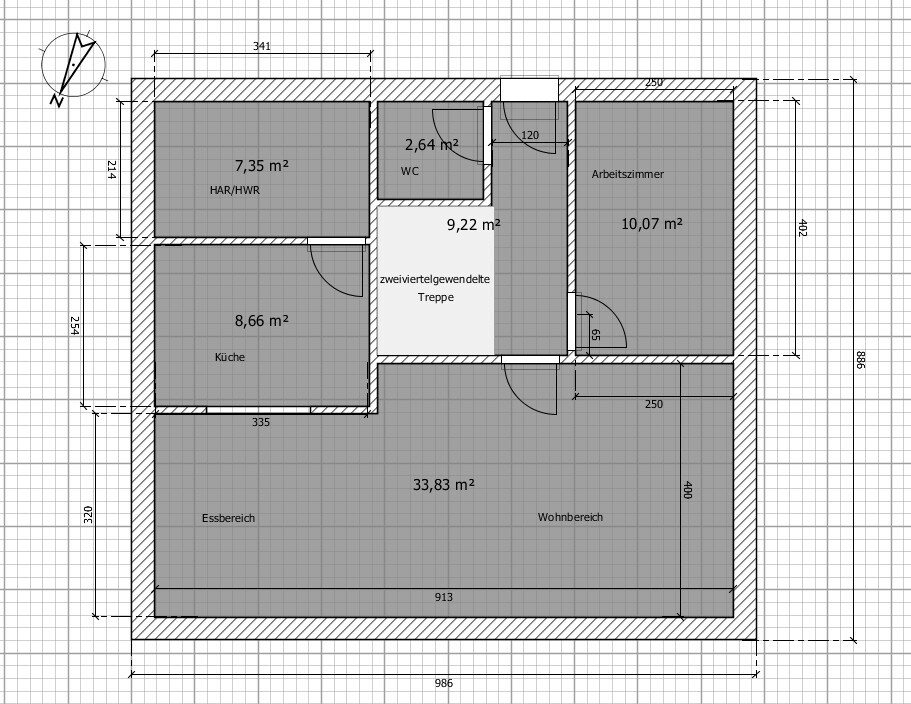
I will still figure out a place for the wardrobe (or the builder’s planner will), but roughly speaking, I think this floor plan makes very efficient use of the space. In the end, it should be no more than 130-135 square meters (1,400-1,450 square feet) of living space over two levels, yet it includes a 10 square meter (108 square feet) study. The dining area is adequately sized with a width of 3.20 meters (10.5 feet), and the living/dining area without the kitchen is about 34 square meters (366 square feet), so it won’t feel small. The kitchen should work well at nearly 9 square meters (97 square feet), and the utility room (HAR) is almost 7.5 square meters (81 square feet). Details like the wardrobe, windows, and upper floor are still missing. The upper floor should hopefully not be too complicated, as it only needs to accommodate two children’s rooms, one master bedroom, and one bathroom.
The wardrobe could be created by recessing the WC toward the utility room or by adding a niche toward the study.
P.S.: Ignore the orientation; it’s exactly the wrong way around (north = south).
I will still figure out a place for the wardrobe (or the builder’s planner will), but roughly speaking, I think this floor plan makes very efficient use of the space. In the end, it should be no more than 130-135 square meters (1,400-1,450 square feet) of living space over two levels, yet it includes a 10 square meter (108 square feet) study. The dining area is adequately sized with a width of 3.20 meters (10.5 feet), and the living/dining area without the kitchen is about 34 square meters (366 square feet), so it won’t feel small. The kitchen should work well at nearly 9 square meters (97 square feet), and the utility room (HAR) is almost 7.5 square meters (81 square feet). Details like the wardrobe, windows, and upper floor are still missing. The upper floor should hopefully not be too complicated, as it only needs to accommodate two children’s rooms, one master bedroom, and one bathroom.
The wardrobe could be created by recessing the WC toward the utility room or by adding a niche toward the study.
P.S.: Ignore the orientation; it’s exactly the wrong way around (north = south).
Similar topics