
ᐅ House without a garage and basement? Converting the attic? Vent pipe?
Created on: 24 Jun 2015 19:59
G
Grym
We have been considering the following:
If we want to build without a basement and without a garage, preferably with just a carport, does it make sense – and what would the cost difference be – to convert the attic instead?
We plan to build a structure approximately 10.50 meters x 8.50 meters (34.4 ft x 27.9 ft) along the street. On top, a gable roof with a 45-degree pitch (alternatively: only 40 degrees), and the knee wall on the first floor should be about 1.40 meters (4.6 ft) high. At the highest point, the interior height would probably be around 2.80 meters (9.2 ft).
Instead of insulating the top floor ceiling, we would insulate the roof. For cost reasons, the top floor ceiling would remain a wooden beam construction (I assume?). The attic would be an unheated secondary space but equipped with at least one ventilation opening.
The staircase up to the attic should be reasonably comfortable. What is the cost of a standard residential staircase? We might simply extend the living area staircase to the attic if the additional cost is not too high.
In the medium term, we want a wood-and-metal design carport for two cars next to the house, with bike racks in the rear area (which in my opinion looks much better than a concrete and steel garage box). The bikes would be weather-protected but quickly accessible. Necessary garden tools will be stored in the utility room; unnecessary items, seasonal goods, heirlooms, etc., will go into the attic (within the thermal envelope and ventilated by a controlled residential ventilation system). Likewise, winter storage of the garden chairs would be in the attic; in summer, they will remain outside permanently.
It is also unclear whether and what kind of equipment could be located in the utility room (ground or air source heat pump, controlled residential ventilation system, hot water hygiene storage tank, etc.).
Another question is what the cost impact would be for this kind of attic conversion (planned from the start and carried out by the general contractor) compared to the standard option (insulating the top floor ceiling, insulated pull-down stairs to the unheated attic space).
If we want to build without a basement and without a garage, preferably with just a carport, does it make sense – and what would the cost difference be – to convert the attic instead?
We plan to build a structure approximately 10.50 meters x 8.50 meters (34.4 ft x 27.9 ft) along the street. On top, a gable roof with a 45-degree pitch (alternatively: only 40 degrees), and the knee wall on the first floor should be about 1.40 meters (4.6 ft) high. At the highest point, the interior height would probably be around 2.80 meters (9.2 ft).
Instead of insulating the top floor ceiling, we would insulate the roof. For cost reasons, the top floor ceiling would remain a wooden beam construction (I assume?). The attic would be an unheated secondary space but equipped with at least one ventilation opening.
The staircase up to the attic should be reasonably comfortable. What is the cost of a standard residential staircase? We might simply extend the living area staircase to the attic if the additional cost is not too high.
In the medium term, we want a wood-and-metal design carport for two cars next to the house, with bike racks in the rear area (which in my opinion looks much better than a concrete and steel garage box). The bikes would be weather-protected but quickly accessible. Necessary garden tools will be stored in the utility room; unnecessary items, seasonal goods, heirlooms, etc., will go into the attic (within the thermal envelope and ventilated by a controlled residential ventilation system). Likewise, winter storage of the garden chairs would be in the attic; in summer, they will remain outside permanently.
It is also unclear whether and what kind of equipment could be located in the utility room (ground or air source heat pump, controlled residential ventilation system, hot water hygiene storage tank, etc.).
Another question is what the cost impact would be for this kind of attic conversion (planned from the start and carried out by the general contractor) compared to the standard option (insulating the top floor ceiling, insulated pull-down stairs to the unheated attic space).
Hmm, I’m not really sure either. Somehow, I don’t like these town villa block floor plans at all. Of course, that’s a matter of personal taste. But it seems like in the end, they are all built pretty much the same way. That’s why I suggest using an existing and functional modular house floor plan as a starting point instead of trying to create one yourself. Some points were mentioned that any reasonable architect would strongly emphasize. But in the end, the general contractor doesn’t really care what they put together for you. The main thing is that you’re happy and they get paid. Have you looked at any model homes? I think that gives a lot of useful insight!
Best regards
Best regards
It will no longer be an urban villa, but rather a wider house with a knee wall height between approximately 140 and 200 cm (55 and 79 inches) and a gable roof. Visually, something like a Kampa Oslo.
We are still visiting show homes, not only the show home park in Dresden, but also in Chemnitz, and in the coming weeks we will go to Leipzig and possibly Berlin as well.
We are still visiting show homes, not only the show home park in Dresden, but also in Chemnitz, and in the coming weeks we will go to Leipzig and possibly Berlin as well.

Why not just tidy up the upper floor? Only to make the two children’s bedrooms exactly the same size, you create three dead corners that are not beneficial for either the bedrooms or the hallway.
By the way, the hallway on the ground floor is really no good. Imagine entering the house and being squeezed by a wall on the right and the staircase on the left.
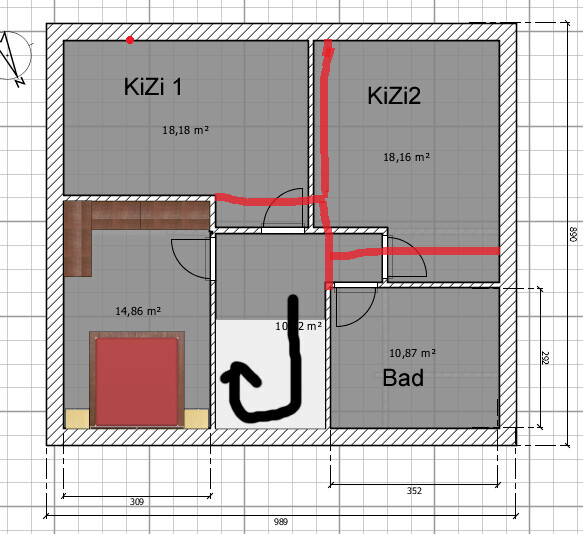
By the way, the hallway on the ground floor is really no good. Imagine entering the house and being squeezed by a wall on the right and the staircase on the left.
so, now then:
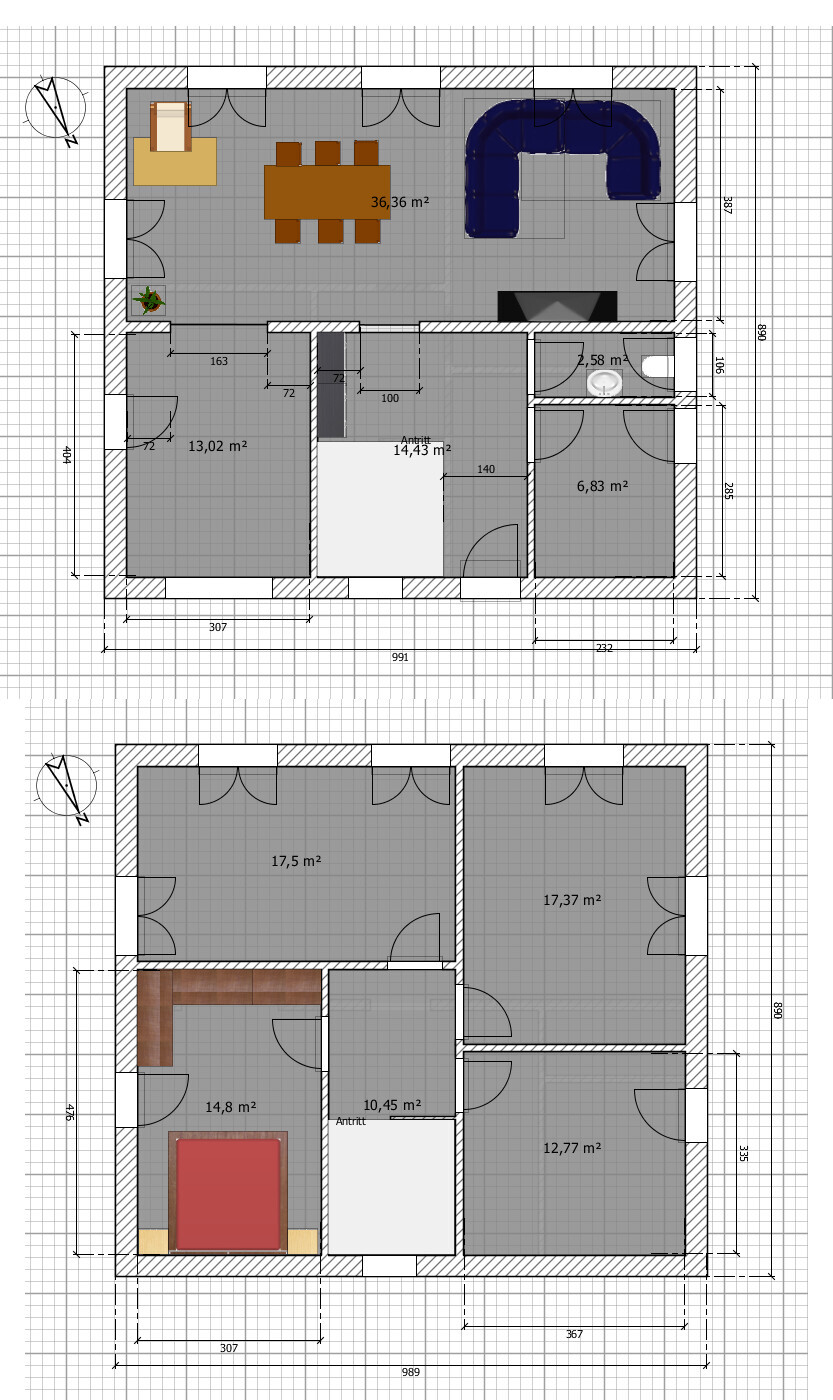
Instead of the hallway cupboards, you could of course put a door there, but is it really, really necessary?
There might even be too many windows, or some of them could be fixed panes. For example, the terrace access should ideally be centered in the living room, while the other windows could remain operable in case we decide to change the furniture layout later.
Instead of the opening to the living area, there is actually space for a door as well.
Instead of the hallway cupboards, you could of course put a door there, but is it really, really necessary?
There might even be too many windows, or some of them could be fixed panes. For example, the terrace access should ideally be centered in the living room, while the other windows could remain operable in case we decide to change the furniture layout later.
Instead of the opening to the living area, there is actually space for a door as well.
Similar topics