
ᐅ House without a garage and basement? Converting the attic? Vent pipe?
Created on: 24 Jun 2015 19:59
G
Grym
We have been considering the following:
If we want to build without a basement and without a garage, preferably with just a carport, does it make sense – and what would the cost difference be – to convert the attic instead?
We plan to build a structure approximately 10.50 meters x 8.50 meters (34.4 ft x 27.9 ft) along the street. On top, a gable roof with a 45-degree pitch (alternatively: only 40 degrees), and the knee wall on the first floor should be about 1.40 meters (4.6 ft) high. At the highest point, the interior height would probably be around 2.80 meters (9.2 ft).
Instead of insulating the top floor ceiling, we would insulate the roof. For cost reasons, the top floor ceiling would remain a wooden beam construction (I assume?). The attic would be an unheated secondary space but equipped with at least one ventilation opening.
The staircase up to the attic should be reasonably comfortable. What is the cost of a standard residential staircase? We might simply extend the living area staircase to the attic if the additional cost is not too high.
In the medium term, we want a wood-and-metal design carport for two cars next to the house, with bike racks in the rear area (which in my opinion looks much better than a concrete and steel garage box). The bikes would be weather-protected but quickly accessible. Necessary garden tools will be stored in the utility room; unnecessary items, seasonal goods, heirlooms, etc., will go into the attic (within the thermal envelope and ventilated by a controlled residential ventilation system). Likewise, winter storage of the garden chairs would be in the attic; in summer, they will remain outside permanently.
It is also unclear whether and what kind of equipment could be located in the utility room (ground or air source heat pump, controlled residential ventilation system, hot water hygiene storage tank, etc.).
Another question is what the cost impact would be for this kind of attic conversion (planned from the start and carried out by the general contractor) compared to the standard option (insulating the top floor ceiling, insulated pull-down stairs to the unheated attic space).
If we want to build without a basement and without a garage, preferably with just a carport, does it make sense – and what would the cost difference be – to convert the attic instead?
We plan to build a structure approximately 10.50 meters x 8.50 meters (34.4 ft x 27.9 ft) along the street. On top, a gable roof with a 45-degree pitch (alternatively: only 40 degrees), and the knee wall on the first floor should be about 1.40 meters (4.6 ft) high. At the highest point, the interior height would probably be around 2.80 meters (9.2 ft).
Instead of insulating the top floor ceiling, we would insulate the roof. For cost reasons, the top floor ceiling would remain a wooden beam construction (I assume?). The attic would be an unheated secondary space but equipped with at least one ventilation opening.
The staircase up to the attic should be reasonably comfortable. What is the cost of a standard residential staircase? We might simply extend the living area staircase to the attic if the additional cost is not too high.
In the medium term, we want a wood-and-metal design carport for two cars next to the house, with bike racks in the rear area (which in my opinion looks much better than a concrete and steel garage box). The bikes would be weather-protected but quickly accessible. Necessary garden tools will be stored in the utility room; unnecessary items, seasonal goods, heirlooms, etc., will go into the attic (within the thermal envelope and ventilated by a controlled residential ventilation system). Likewise, winter storage of the garden chairs would be in the attic; in summer, they will remain outside permanently.
It is also unclear whether and what kind of equipment could be located in the utility room (ground or air source heat pump, controlled residential ventilation system, hot water hygiene storage tank, etc.).
Another question is what the cost impact would be for this kind of attic conversion (planned from the start and carried out by the general contractor) compared to the standard option (insulating the top floor ceiling, insulated pull-down stairs to the unheated attic space).

Grym schrieb:
For now, there are three of us living in the 150m² (1600 sq ft). A second child will come later. So, I don’t expect any space issues for the next few years. When the time comes, we can decide about converting the attic or adding a garage. Space for a garage is reserved. The attic is designed so that there will be no structural problems with a future conversion, but with three people on 150m² (1600 sq ft), conversion is not necessary at this stage.Does converting the attic mean turning it into living space or just storage? If living space is planned, the roof structure needs to be different from the start. No truss roof, increased roof pitch, insulation not just on the intermediate ceiling, and so on.
So, a new design with 8.90 x 9.90 meters (29.2 x 32.5 feet). The kitchen/dining/living area is basically already set. We want an almost completely open space here, but due to the L-shape, there should be no direct line of sight between the kitchen and the living room. In my opinion, the size of the WC and utility room fits well, and the staircase does not start in the "mudroom" area. On the contrary, the staircase has already reached more than half its height next to the entrance area, meaning shoes, a stroller, or even a ride-on toy can be stored there. The door to the utility room is deliberately positioned lower, allowing for closet space in the upper part of the hallway.
The front door swings open in such a way that you can immediately take off your shoes and store them under the stairs.
The layout of the upper floor needs to follow the ground floor somewhat (staircase; utility room beneath the bathroom). The bedroom deliberately takes a bit of space from child’s bedroom 1. Of course, you could draw a straight line there, which is often preferred here, but the extra approximately 65cm (26 inches) allows for a standard bedroom wardrobe, even an L-shaped one with a corner unit, in the bedroom. The precise position of the staircase is chosen so that there is about 55–60cm (22–24 inches) of clearance on each side. We currently have a 180cm (71 inch) mattress, but the bed frame is almost 200cm (79 inches), so right now the clearance is closer to 55cm (22 inches). With a 187cm (74 inch) bed and a 180cm mattress, this clearance even reaches 64cm (25 inches) next to the bed.
When it comes to access to the bathroom, we debated it, but the reasoning for door placement was that we don’t want to risk heading straight down the stairs from the bathroom.
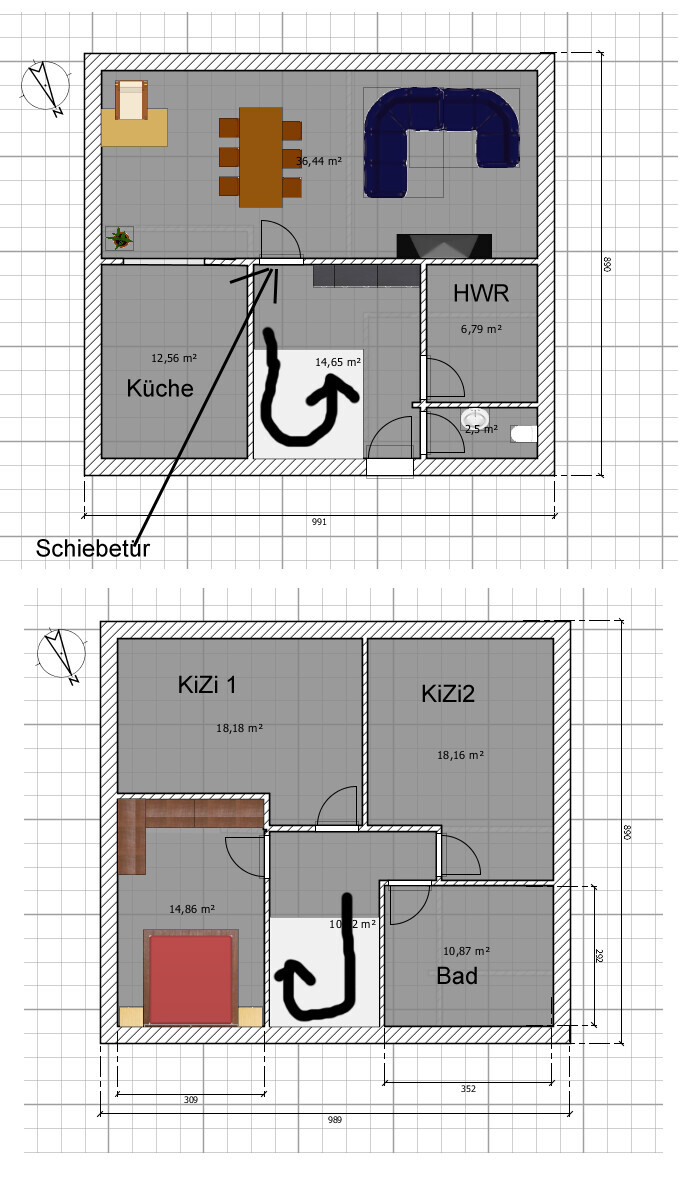
Edit: The living room is the central point in the house, which means it can also be used as a passageway. There is enough space available, more room than just for functional needs. The kitchen is a functional space. In my opinion, a 30 sq.m. (323 sq.ft.) kitchen as a passageway works well, but when we talk about 9–15 sq.m. (97–161 sq.ft.) kitchens, those are purely functional kitchens.
The front door swings open in such a way that you can immediately take off your shoes and store them under the stairs.
The layout of the upper floor needs to follow the ground floor somewhat (staircase; utility room beneath the bathroom). The bedroom deliberately takes a bit of space from child’s bedroom 1. Of course, you could draw a straight line there, which is often preferred here, but the extra approximately 65cm (26 inches) allows for a standard bedroom wardrobe, even an L-shaped one with a corner unit, in the bedroom. The precise position of the staircase is chosen so that there is about 55–60cm (22–24 inches) of clearance on each side. We currently have a 180cm (71 inch) mattress, but the bed frame is almost 200cm (79 inches), so right now the clearance is closer to 55cm (22 inches). With a 187cm (74 inch) bed and a 180cm mattress, this clearance even reaches 64cm (25 inches) next to the bed.
When it comes to access to the bathroom, we debated it, but the reasoning for door placement was that we don’t want to risk heading straight down the stairs from the bathroom.
Edit: The living room is the central point in the house, which means it can also be used as a passageway. There is enough space available, more room than just for functional needs. The kitchen is a functional space. In my opinion, a 30 sq.m. (323 sq.ft.) kitchen as a passageway works well, but when we talk about 9–15 sq.m. (97–161 sq.ft.) kitchens, those are purely functional kitchens.
Well, if you deliberately designed everything the way you did, then what is the point of this statement—deliberately without windows, with a short wall in the hallway, a deliberately small utility room, intentionally opposite stair directions, and knowingly going against common advice?
S
Sebastian799 Jul 2015 07:55You probably don’t care anyway...
Similar topics