
ᐅ House without a garage and basement? Converting the attic? Vent pipe?
Created on: 24 Jun 2015 19:59
G
Grym
We have been considering the following:
If we want to build without a basement and without a garage, preferably with just a carport, does it make sense – and what would the cost difference be – to convert the attic instead?
We plan to build a structure approximately 10.50 meters x 8.50 meters (34.4 ft x 27.9 ft) along the street. On top, a gable roof with a 45-degree pitch (alternatively: only 40 degrees), and the knee wall on the first floor should be about 1.40 meters (4.6 ft) high. At the highest point, the interior height would probably be around 2.80 meters (9.2 ft).
Instead of insulating the top floor ceiling, we would insulate the roof. For cost reasons, the top floor ceiling would remain a wooden beam construction (I assume?). The attic would be an unheated secondary space but equipped with at least one ventilation opening.
The staircase up to the attic should be reasonably comfortable. What is the cost of a standard residential staircase? We might simply extend the living area staircase to the attic if the additional cost is not too high.
In the medium term, we want a wood-and-metal design carport for two cars next to the house, with bike racks in the rear area (which in my opinion looks much better than a concrete and steel garage box). The bikes would be weather-protected but quickly accessible. Necessary garden tools will be stored in the utility room; unnecessary items, seasonal goods, heirlooms, etc., will go into the attic (within the thermal envelope and ventilated by a controlled residential ventilation system). Likewise, winter storage of the garden chairs would be in the attic; in summer, they will remain outside permanently.
It is also unclear whether and what kind of equipment could be located in the utility room (ground or air source heat pump, controlled residential ventilation system, hot water hygiene storage tank, etc.).
Another question is what the cost impact would be for this kind of attic conversion (planned from the start and carried out by the general contractor) compared to the standard option (insulating the top floor ceiling, insulated pull-down stairs to the unheated attic space).
If we want to build without a basement and without a garage, preferably with just a carport, does it make sense – and what would the cost difference be – to convert the attic instead?
We plan to build a structure approximately 10.50 meters x 8.50 meters (34.4 ft x 27.9 ft) along the street. On top, a gable roof with a 45-degree pitch (alternatively: only 40 degrees), and the knee wall on the first floor should be about 1.40 meters (4.6 ft) high. At the highest point, the interior height would probably be around 2.80 meters (9.2 ft).
Instead of insulating the top floor ceiling, we would insulate the roof. For cost reasons, the top floor ceiling would remain a wooden beam construction (I assume?). The attic would be an unheated secondary space but equipped with at least one ventilation opening.
The staircase up to the attic should be reasonably comfortable. What is the cost of a standard residential staircase? We might simply extend the living area staircase to the attic if the additional cost is not too high.
In the medium term, we want a wood-and-metal design carport for two cars next to the house, with bike racks in the rear area (which in my opinion looks much better than a concrete and steel garage box). The bikes would be weather-protected but quickly accessible. Necessary garden tools will be stored in the utility room; unnecessary items, seasonal goods, heirlooms, etc., will go into the attic (within the thermal envelope and ventilated by a controlled residential ventilation system). Likewise, winter storage of the garden chairs would be in the attic; in summer, they will remain outside permanently.
It is also unclear whether and what kind of equipment could be located in the utility room (ground or air source heat pump, controlled residential ventilation system, hot water hygiene storage tank, etc.).
Another question is what the cost impact would be for this kind of attic conversion (planned from the start and carried out by the general contractor) compared to the standard option (insulating the top floor ceiling, insulated pull-down stairs to the unheated attic space).

Musketier schrieb:
In defense of Grym, I still need to say something.
Daily routines vary depending on the day of the week and the season, and they also change with the age of the children or our own age. I don’t believe it’s possible to optimize every current and future variation of daily routines into a single floor plan.
Here are a few examples:
Breakfast, and on weekends also lunch, take place at our kitchen table. Our little one also has dinner in the kitchen.
This simply has the advantage that food doesn’t end up scattered all over the living room floor. In fact, we often eat dinner on the couch in front of the TV. In summer, on the other hand, we eat a lot outdoors. So right now, our dining table is mostly unused.
But this will definitely change once our little one has dinner with us and no longer needs a high chair.
In summer, the living room mainly serves as a passage to the terrace, while in winter it is the central space (for playing, living, partly working, and partly eating).
Ironing is done:
- sometimes in the bedroom, so clothes can be hung up immediately,
- sometimes in the living room to chat casually at the same time, or
- in nice weather, even in the garden.
The guest and office room, which was originally planned for these kinds of activities, is strangely never used for that. You have described our usage of the rooms almost exactly, with only minor differences.
When the kids are with us, meals are eaten in the kitchen—for one, because of the mess young children tend to make, and secondly, because for my daughter, everything else is more important than eating (distraction in the living room from toys, etc.).
When we eat alone in the evening, we usually eat at the coffee table (usually between 8:00 and 9:30 pm).
The dining table (which is in the living/dining area) is mainly used for folding laundry and as a “drawing/craft station” for the kids. That’s why it’s an older model.
The only significant difference is that we never iron in the bedroom. For this monotonous task, we need some distraction.
N
nordanney17 Jul 2015 15:21Grym schrieb:
My problem was probably that I believed the architects' mantra that intelligent planning can save a lot of space. But that's not the case. For our requirements, it starts at about 160-165 sqm (1,722-1,777 sq ft). Living room, dining area, and kitchen arranged at a corner, a large utility room, and a reasonably sized office with a fitness corner cannot fit into 150 sqm (1,615 sq ft). A new plan, certainly around 165 sqm (1,777 sq ft), will follow today or tomorrow. Actually, with intelligent planning, that is quite possible.
We previously lived in 135 sqm (1,452 sq ft) ("2 1/2" stories, semi-detached house). There, we had two equally sized children's rooms on the upper floor plus a large office/hobby room, and in the attic, a huge sleeping/play area. On the ground floor, a large living room arranged at a corner, and the kitchen was separate (if we had removed one wall, it would have been a kitchen/dining area arranged at a corner).
The utility room was in the basement—if the house had been a bit bigger, it could have fit on the ground floor. A guest toilet on the ground floor and a bathroom with shower and bathtub on the upper floor also fit comfortably.
Musketier schrieb:
That took a long time I’ve always been a late bloomer and find it hard to believe many things, even when they’re obvious...
Grym schrieb:
On a space-saving 9.86 x 8.86 meters (32.4 x 29.1 feet) footprint while minimizing hallway area:
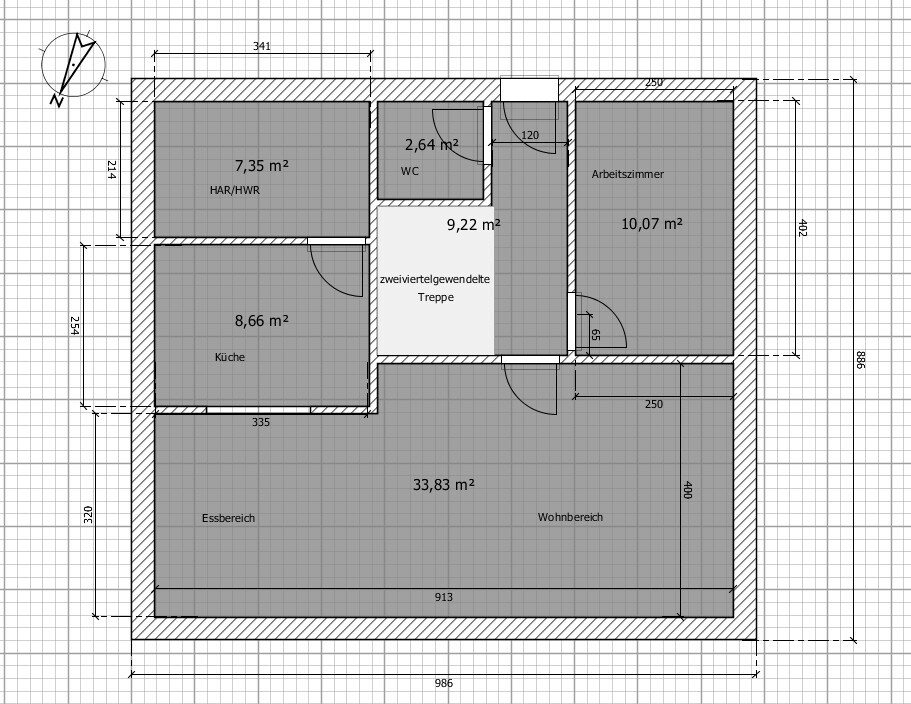
My floor plan is based on this design (the latest one) and this discussion:
Grym schrieb:
The utility room is no further from the living room than it would be if accessed from the hallway. The kitchen is even closer to the living room than if it was accessible from the hallway. I don’t understand why the distance should be measured from the front door? The living room is the central place in the house, so if I want to optimize routes, it’s from the living room to room X (kitchen, utility room).I have a lifestyle that keeps changing. I don’t have to clean every day (thank goodness), and I usually do ironing in front of the TV (actually, my husband does it :cool
ypg schrieb:
(Exceptions prove the rule, and I’m an exception too )Musketier schrieb:
Daily routines vary depending on the day of the week, season, and they also change as children get older or as you age yourself. I don’t believe every possible variation of current and future daily routines can be optimized into one floor plan.You’re certainly right.
But you simply shouldn’t make the living room the main traffic hub.
The living room should be the family’s focal point, but not the junction that everything passes through. Why put yourself through routing from the hallway to the utility room through the whole house — including the quiet area? Both of you @Musketier and @f-pNo have described the quiet area, meaning the living room within family life or partnership, very well.
The hub in a roughly 140 square meter (1,507 square foot) house is ultimately the hallway, the entrance with the staircase area.
Grym schrieb:
My problem probably was that I believed the architects’ mantra that smart design can save a lot of spaceThe smart design has yet to appear – we’re still waiting… patiently
I want to make it clear that I am not discussing the companies or their quality here, but only the catalogue floor plans. Therefore, I hope this thread can remain in the non-moderated forum. In principle, any builder can construct anything, and the catalogue floor plans are purely suggestions.
Without the bay/balcony, of course.
Possibly convert the study into a study and WC, while enlarging the utility room in return.
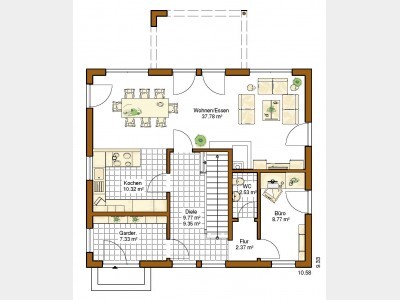
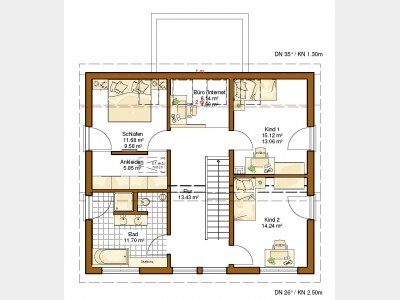
Option A: entrance in the middle, cloakroom converted into a utility room; WC and study basically swap positions; the study is then made as large as needed (or remains as is if already large enough) by moving the wall towards the living room.
Option B: like A, but with a rectangular bay at the top left for the dining room, which shifts the kitchen upwards a bit and extends the partition between kitchen and living area, enlarging the utility room through this change (kitchen size can also be adjusted depending on need).
Both floor plans have a net floor area of around 160-170 sqm (square meters) (1720-1830 sq ft) across both floors. In my opinion, there is no wasted space on the ground floor (I am not concerned about the upper floor, since it is sufficiently large in any case), and with less space it wouldn’t be possible to fit everything including the utility room and office on the ground floor. Having the office on the ground floor is a basic requirement, as is the open-plan relationship between living room, dining area, and kitchen.
At 149 sqm (1605 sq ft) net floor area, you can already see some issues in places: the living room feels too small, children’s rooms are too small, and the kitchen would face south (we have a “catalogue lot,” i.e., a square plot, large enough, with south orientation).
The big companies all have top architects, and the reality is that only a limited number of functional spaces can fit into a certain area. We either give up the office on the ground floor, or we build from at least 160 sqm (1720 sq ft) net floor area upwards.
If this is already too specific for the non-moderated forum, please delete the post and do not move it to the moderated forum.
Edit: Alternatively, we build around 140-150 sqm (1505-1615 sq ft) with a basement and use the typical catalogue utility room as an office.
Without the bay/balcony, of course.
Possibly convert the study into a study and WC, while enlarging the utility room in return.
Option A: entrance in the middle, cloakroom converted into a utility room; WC and study basically swap positions; the study is then made as large as needed (or remains as is if already large enough) by moving the wall towards the living room.
Option B: like A, but with a rectangular bay at the top left for the dining room, which shifts the kitchen upwards a bit and extends the partition between kitchen and living area, enlarging the utility room through this change (kitchen size can also be adjusted depending on need).
Both floor plans have a net floor area of around 160-170 sqm (square meters) (1720-1830 sq ft) across both floors. In my opinion, there is no wasted space on the ground floor (I am not concerned about the upper floor, since it is sufficiently large in any case), and with less space it wouldn’t be possible to fit everything including the utility room and office on the ground floor. Having the office on the ground floor is a basic requirement, as is the open-plan relationship between living room, dining area, and kitchen.
At 149 sqm (1605 sq ft) net floor area, you can already see some issues in places: the living room feels too small, children’s rooms are too small, and the kitchen would face south (we have a “catalogue lot,” i.e., a square plot, large enough, with south orientation).
The big companies all have top architects, and the reality is that only a limited number of functional spaces can fit into a certain area. We either give up the office on the ground floor, or we build from at least 160 sqm (1720 sq ft) net floor area upwards.
If this is already too specific for the non-moderated forum, please delete the post and do not move it to the moderated forum.
Edit: Alternatively, we build around 140-150 sqm (1505-1615 sq ft) with a basement and use the typical catalogue utility room as an office.
N
nordanney17 Jul 2015 21:25Children’s rooms too small? Our three are each 12 sqm (130 sq ft) – but that’s actually 8 sqm (86 sq ft) too much. A bed with a wardrobe would be enough; the rest of the children’s time, especially for kids who also go outside, hardly takes place in the bedroom.
Why is the living room too small as well? What issues are you experiencing?
Kitchen facing south? That’s fine, then the living room with the terrace is oriented west. Exactly where you get the afternoon sun after work. The children’s rooms upstairs would also have good natural light.
Think about your needs and your budget. You’ll have to make a trade-off – just build bigger. That’s what we did too – living/dining/kitchen area of 75 sqm (810 sq ft). It’s really nice – but you’ll have to open your wallet.
Why is the living room too small as well? What issues are you experiencing?
Kitchen facing south? That’s fine, then the living room with the terrace is oriented west. Exactly where you get the afternoon sun after work. The children’s rooms upstairs would also have good natural light.
Think about your needs and your budget. You’ll have to make a trade-off – just build bigger. That’s what we did too – living/dining/kitchen area of 75 sqm (810 sq ft). It’s really nice – but you’ll have to open your wallet.
Similar topics