
Hello community,
with our first post, we would like to ask for help regarding our building project and would appreciate any suggestions and advice.
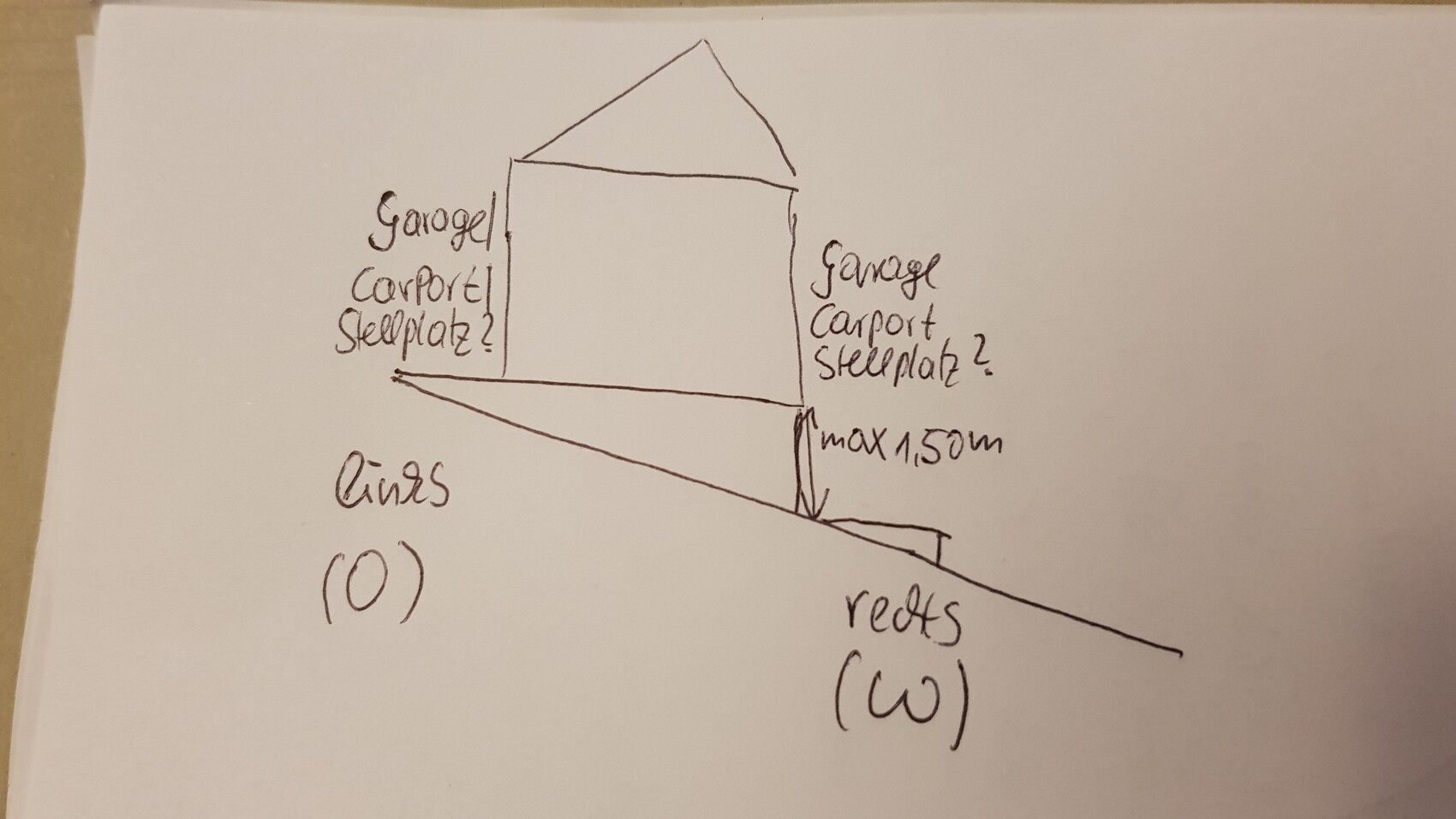
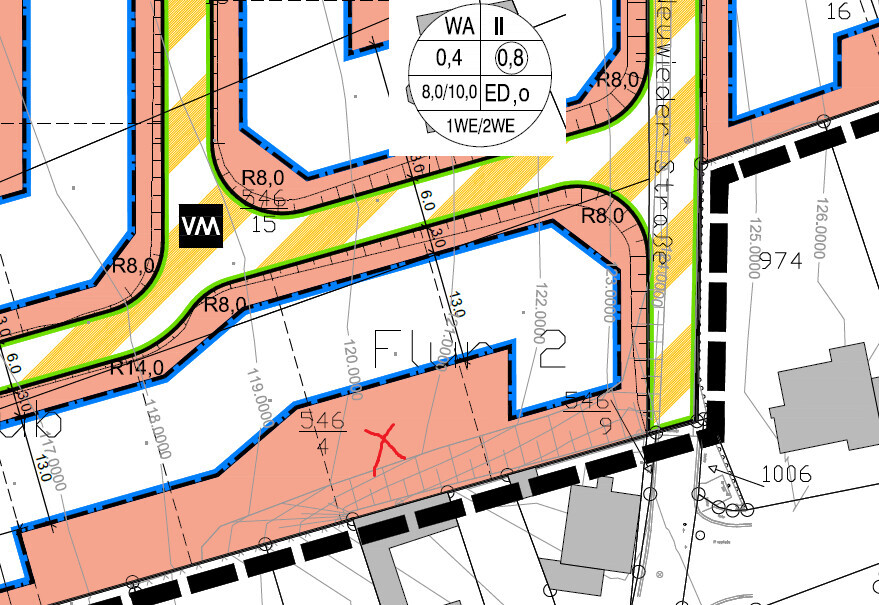
We are planning to build the house on a slight slope. The property is 18m (59 feet) wide, with a drop of about 1.5m (5 feet) along this length, which is approximately 8.3% (see sketch from east to west as well as a section of the development plan/planning permission).
To make the best use of the width, parking spaces will be created on both the left and right sides of the house in the form of at least one garage and one parking space/carport each (requirement according to the development plan/planning permission: 2 parking spaces). This way, the setback from the boundary line will be optimized and the house can theoretically be 12m (39 feet) wide. Due to the 1.5m (5 feet) fill, the parking space on the right side will inevitably be lower than the house because of the slope.
Now we are wondering if the fill can be built as shown in the sketch and also be retained flush with the house wall, and if so, how—using L-shaped retaining blocks or retaining walls—and what the approximate cost might be.
Thank you very much
with our first post, we would like to ask for help regarding our building project and would appreciate any suggestions and advice.
We are planning to build the house on a slight slope. The property is 18m (59 feet) wide, with a drop of about 1.5m (5 feet) along this length, which is approximately 8.3% (see sketch from east to west as well as a section of the development plan/planning permission).
To make the best use of the width, parking spaces will be created on both the left and right sides of the house in the form of at least one garage and one parking space/carport each (requirement according to the development plan/planning permission: 2 parking spaces). This way, the setback from the boundary line will be optimized and the house can theoretically be 12m (39 feet) wide. Due to the 1.5m (5 feet) fill, the parking space on the right side will inevitably be lower than the house because of the slope.
Now we are wondering if the fill can be built as shown in the sketch and also be retained flush with the house wall, and if so, how—using L-shaped retaining blocks or retaining walls—and what the approximate cost might be.
Thank you very much
F
fsbau20194 Jan 2019 20:15Attached is the floor plan of the ground floor, but I am more concerned about the site itself.
What is this supposed to be used for?
The kitchen and utility room are planned to be on the north side, facing the street.
We are not yet sure about the terrace, but it will definitely be on the south side, probably not spanning the entire width of the house.

What is this supposed to be used for?
The kitchen and utility room are planned to be on the north side, facing the street.
We are not yet sure about the terrace, but it will definitely be on the south side, probably not spanning the entire width of the house.
Let me give you a tip. You’re right, you didn’t want to discuss floor plans or basements here, but rather landscape design. So, we didn’t do this alone either; we sorted it out on-site with our building supervisor and the local landscape gardener. The landscape gardener then created a PDF with measurements and a visualization, we approved it, forwarded it to the building supervisor, who roughly implemented everything for the foundation work as it should be. Later, the landscape gardener did the final touches. We are amateurs, that’s what companies are for—they’ve been trained for this. K.

A floor plan is useful here to help us visualize how the front entrance side and the terrace side integrate into the terrain profile. If you haven’t decided yet where the terrace should be, it can also help provide some suggestions.
@Nordlys: I see the problem as more complex than in your case: cross and longitudinal slopes, plus a slight concave shape from the street side. It doesn’t look like there’s a way to simply dig in one corner and have the building level in the middle.
Here in the Pellenz region, we don’t really deal with dikes (or artificial mounds either, but that seems to be a nationwide trend at the moment; it’s not something used here).
https://www.instagram.com/11antgmxde/
https://www.linkedin.com/company/bauen-jetzt/
@Nordlys: I see the problem as more complex than in your case: cross and longitudinal slopes, plus a slight concave shape from the street side. It doesn’t look like there’s a way to simply dig in one corner and have the building level in the middle.
Here in the Pellenz region, we don’t really deal with dikes (or artificial mounds either, but that seems to be a nationwide trend at the moment; it’s not something used here).
https://www.instagram.com/11antgmxde/
https://www.linkedin.com/company/bauen-jetzt/
How much do you need to raise the terrace area by the living room?
I would place the kitchen next to the terrace.
Think about how the outdoor area will be designed. You will also need to account for leveling and filling there.
Talk to construction companies and landscaping professionals. Gather information and have them provide some estimates.
If the basement is really not an option for living space, I would try to find a compromise. My Nordlys did it that way.
Don’t raise the house to the level of the garage; lower the kitchen side slightly into the ground, which is not so easy with a timber frame.
I would place the kitchen next to the terrace.
Think about how the outdoor area will be designed. You will also need to account for leveling and filling there.
Talk to construction companies and landscaping professionals. Gather information and have them provide some estimates.
If the basement is really not an option for living space, I would try to find a compromise. My Nordlys did it that way.
Don’t raise the house to the level of the garage; lower the kitchen side slightly into the ground, which is not so easy with a timber frame.
Ant, I know their slope is steeper than here. But you also know that sometimes people get so fixated and can’t see the forest for the trees, standing on their land and only imagining that one solution. This is when a professional can sometimes work wonders, because they open your eyes, and suddenly you realize, yes, it can be done another way. And this is not something forums can provide; it works best through an on-site visit.
F
fsbau20194 Jan 2019 22:45Everything is fine; I learned about the option to partially bury it from your posts.
The idea of notifying them sounds good, and I would also prefer that approach. The only question is whether it is allowed and how much it will cost. Due to the current workload, companies hardly provide any information unless you pay upfront.
We are torn about whether to build there or not. Originally, the budget included 20,000 for earthworks, including the terrace, garage foundation, drainage, and trenches for utility connections.
If it is much more expensive, we will have to skip it. As I said, an additional 50,000 for the basement is too much.
The idea of notifying them sounds good, and I would also prefer that approach. The only question is whether it is allowed and how much it will cost. Due to the current workload, companies hardly provide any information unless you pay upfront.
We are torn about whether to build there or not. Originally, the budget included 20,000 for earthworks, including the terrace, garage foundation, drainage, and trenches for utility connections.
If it is much more expensive, we will have to skip it. As I said, an additional 50,000 for the basement is too much.
Similar topics