
Hello community,
with our first post, we would like to ask for help regarding our building project and would appreciate any suggestions and advice.
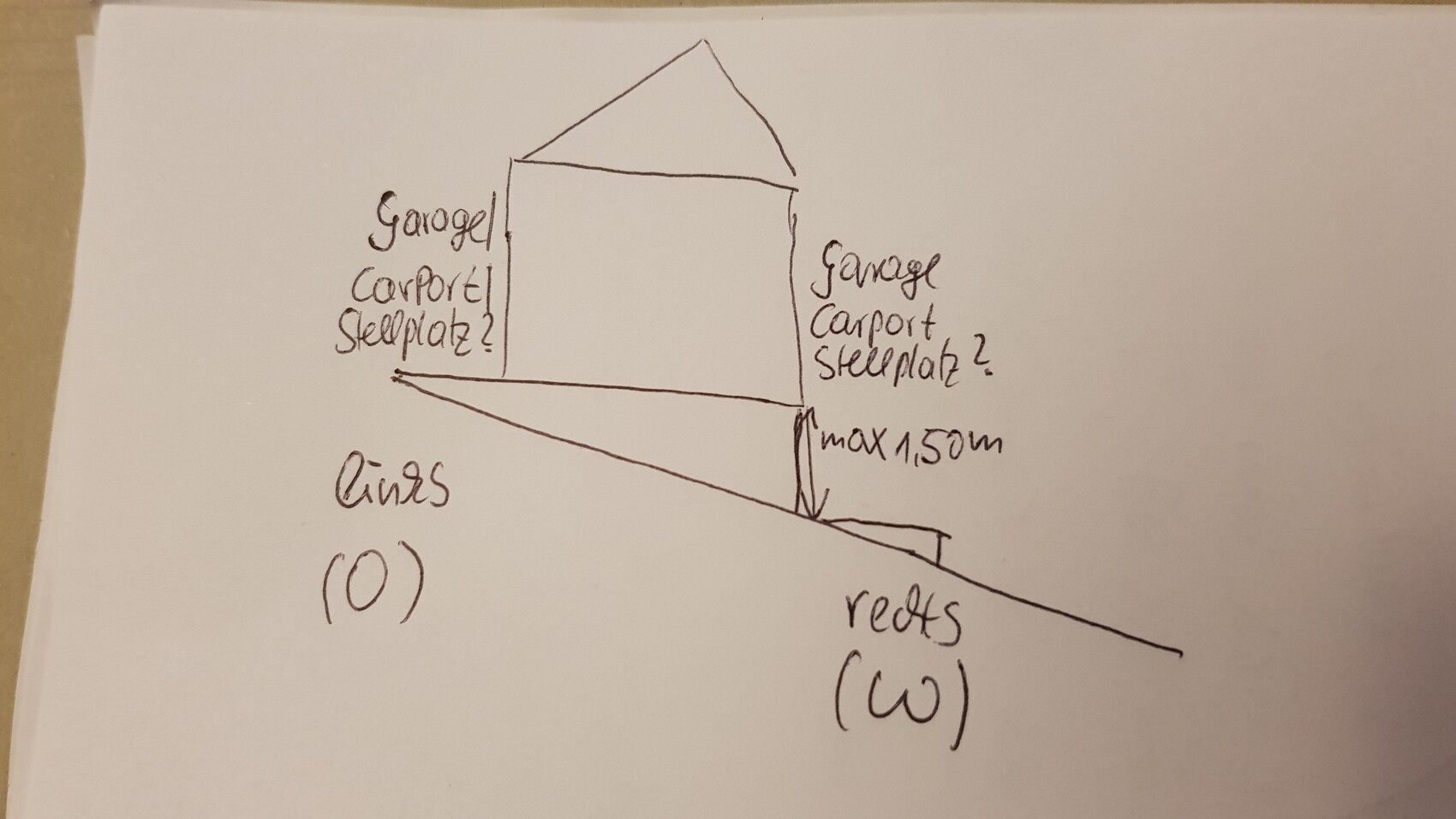
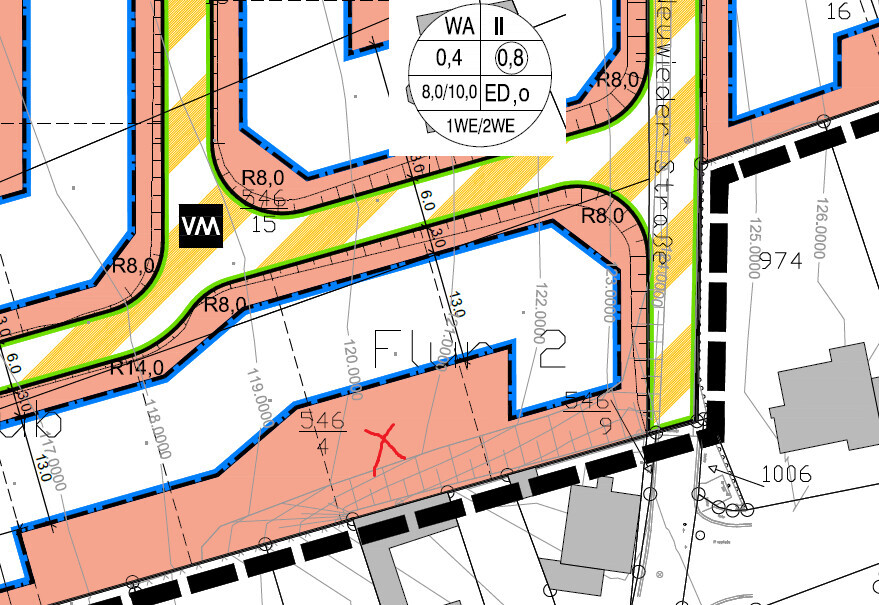
We are planning to build the house on a slight slope. The property is 18m (59 feet) wide, with a drop of about 1.5m (5 feet) along this length, which is approximately 8.3% (see sketch from east to west as well as a section of the development plan/planning permission).
To make the best use of the width, parking spaces will be created on both the left and right sides of the house in the form of at least one garage and one parking space/carport each (requirement according to the development plan/planning permission: 2 parking spaces). This way, the setback from the boundary line will be optimized and the house can theoretically be 12m (39 feet) wide. Due to the 1.5m (5 feet) fill, the parking space on the right side will inevitably be lower than the house because of the slope.
Now we are wondering if the fill can be built as shown in the sketch and also be retained flush with the house wall, and if so, how—using L-shaped retaining blocks or retaining walls—and what the approximate cost might be.
Thank you very much
with our first post, we would like to ask for help regarding our building project and would appreciate any suggestions and advice.
We are planning to build the house on a slight slope. The property is 18m (59 feet) wide, with a drop of about 1.5m (5 feet) along this length, which is approximately 8.3% (see sketch from east to west as well as a section of the development plan/planning permission).
To make the best use of the width, parking spaces will be created on both the left and right sides of the house in the form of at least one garage and one parking space/carport each (requirement according to the development plan/planning permission: 2 parking spaces). This way, the setback from the boundary line will be optimized and the house can theoretically be 12m (39 feet) wide. Due to the 1.5m (5 feet) fill, the parking space on the right side will inevitably be lower than the house because of the slope.
Now we are wondering if the fill can be built as shown in the sketch and also be retained flush with the house wall, and if so, how—using L-shaped retaining blocks or retaining walls—and what the approximate cost might be.
Thank you very much
Hello fsbau
I’m afraid I have to take some of your enthusiasm away: you can’t just stack formwork blocks and build a house on top after filling them. The pressure doesn’t only go downward. It also spreads out at a 45° angle to the sides. To support this will require more than just a few formwork blocks, some reinforcing steel, and concrete.
I would consider a basement. If that’s not an option, a structural engineer will precisely tell you how to manage the load transfer.
Steven
I’m afraid I have to take some of your enthusiasm away: you can’t just stack formwork blocks and build a house on top after filling them. The pressure doesn’t only go downward. It also spreads out at a 45° angle to the sides. To support this will require more than just a few formwork blocks, some reinforcing steel, and concrete.
I would consider a basement. If that’s not an option, a structural engineer will precisely tell you how to manage the load transfer.
Steven

If you don’t own the plot yet and a slab-on-grade house / no-basement house is important to you, I would recommend continuing to look, as the slope seems to be not as straightforward in reality as it appears visually.
If you already own the plot, I would still not start the planning based on the building envelope but first define the desired house’s space requirements and shape.
Elevation data at measuring points would be helpful; contour lines alone are better than nothing but still provide a somewhat less precise picture.
Even from the aerial image
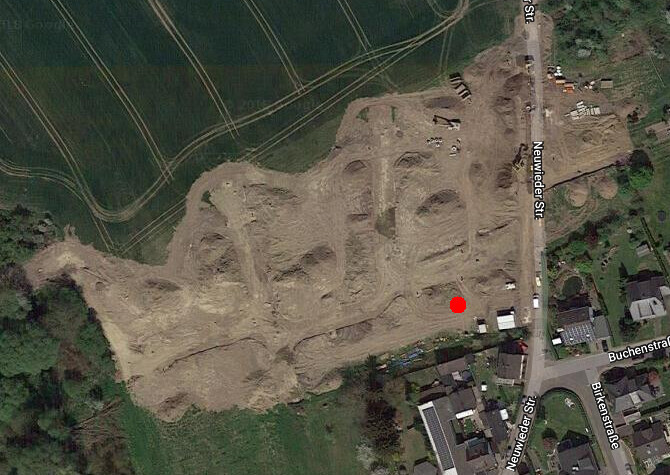
I cannot determine it exactly, but if I am not misinterpreting the slope symbols from the opening post, the building plots lie in a basin slightly below street level (?)
Many things are possible—at least at the price of it being a Pyrrhic victory. Fundamentally, a berm with a house-wall-flush “steep edge” is possible. For example, on the coast of Heligoland, this works due to bedrock. With normal soil, an engineer might not see a problem, but economically it won’t add up. Whether the aesthetics justify the effort depends on having a clear idea of the house planned for that spot.
To summarize what you’ll find in those posts: as a rough experiential rule of thumb, I postulate that from around two meters (approximately 6.5 feet) of height difference (within the house’s footprint), a “avoided” basement equals a “built” basement in cost, and this relationship is roughly linear in proportion. So you can mentally add about 10% of basement costs for every 20cm (8 inches) of height difference.
Regarding embankments and their reinforcements, physics is unforgiving and doesn’t favor vertical (i.e. 90°) slopes. On the free side, the vertically acting gravity load is not held in place by any significant counterpressure. Air compresses far more than any soil. As a result, the load shears off. The slope’s job is to resist this. The L-shaped retaining wall essentially achieves this by redirecting forces.
In conclusion: no Frisian would ever consider a berm with vertical edges—no matter how much it might excite an engineer’s imagination.
https://www.instagram.com/11antgmxde/
https://www.linkedin.com/company/bauen-jetzt/
If you already own the plot, I would still not start the planning based on the building envelope but first define the desired house’s space requirements and shape.
Elevation data at measuring points would be helpful; contour lines alone are better than nothing but still provide a somewhat less precise picture.
Even from the aerial image
I cannot determine it exactly, but if I am not misinterpreting the slope symbols from the opening post, the building plots lie in a basin slightly below street level (?)
fsbau2019 schrieb:Personally, I consider berms for slope-ignoring slab-on-grade construction generally a nonsense, but people’s wishes are their paradise. However, I do put a question mark behind the bliss of the idea to prop up house edges with L-shaped retaining walls as if using car jacks.
Now we ask ourselves whether the embankment can be constructed as shown in the sketch and also anchored flush with the house wall,
Many things are possible—at least at the price of it being a Pyrrhic victory. Fundamentally, a berm with a house-wall-flush “steep edge” is possible. For example, on the coast of Heligoland, this works due to bedrock. With normal soil, an engineer might not see a problem, but economically it won’t add up. Whether the aesthetics justify the effort depends on having a clear idea of the house planned for that spot.
Escroda schrieb:Indeed, searching for “11ant basement” or similar will yield a lot of valuable information here.
It can be done, but is only marginally cheaper than a basement. @11ant has written extensively about this in several threads.
To summarize what you’ll find in those posts: as a rough experiential rule of thumb, I postulate that from around two meters (approximately 6.5 feet) of height difference (within the house’s footprint), a “avoided” basement equals a “built” basement in cost, and this relationship is roughly linear in proportion. So you can mentally add about 10% of basement costs for every 20cm (8 inches) of height difference.
Regarding embankments and their reinforcements, physics is unforgiving and doesn’t favor vertical (i.e. 90°) slopes. On the free side, the vertically acting gravity load is not held in place by any significant counterpressure. Air compresses far more than any soil. As a result, the load shears off. The slope’s job is to resist this. The L-shaped retaining wall essentially achieves this by redirecting forces.
In conclusion: no Frisian would ever consider a berm with vertical edges—no matter how much it might excite an engineer’s imagination.
https://www.instagram.com/11antgmxde/
https://www.linkedin.com/company/bauen-jetzt/
F
fsbau20194 Jan 2019 18:2511ant schrieb:
If I’m not misunderstanding the slope plan symbols in the opening post, the building plots are located in a slight depression just below street levelYes, the depression is about 40 cm (16 inches) lower than the street on the left side.
At the right property boundary, it is level with the street and slopes down in the middle.
It might also be possible to create steps so the fill height is not too high.
Set the left side, including the house, at this level of 40 cm (16 inches) or maybe even 50 cm (20 inches) below street level.
On the right side, have a 50 cm (20 inches) slope. Shape the front yard terrain so that water can run down the street along the right side of the property.
This way, you only need to compensate for three times 50 cm (20 inches). What do you think about this?
Building with a basement (due to groundwater, a waterproof concrete shell is necessary) for about 50,000 EUR is too expensive for us.
We would choose a prefabricated house, with the foundation slab measuring 10.84 m (35.6 ft) along the street side and 9 m (29.5 ft) wide.
fsbau2019 schrieb:
We have chosen a house (prefabricated house), with the foundation slab measuring 10.84 m (35.6 ft) along the street side and 9 m (29.5 ft) wide. So, you have a specific desired house model and already know the dimensions (before or after floor plan customization?) – then go ahead and share it!
https://www.instagram.com/11antgmxde/
https://www.linkedin.com/company/bauen-jetzt/
WU concrete is only necessary for the walls in contact with the ground. Using a basement as living space saves above-ground floor area. Your prefabricated house on top will be smaller and more cost-effective.
Yes, most timber frame suppliers discourage this. For structural reasons, they usually cannot build a timber frame in the basement. We experienced the same. If there is no profit to be made, it is considered unfavorable.
You want to build on a slab foundation.
Backfill for the house should be compacted in layers – for high loads, provide a plate load test as proof of compaction.
Retaining wall. It must not only hold back the 1.5 m (5 feet) of earth but also support the house itself. This cannot be done with just a few steel bars.
What about the terrace?
What about the garden?
Yes, most timber frame suppliers discourage this. For structural reasons, they usually cannot build a timber frame in the basement. We experienced the same. If there is no profit to be made, it is considered unfavorable.
You want to build on a slab foundation.
Backfill for the house should be compacted in layers – for high loads, provide a plate load test as proof of compaction.
Retaining wall. It must not only hold back the 1.5 m (5 feet) of earth but also support the house itself. This cannot be done with just a few steel bars.
What about the terrace?
What about the garden?
haydee schrieb:
A basement used as living space saves above-ground floor area. Your prefabricated house on top will be smaller and cheaper.
Yes, most timber frame suppliers discourage this. For structural reasons, they usually can't build timber frames in the basement. We've experienced that too. If they don't make any profit from it, they say it's not a good idea. Exactly, that basically means a basement from a subcontractor or one where they don’t make any profit. However, they don’t have to cover the terrain grading effort or include it in their overall price. They prefer to pass on this effort as "on-site work".
https://www.instagram.com/11antgmxde/
https://www.linkedin.com/company/bauen-jetzt/
Similar topics