
Hello community,
with our first post, we would like to ask for help regarding our building project and would appreciate any suggestions and advice.
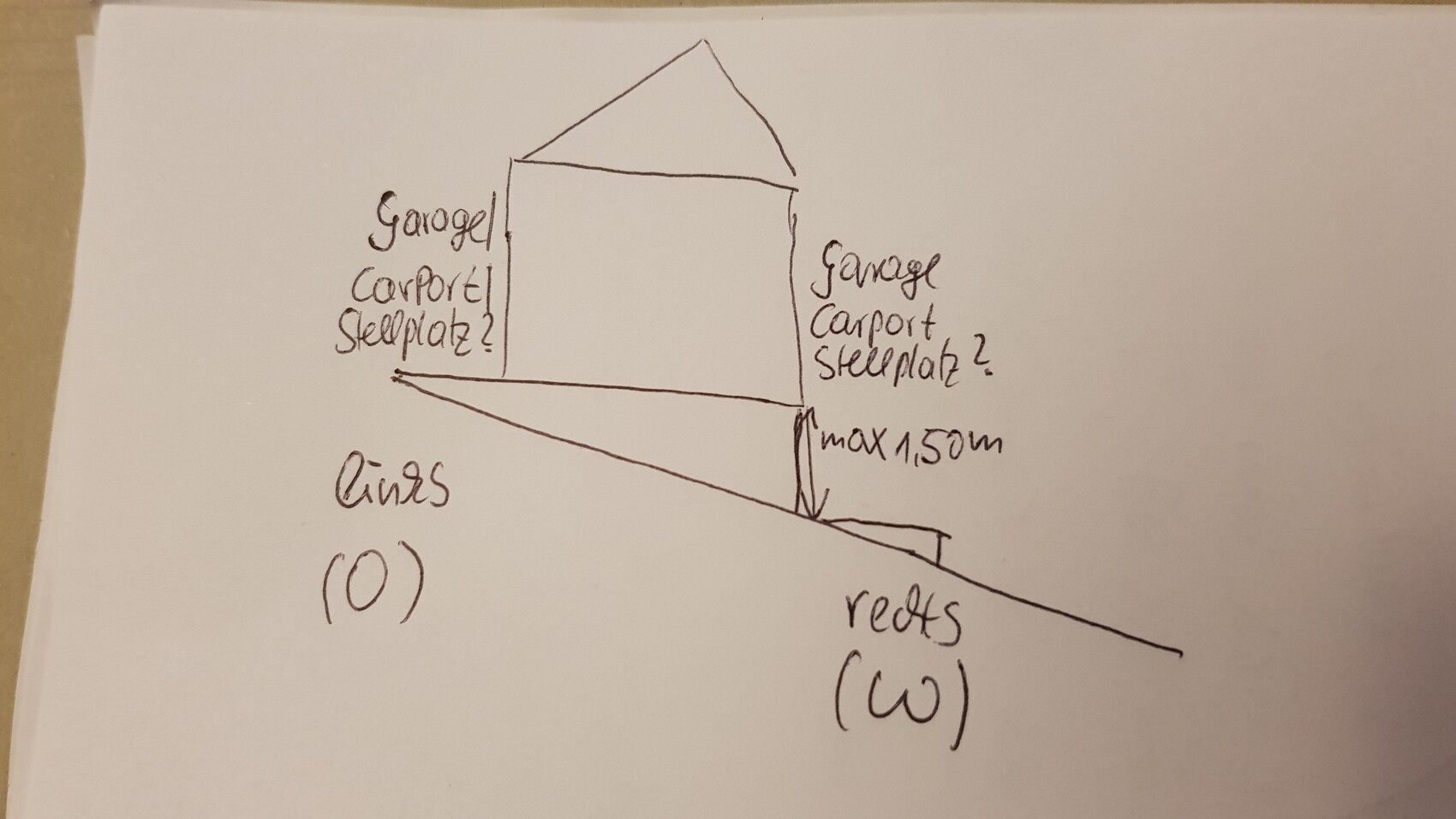
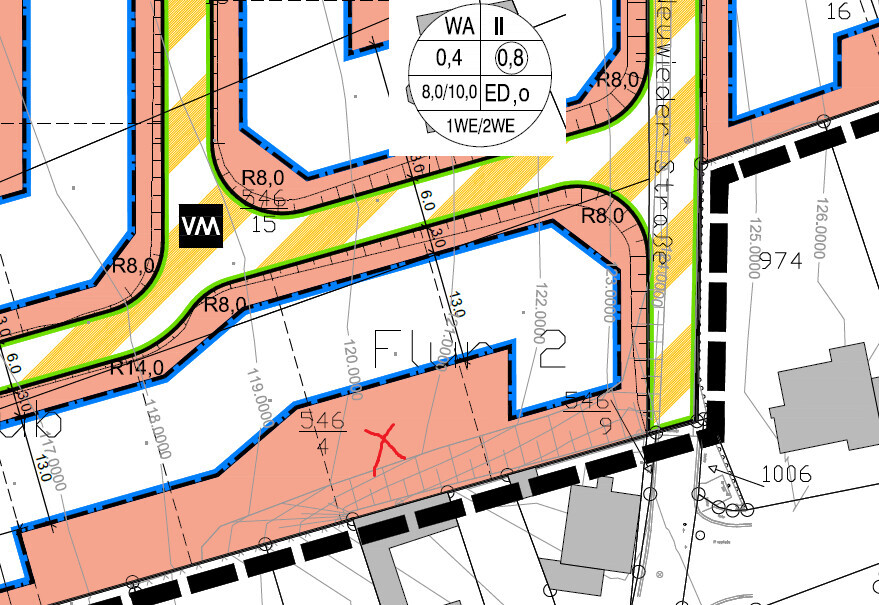
We are planning to build the house on a slight slope. The property is 18m (59 feet) wide, with a drop of about 1.5m (5 feet) along this length, which is approximately 8.3% (see sketch from east to west as well as a section of the development plan/planning permission).
To make the best use of the width, parking spaces will be created on both the left and right sides of the house in the form of at least one garage and one parking space/carport each (requirement according to the development plan/planning permission: 2 parking spaces). This way, the setback from the boundary line will be optimized and the house can theoretically be 12m (39 feet) wide. Due to the 1.5m (5 feet) fill, the parking space on the right side will inevitably be lower than the house because of the slope.
Now we are wondering if the fill can be built as shown in the sketch and also be retained flush with the house wall, and if so, how—using L-shaped retaining blocks or retaining walls—and what the approximate cost might be.
Thank you very much
with our first post, we would like to ask for help regarding our building project and would appreciate any suggestions and advice.
We are planning to build the house on a slight slope. The property is 18m (59 feet) wide, with a drop of about 1.5m (5 feet) along this length, which is approximately 8.3% (see sketch from east to west as well as a section of the development plan/planning permission).
To make the best use of the width, parking spaces will be created on both the left and right sides of the house in the form of at least one garage and one parking space/carport each (requirement according to the development plan/planning permission: 2 parking spaces). This way, the setback from the boundary line will be optimized and the house can theoretically be 12m (39 feet) wide. Due to the 1.5m (5 feet) fill, the parking space on the right side will inevitably be lower than the house because of the slope.
Now we are wondering if the fill can be built as shown in the sketch and also be retained flush with the house wall, and if so, how—using L-shaped retaining blocks or retaining walls—and what the approximate cost might be.
Thank you very much
ypg schrieb:
I would invest more planning input from an architect and design a house with a basement. Anything else would be a waste of money and space.
Just a few notes. I find 1.5m (5 feet) at the bottom a bit too much. Dig the house in a little, about 0.5m (1.5 feet) at the top, which leaves 1.0m (3 feet) at the bottom—that's more manageable.
I would also place only one parking space next to the house, not one on both the left and right sides. I built the second spot as a parallel parking bay along the street.
We are also on a sloping street, but less steep than your location. At the top by the house, we have a driveway and garage that are gently sloped, about 3m (10 feet) wide, making it easy to drive on. Down below, there’s the mentioned parking bay with steps leading up to the house and a fieldstone wall as support.
To the left and right of our houses, the ground was only slightly cut to the neighboring properties, and everything was covered with grass and plants, so we kept the natural terrain as intact as possible. This setup causes hardly any water problems since the plants absorb it all. Karsten
I would also place only one parking space next to the house, not one on both the left and right sides. I built the second spot as a parallel parking bay along the street.
We are also on a sloping street, but less steep than your location. At the top by the house, we have a driveway and garage that are gently sloped, about 3m (10 feet) wide, making it easy to drive on. Down below, there’s the mentioned parking bay with steps leading up to the house and a fieldstone wall as support.
To the left and right of our houses, the ground was only slightly cut to the neighboring properties, and everything was covered with grass and plants, so we kept the natural terrain as intact as possible. This setup causes hardly any water problems since the plants absorb it all. Karsten

ypg schrieb:
And my question is whether a total length of 12 meters (39 feet) is allowed on the boundary. Here, it is only 9 meters (30 feet). I always thought that refers to each side? Are you only allowed to build a total of 9 meters (30 feet) along your own property boundary? For example, 3 meters (10 feet) on the left, back, and right sides?
F
fsbau20194 Jan 2019 11:03Nordlys schrieb:
Below we have the mentioned parking bay with steps leading up to the house and a fieldstone wall as support.So, you built up 1m (3 feet) above the original ground level and supported it with a retaining wall?
That was possible?
What was the approximate cost of the support structure, and how is it holding up in terms of settling?
kaho674 schrieb:
Garage on the left, carport on the right. That will look like a terraced house. I already find that ugly. Well, we’ve already had the “elephant with two ears” situation.
Niloa schrieb:
I always thought that applies to each side? Are you only allowed to build a total of 9m along your own property boundary? So, for example, 3m on the left, back, and right?The total boundary construction counts, see @Escroda
fsbau2019 schrieb:
otherwise it becomes a parking space and not a carport. A parking space also counts as boundary construction.
Similar topics