
Hello,
we already own a plot of land and are considering the best way to position the house on it.
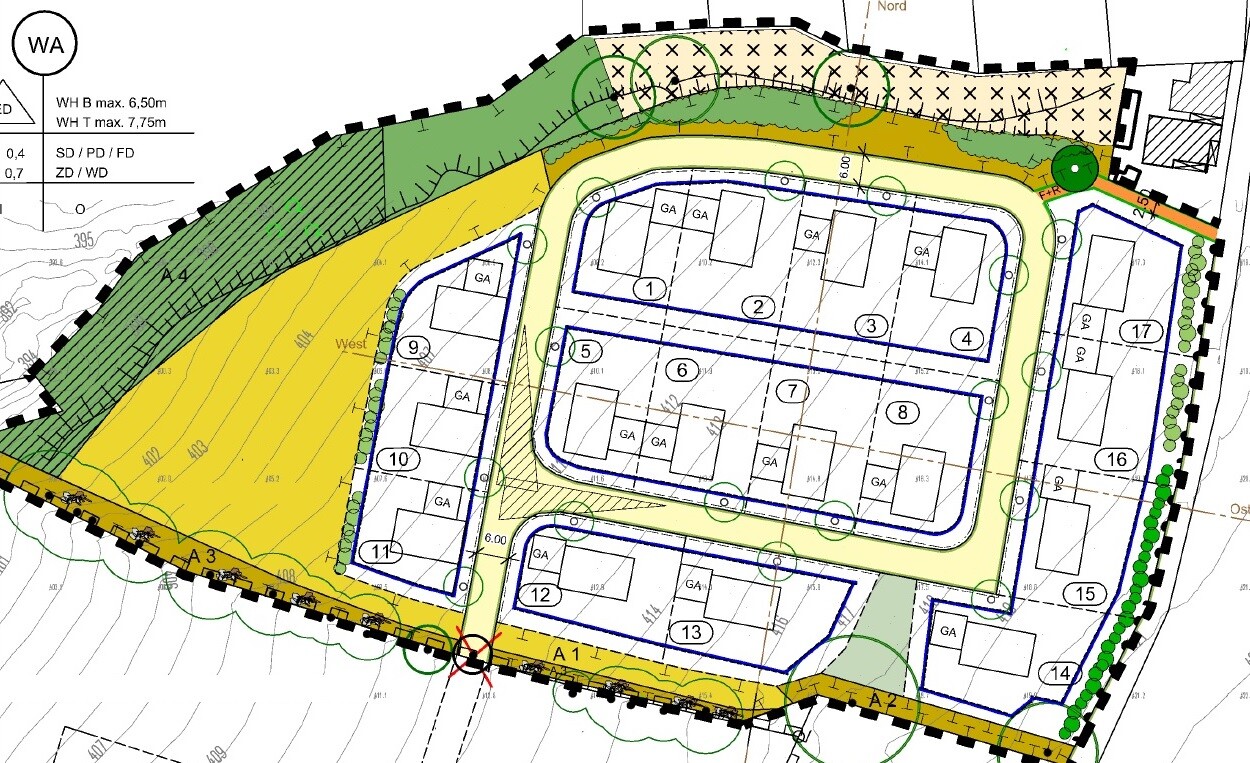
The plot is 665 sqm (7159 sq ft), approximately 21.5 m (70.5 ft) wide and 31 m (102 ft) long, with access from the south side. The slope is about 1.5 m (5 ft) from south to north and about 2 m (6.5 ft) from east to west. There is a relatively free building area, except for a 3 m (10 ft) setback at the front and rear, as well as the usual boundary setbacks. See item no. 6 in the attached plan.
We would like a house with about 140-150 sqm (1507-1615 sq ft) of living space distributed over the ground floor and first floor (either without or possibly with a high knee wall), plus a double garage. Two fundamental questions are troubling us:
1. With or without a basement? Is a basement advisable on this slight slope? Basically, we could do without a basement, then with a small utility room on the ground floor and a small laundry room on the upper floor, plus possibly a slightly larger garage. However, if a basement would not cost much more due to the site conditions, we would not mind. A partial basement would also be sufficient, but we often read that the cost savings compared to a full basement are minimal. With a basement, the house could also have only 140 sqm (1507 sq ft) instead of 150 sqm (1615 sq ft). We would not want less than that because we would like to have an office/guest room on the ground floor.
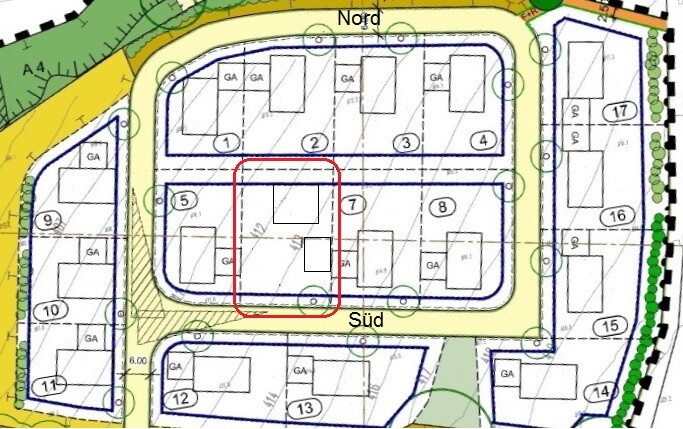
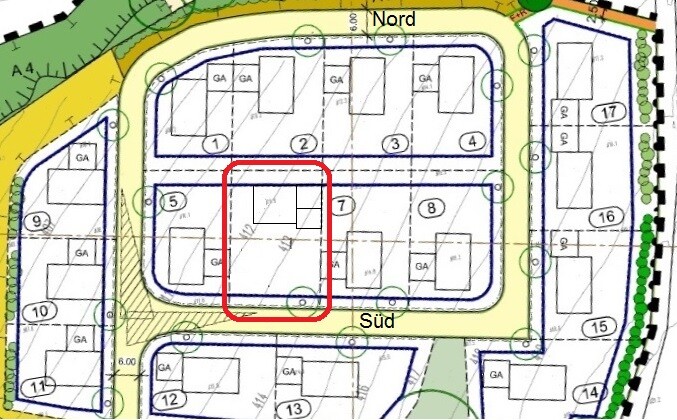
2. An equally important question is where and how to best position the house. Due to the southern access, it is unfortunately not so easy. So far, we have the following ideas (the first two are shown in the attached sketch):
a) House with east entrance as far back as possible in the northeast, garage with 5-6 m (16.5-20 ft) driveway in front in the southeast. Pros: a large southwest garden, privacy thanks to the garage. Cons: longer and potentially wet path to the house.
b) House with east entrance roughly centered at the back and garage attached at the boundary to the east side. Pros: direct access to the house, large south garden. Cons: long driveway (snow removal), less western garden.
c) House with west entrance roughly centered at the back and garage attached at the boundary to the west side. Pros: direct access to the house, large south garden. Cons: long driveway (snow removal), no western garden but rather an eastern garden.
We might not push the house fully to the back as far as possible but leave some northern garden instead. So instead of the 3 m (10 ft) minimum distance, perhaps 5 to 7 m (16.5-23 ft). To have a secluded and shaded garden area in midsummer. Does that make sense or not?
I look forward to your opinions and advice. Thanks in advance.
Regards,
Thomas
we already own a plot of land and are considering the best way to position the house on it.
The plot is 665 sqm (7159 sq ft), approximately 21.5 m (70.5 ft) wide and 31 m (102 ft) long, with access from the south side. The slope is about 1.5 m (5 ft) from south to north and about 2 m (6.5 ft) from east to west. There is a relatively free building area, except for a 3 m (10 ft) setback at the front and rear, as well as the usual boundary setbacks. See item no. 6 in the attached plan.
We would like a house with about 140-150 sqm (1507-1615 sq ft) of living space distributed over the ground floor and first floor (either without or possibly with a high knee wall), plus a double garage. Two fundamental questions are troubling us:
1. With or without a basement? Is a basement advisable on this slight slope? Basically, we could do without a basement, then with a small utility room on the ground floor and a small laundry room on the upper floor, plus possibly a slightly larger garage. However, if a basement would not cost much more due to the site conditions, we would not mind. A partial basement would also be sufficient, but we often read that the cost savings compared to a full basement are minimal. With a basement, the house could also have only 140 sqm (1507 sq ft) instead of 150 sqm (1615 sq ft). We would not want less than that because we would like to have an office/guest room on the ground floor.
2. An equally important question is where and how to best position the house. Due to the southern access, it is unfortunately not so easy. So far, we have the following ideas (the first two are shown in the attached sketch):
a) House with east entrance as far back as possible in the northeast, garage with 5-6 m (16.5-20 ft) driveway in front in the southeast. Pros: a large southwest garden, privacy thanks to the garage. Cons: longer and potentially wet path to the house.
b) House with east entrance roughly centered at the back and garage attached at the boundary to the east side. Pros: direct access to the house, large south garden. Cons: long driveway (snow removal), less western garden.
c) House with west entrance roughly centered at the back and garage attached at the boundary to the west side. Pros: direct access to the house, large south garden. Cons: long driveway (snow removal), no western garden but rather an eastern garden.
We might not push the house fully to the back as far as possible but leave some northern garden instead. So instead of the 3 m (10 ft) minimum distance, perhaps 5 to 7 m (16.5-23 ft). To have a secluded and shaded garden area in midsummer. Does that make sense or not?
I look forward to your opinions and advice. Thanks in advance.
Regards,
Thomas

I don’t like either option: I didn’t want my garage to be that wide in front of the south side, nor did I want such a long driveway (which also affects the floor area ratio). With the tree in the driveway, neither option fits very well.
Regarding the basement, I recently mentioned in another thread that for every 1.0 m (3.3 ft) of height difference within the house footprint, roughly 50% of the cost of a basement is incurred—whether you actually build one or “compensate” for it through deeper foundation slabs, terrain modeling, or a combination of these methods. Practically speaking, at a height difference of 2.0 m (6.6 ft) or more, leaving out the basement costs about the same as building one. As with any rule of thumb, this is a rough estimate (and someone will always say it’s too rough). Partial basements are definitely somewhat cheaper, but relatively not by much (roughly: a half-basement costs about three-quarters of a full one).
https://www.instagram.com/11antgmxde/
https://www.linkedin.com/company/bauen-jetzt/
Regarding the basement, I recently mentioned in another thread that for every 1.0 m (3.3 ft) of height difference within the house footprint, roughly 50% of the cost of a basement is incurred—whether you actually build one or “compensate” for it through deeper foundation slabs, terrain modeling, or a combination of these methods. Practically speaking, at a height difference of 2.0 m (6.6 ft) or more, leaving out the basement costs about the same as building one. As with any rule of thumb, this is a rough estimate (and someone will always say it’s too rough). Partial basements are definitely somewhat cheaper, but relatively not by much (roughly: a half-basement costs about three-quarters of a full one).
https://www.instagram.com/11antgmxde/
https://www.linkedin.com/company/bauen-jetzt/
First of all, I would avoid unnecessary restrictions. With a plot of this size, there’s no need to overdo it by trying to have all the garden space on the south side. I often come across the misconception that any distance over three meters (about 10 feet) between the trunk and the refrigerator is a disaster—in the best case, people want a drive-in pantry—and that umbrellas haven’t been invented yet. This only makes me smile wearily and sympathetically. On “my” street, the nearest parking spot after grocery shopping is regularly about 20 meters (65 feet) away from the front door. Having a garage within less than 100 meters (330 feet) of the apartment already counts as luxury here. My neighbors and I make use of a device called doormats, so we can even walk barefoot through the staircase shortly after the mailboxes.
Therefore, I would place the house primarily in the building area where it looks best. I would not position the main entrance facing north, for two reasons: first, a practical one, to avoid turning the path from the street into a tiring procession; second, an aesthetic one: as the homeowner, you don’t enter your house through the delivery entrance.
My second priority would be the garden. In summer, you want to be able to enjoy the living room view outside as well, and you should find both sun and shade there. I don’t care who can see me from their spot on the cake plate.
As for the cars—whether Porsche or not—they should kindly go where there is space left. This secondary building may be designed with the side benefit of providing shade, but I wouldn’t allow it to block the view of the main entrance. That’s where the cars sleep—nothing more. Whether they sleep separately or in a double garage is something I would gladly leave to the overall balancing of the ensemble.
If you can drop the rule of placing the garage strictly between the main and secondary entrances, in my opinion the most difficult conflict is already solved, and you can proceed with enthusiasm. The drawback of a south-facing street is less “severe” with this plot size. On the other hand, the building area allows quite a bit of “play” — although with the small catch that the neighbor might use it differently. Regarding my question of where I have shade in my garden, early communication with the neighbors is very revealing.
https://www.instagram.com/11antgmxde/
https://www.linkedin.com/company/bauen-jetzt/
Therefore, I would place the house primarily in the building area where it looks best. I would not position the main entrance facing north, for two reasons: first, a practical one, to avoid turning the path from the street into a tiring procession; second, an aesthetic one: as the homeowner, you don’t enter your house through the delivery entrance.
My second priority would be the garden. In summer, you want to be able to enjoy the living room view outside as well, and you should find both sun and shade there. I don’t care who can see me from their spot on the cake plate.
As for the cars—whether Porsche or not—they should kindly go where there is space left. This secondary building may be designed with the side benefit of providing shade, but I wouldn’t allow it to block the view of the main entrance. That’s where the cars sleep—nothing more. Whether they sleep separately or in a double garage is something I would gladly leave to the overall balancing of the ensemble.
If you can drop the rule of placing the garage strictly between the main and secondary entrances, in my opinion the most difficult conflict is already solved, and you can proceed with enthusiasm. The drawback of a south-facing street is less “severe” with this plot size. On the other hand, the building area allows quite a bit of “play” — although with the small catch that the neighbor might use it differently. Regarding my question of where I have shade in my garden, early communication with the neighbors is very revealing.
https://www.instagram.com/11antgmxde/
https://www.linkedin.com/company/bauen-jetzt/
Do I understand correctly that the plot slopes downwards towards the back left (on the plan), or towards the northwest?
I would also separate these considerations, as @11ant nicely puts it.
Of course, even on the north side there is sunlight on the property. The higher you build your house, the more shade it will cast to the north when the sun is lower in the east or west. Even in winter, while there is more shadow on the house around midday, the garden itself—that is, the green space—is still fully usable both in the north and south.
The key issue is that you want sunlight in the living areas. This can be achieved with clever room and window design.
Personally, I would probably plan a basement according to room needs, but not necessarily add a full additional floor above the ground level.
For example, bedrooms could be accommodated in the basement (as well as the utility room and technical equipment), with access to the garden, and living spaces on the ground floor with additional access to the terrace. The terrace can, as the name suggests, be designed in levels—for example, over two tiers.
I would likely position the main entrance on the east or southeast side, the terrace on the west, with nice garden areas to the south and north. The exact placement should be determined taking into account existing elevation levels. And some excavation work will be necessary anyway.
In addition, external factors (neighboring houses, planting, etc.) must be considered.
On the upper floor (ground floor?), a staggered shed roof could be used to bring sunlight into the northern rooms. The garage placement will follow from that.
tepee schrieb:
Perhaps we wouldn’t push the house all the way back as far as possible, but would leave some space for a north-facing garden. So instead of a minimum distance of 3m (10 feet), maybe 5 - 7m (16 - 23 feet). As a private and shaded garden area in the height of summer. Is that sensible or not?
I would also separate these considerations, as @11ant nicely puts it.
Of course, even on the north side there is sunlight on the property. The higher you build your house, the more shade it will cast to the north when the sun is lower in the east or west. Even in winter, while there is more shadow on the house around midday, the garden itself—that is, the green space—is still fully usable both in the north and south.
The key issue is that you want sunlight in the living areas. This can be achieved with clever room and window design.
Personally, I would probably plan a basement according to room needs, but not necessarily add a full additional floor above the ground level.
For example, bedrooms could be accommodated in the basement (as well as the utility room and technical equipment), with access to the garden, and living spaces on the ground floor with additional access to the terrace. The terrace can, as the name suggests, be designed in levels—for example, over two tiers.
I would likely position the main entrance on the east or southeast side, the terrace on the west, with nice garden areas to the south and north. The exact placement should be determined taking into account existing elevation levels. And some excavation work will be necessary anyway.
In addition, external factors (neighboring houses, planting, etc.) must be considered.
On the upper floor (ground floor?), a staggered shed roof could be used to bring sunlight into the northern rooms. The garage placement will follow from that.
Thanks for your tips.
Because of the current site development (and the possible simultaneous installation of utility connections to the property), we had to decide on the approximate location of the technical room. It will be in the northeast corner of the building, about 6.5 m (21 feet) away from the eastern property boundary.
This is a special case with our local utilities. It restricts us a bit, but hopefully it won’t be a problem.
If we don’t handle this now, in a few months we’ll have to tear up the fresh asphalt and then run the connection from the main line to the property, which would involve corresponding costs.
We have noticed that the property is not oriented exactly to the south but slightly southwest, which actually isn’t a bad thing. So, south is not in the direction down on the plot but rather as the page would be vertically down. That doesn’t change much in our basic considerations.
From what I understand from you, you are focusing only on the house itself for now and wouldn’t push it too far back, right?
To answer some questions: yes, the property slopes slightly downward to the northwest. Minimally to the north and slightly to the west. The slope is somewhat steeper in the northwest corner. See the contour lines. Subjectively, the nicest part is more toward the middle near the eastern boundary. It’s a bit flatter there and also a little higher. You have a view to the west and north of a beautiful forest behind the development area.
It also depends quite a bit on how the neighbors will build. The eastern neighbor is taking their time; I still have to reach the western neighbor, who would be more important.
I had already considered a solution like what ypg kindly suggested—something like a bungalow but with a partial basement and living space below. However, having the bedrooms downstairs might not be our preference. Still, we’ll keep it in mind as a possible option.
Basically, we are leaning more toward a modern house with a ground floor and upper floor and a shallow pitched roof. Hmm...
We already had an initial discussion with the architect of our general contractor. It might be too early, but we didn’t get much fresh input yet. It was more like garage left or right, no basement due to cost, just a slab foundation is fine...
Because of the current site development (and the possible simultaneous installation of utility connections to the property), we had to decide on the approximate location of the technical room. It will be in the northeast corner of the building, about 6.5 m (21 feet) away from the eastern property boundary.
This is a special case with our local utilities. It restricts us a bit, but hopefully it won’t be a problem.
If we don’t handle this now, in a few months we’ll have to tear up the fresh asphalt and then run the connection from the main line to the property, which would involve corresponding costs.
We have noticed that the property is not oriented exactly to the south but slightly southwest, which actually isn’t a bad thing. So, south is not in the direction down on the plot but rather as the page would be vertically down. That doesn’t change much in our basic considerations.
From what I understand from you, you are focusing only on the house itself for now and wouldn’t push it too far back, right?
To answer some questions: yes, the property slopes slightly downward to the northwest. Minimally to the north and slightly to the west. The slope is somewhat steeper in the northwest corner. See the contour lines. Subjectively, the nicest part is more toward the middle near the eastern boundary. It’s a bit flatter there and also a little higher. You have a view to the west and north of a beautiful forest behind the development area.
It also depends quite a bit on how the neighbors will build. The eastern neighbor is taking their time; I still have to reach the western neighbor, who would be more important.
I had already considered a solution like what ypg kindly suggested—something like a bungalow but with a partial basement and living space below. However, having the bedrooms downstairs might not be our preference. Still, we’ll keep it in mind as a possible option.
Basically, we are leaning more toward a modern house with a ground floor and upper floor and a shallow pitched roof. Hmm...
We already had an initial discussion with the architect of our general contractor. It might be too early, but we didn’t get much fresh input yet. It was more like garage left or right, no basement due to cost, just a slab foundation is fine...
Similar topics