
Hello everyone!
Although we are from Austria and building here, we have been following various posts in this forum for some time. There are many creative minds here, and I really appreciate your advice in the other discussions.
We ourselves have been in the house planning phase for quite a while. We recently purchased a plot of land south of Vienna and plan to start construction in 2020. We want to build with solid construction methods, but we are still deciding between brick (which is very common here) and aerated concrete blocks (we really like the kit house concept from Ytong based on what we’ve heard so far, although it is quite rare in our area).
Efficiency in the use of living space is very important to us (no unnecessary features, no long hallways, no balconies or bay windows), as well as in the building services (heat pump, controlled mechanical ventilation system, etc.).
I assume there isn’t much experience here with Austrian building regulations, so I will try to answer any questions that come up as quickly and competently as possible.
Here is the completed questionnaire:
Zoning Plan / Restrictions
Plot size: 604 m² (6500 ft² approx.)
Slope: No, completely flat
Site coverage ratio: (not applicable here) - 32% buildable area
Floor area ratio: (not applicable here)
Building setback lines and boundaries: front setback 3 m (10 ft), side setback 3 m (10 ft) or half the eave height of the adjoining façade – whichever is greater, rear setback 3 m (10 ft)
Edge building restrictions: within the setback zone up to a maximum height of 3 m (10 ft)
Number of parking spaces: 2
Number of floors: not specified in the zoning plan
Roof shape: no restriction according to zoning plan
Architectural style: no restriction
Orientation: no restriction
Maximum height/limits: max. building height 6.8 m (22 ft) (eave height)
Other requirements: none
Client Requirements
Style, roof shape, building type: classic rectangular shape, gable roof or staggered shed roof, simple building form without bay windows or dormers, no balconies!
Basement, floors: basement (gym, workshop, laundry, mainly storage), ground floor (living areas + guest room), upper floor (bedrooms)
Number of occupants, ages: male 28, female 34, child 0.5 years, child 11 years (every second weekend + school holidays)
Space requirements ground floor, upper floor: ground floor (shower bathroom, guest room/home office/play/multi-purpose room, living room, kitchen, pantry), upper floor (bedroom including walk-in closet, 2 children’s rooms, bathroom), basement (gym, laundry, storage, workshop)
Office: family use or home office?: 80% family use as playroom, 10% home office, 10% guest room
Overnight guests per year: approximately 5, mainly relatives visiting for various celebrations from afar
Open or closed layout: open plan
Conservative or modern construction: rather conservative but open to “unconventional ideas”
Open kitchen, kitchen island: open kitchen with breakfast bar
Number of dining seats: permanently 6, at family celebrations minimum 12 temporarily, >16 long term
Fireplace: no
Music/speaker wall: no – but large TV frequently used
Balcony, roof terrace: definitely no!
Garage, carport: carport within the setback zone (on the north side?)
Vegetable garden, greenhouse: definitely yes! Gardening is a big wish and the main reason for the whole project
Other wishes/special features/daily routines, explanations if desired: The house should be as efficient as possible (during construction and especially in operation), therefore no awkward bay windows etc. (ratio of surface to volume)
Additional requests: controlled mechanical ventilation system, laundry chute, non-load-bearing partition wall between the children’s rooms so it can be removed in a few years if the older child no longer lives at home. The most important thing is a large garden, so that’s why the basement is desired to minimize the building footprint. The kitchen must be large enough for at least two people to cook at the same time – this is currently a problem in our apartment.
House Design
Designed by: DIY with a lot of input from planners
What do you like? Why?: almost all wishes implemented
What do you dislike? Why?: pantry is quite small, upper floor still not quite perfect, niche in the corridor as storage replacement for vacuum cleaner etc.
Price estimate according to architect/planner: €430,000 turnkey, €350,000 “turnkey with owner involvement”
Personal price limit for house, including fixtures and fittings: €350,000 in shell and core condition is the goal, with a comfortable buffer, but that would be our ideal
Preferred heating technology: heat pump with ground source collector (trench collector)
Note: We are not under time pressure for planning or construction. We are very willing and able to do much of the work on the house ourselves. Providing appropriate “self-performance proof” for the bank is not a problem either. This helps keep construction costs low.
If you have to give up something, which details/finishes
- could you give up: almost everything except the pantry and open kitchen
- could you not give up: pantry, open kitchen, and preferably not the controlled ventilation
Why is the design the way it is now?
A mix of many examples from model home parks, magazines, and many discussions with planners/architects etc.
What do you think makes it particularly good or bad?
All the rooms we imagined are present, relatively short circulation routes, hardly any wasted space
What is the most important/basic question about the floor plan in 130 characters?
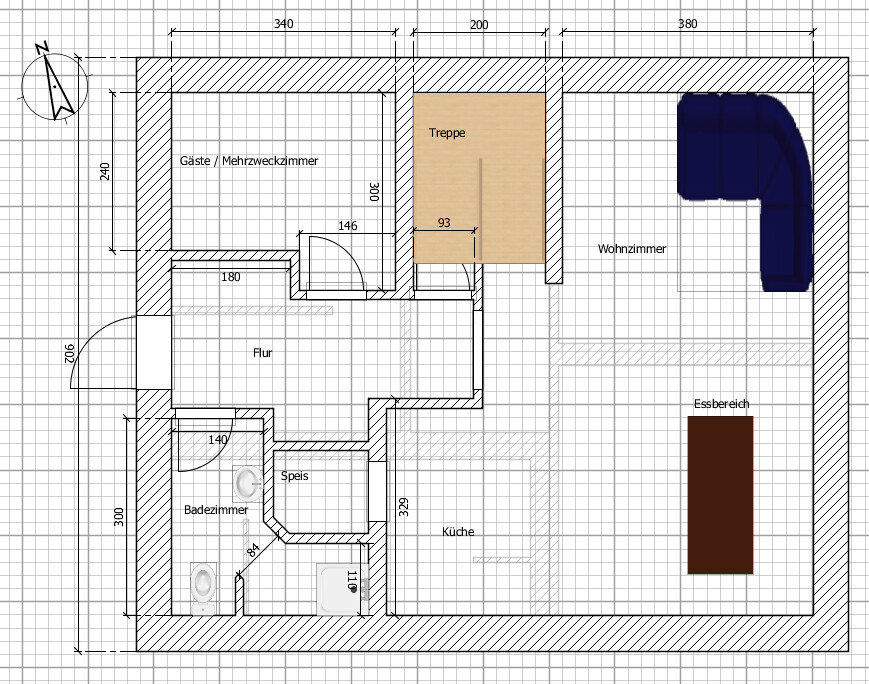
What do you think of the design? Where do you see potential for improvement? Placement of laundry chute?
I look forward to your opinions and comments!
Best regards,
your Gugelhupf

Although we are from Austria and building here, we have been following various posts in this forum for some time. There are many creative minds here, and I really appreciate your advice in the other discussions.
We ourselves have been in the house planning phase for quite a while. We recently purchased a plot of land south of Vienna and plan to start construction in 2020. We want to build with solid construction methods, but we are still deciding between brick (which is very common here) and aerated concrete blocks (we really like the kit house concept from Ytong based on what we’ve heard so far, although it is quite rare in our area).
Efficiency in the use of living space is very important to us (no unnecessary features, no long hallways, no balconies or bay windows), as well as in the building services (heat pump, controlled mechanical ventilation system, etc.).
I assume there isn’t much experience here with Austrian building regulations, so I will try to answer any questions that come up as quickly and competently as possible.
Here is the completed questionnaire:
Zoning Plan / Restrictions
Plot size: 604 m² (6500 ft² approx.)
Slope: No, completely flat
Site coverage ratio: (not applicable here) - 32% buildable area
Floor area ratio: (not applicable here)
Building setback lines and boundaries: front setback 3 m (10 ft), side setback 3 m (10 ft) or half the eave height of the adjoining façade – whichever is greater, rear setback 3 m (10 ft)
Edge building restrictions: within the setback zone up to a maximum height of 3 m (10 ft)
Number of parking spaces: 2
Number of floors: not specified in the zoning plan
Roof shape: no restriction according to zoning plan
Architectural style: no restriction
Orientation: no restriction
Maximum height/limits: max. building height 6.8 m (22 ft) (eave height)
Other requirements: none
Client Requirements
Style, roof shape, building type: classic rectangular shape, gable roof or staggered shed roof, simple building form without bay windows or dormers, no balconies!
Basement, floors: basement (gym, workshop, laundry, mainly storage), ground floor (living areas + guest room), upper floor (bedrooms)
Number of occupants, ages: male 28, female 34, child 0.5 years, child 11 years (every second weekend + school holidays)
Space requirements ground floor, upper floor: ground floor (shower bathroom, guest room/home office/play/multi-purpose room, living room, kitchen, pantry), upper floor (bedroom including walk-in closet, 2 children’s rooms, bathroom), basement (gym, laundry, storage, workshop)
Office: family use or home office?: 80% family use as playroom, 10% home office, 10% guest room
Overnight guests per year: approximately 5, mainly relatives visiting for various celebrations from afar
Open or closed layout: open plan
Conservative or modern construction: rather conservative but open to “unconventional ideas”
Open kitchen, kitchen island: open kitchen with breakfast bar
Number of dining seats: permanently 6, at family celebrations minimum 12 temporarily, >16 long term
Fireplace: no
Music/speaker wall: no – but large TV frequently used
Balcony, roof terrace: definitely no!
Garage, carport: carport within the setback zone (on the north side?)
Vegetable garden, greenhouse: definitely yes! Gardening is a big wish and the main reason for the whole project
Other wishes/special features/daily routines, explanations if desired: The house should be as efficient as possible (during construction and especially in operation), therefore no awkward bay windows etc. (ratio of surface to volume)
Additional requests: controlled mechanical ventilation system, laundry chute, non-load-bearing partition wall between the children’s rooms so it can be removed in a few years if the older child no longer lives at home. The most important thing is a large garden, so that’s why the basement is desired to minimize the building footprint. The kitchen must be large enough for at least two people to cook at the same time – this is currently a problem in our apartment.
House Design
Designed by: DIY with a lot of input from planners
What do you like? Why?: almost all wishes implemented
What do you dislike? Why?: pantry is quite small, upper floor still not quite perfect, niche in the corridor as storage replacement for vacuum cleaner etc.
Price estimate according to architect/planner: €430,000 turnkey, €350,000 “turnkey with owner involvement”
Personal price limit for house, including fixtures and fittings: €350,000 in shell and core condition is the goal, with a comfortable buffer, but that would be our ideal
Preferred heating technology: heat pump with ground source collector (trench collector)
Note: We are not under time pressure for planning or construction. We are very willing and able to do much of the work on the house ourselves. Providing appropriate “self-performance proof” for the bank is not a problem either. This helps keep construction costs low.
If you have to give up something, which details/finishes
- could you give up: almost everything except the pantry and open kitchen
- could you not give up: pantry, open kitchen, and preferably not the controlled ventilation
Why is the design the way it is now?
A mix of many examples from model home parks, magazines, and many discussions with planners/architects etc.
What do you think makes it particularly good or bad?
All the rooms we imagined are present, relatively short circulation routes, hardly any wasted space
What is the most important/basic question about the floor plan in 130 characters?
What do you think of the design? Where do you see potential for improvement? Placement of laundry chute?
I look forward to your opinions and comments!
Best regards,
your Gugelhupf

Nordlys schrieb:
Ant, it really doesn’t matter whether someone is studying, living more with their parents, or if it’s some KfW-related standard, The actual resident structure relevant to the building in the medium term is far from unimportant for the sizing and distribution of the rooms. And I wasn’t referring to KfW, but to the Energy Saving Ordinance. In this forum, we are familiar with the applicable German regulations, but we have little knowledge about the situation in Austria or Switzerland.
Gugelhupf schrieb:
Every bay window, dormer, recess, etc. increases the surface area of the house more than it increases the volume => bad for eligibility for subsidies.
The ideal surface-to-volume ratio is that of a sphere. This principle is also behind the popular square floor plan “town villas” in Germany with as flat as possible hipped roofs. In Germany, the energy assessment has two aspects: subsidies (like KfW) can be pursued voluntarily, but compliance with the legal requirements (Energy Saving Ordinance) is mandatory.
https://www.instagram.com/11antgmxde/
https://www.linkedin.com/company/bauen-jetzt/
boxandroof schrieb:
Saves a lot on initial costs. For an air heating system alone, all conditions really need to be right, and the heating load should not exceed 15W/m². Occupants must adapt their behavior accordingly. I would only consider this for a true passive house, which does not seem to be the case here.At the beginning, KfW 40 and better were mentioned. The heating system works in that case. We have had a pilot system for 13 months.
I would not use it for KfW 40/KfW 50.
Yes, it saves a lot. It balances out the higher cost of the shell construction.
G
Gugelhupf21 Mar 2019 07:42To summarize the last few pages:
KfW 50 is the minimum standard we will build to.
KfW 40 or better is the goal...
Pure air heating is basically not an option for us, even if it would result in a "true passive house."
However, I would now like to steer the discussion back to the floor plan.
This would probably require swapping the guest room and staircase locations. The staircase would then move into the “service area.” The upper floor would have to be completely redone.
Right now, I’m struggling to visualize this…
KfW 50 is the minimum standard we will build to.
KfW 40 or better is the goal...
Pure air heating is basically not an option for us, even if it would result in a "true passive house."
However, I would now like to steer the discussion back to the floor plan.
Gugelhupf schrieb:
An architect we recently spoke with had a suggestion that I would like to open up for discussion here:
The separation between the guest room and living room as a sliding partition wall. This would mean the guest room would have to be planned next to the living room, but then the room could be used as part of the living room about 90% of the time and only separated off when someone actually wants to sleep there (or guests come and the mess is too big to show).
I find this idea basically interesting but I am skeptical because of the downsides (a wall that cannot be adjusted from either side, sound insulation?)... What do you think about this?
This would probably require swapping the guest room and staircase locations. The staircase would then move into the “service area.” The upper floor would have to be completely redone.
Right now, I’m struggling to visualize this…

I have to admit, I find the plot challenging. I’m still stuck in the planning phase.
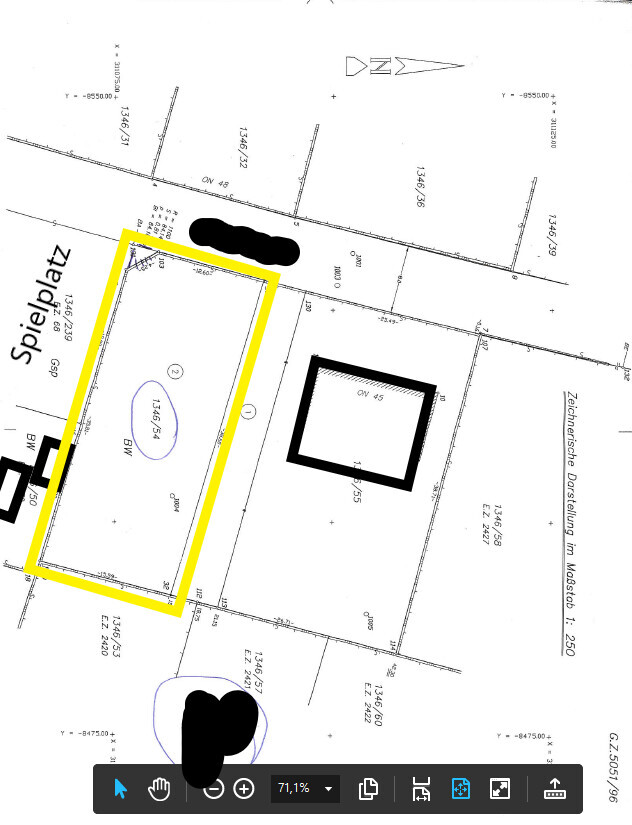
With a width of 16m (52.5 feet) and an east-facing orientation, it’s tempting to go for an 8x12m (26x39 feet) layout and place the terrace on the south side. But: that’s where the playground is!
I once worked next to a playground for a few weeks. If I had a choice, I definitely wouldn’t put my terrace right next to it. When the weather is nice, there tends to be noise and disturbances. It can get so loud that you wish the house would act as a sound barrier in between. However, then you would be sitting on the north side in the dark. The western sun only reaches there quite late in the day, which isn’t very appealing either.
Putting the terrace on the east side doesn’t solve the noise problem either. So what to do? Plan a soundproof wall and still place the terrace on the south? Or have two terraces to have the option?
With a width of 16m (52.5 feet) and an east-facing orientation, it’s tempting to go for an 8x12m (26x39 feet) layout and place the terrace on the south side. But: that’s where the playground is!
I once worked next to a playground for a few weeks. If I had a choice, I definitely wouldn’t put my terrace right next to it. When the weather is nice, there tends to be noise and disturbances. It can get so loud that you wish the house would act as a sound barrier in between. However, then you would be sitting on the north side in the dark. The western sun only reaches there quite late in the day, which isn’t very appealing either.
Putting the terrace on the east side doesn’t solve the noise problem either. So what to do? Plan a soundproof wall and still place the terrace on the south? Or have two terraces to have the option?
G
Gugelhupf21 Mar 2019 08:59We have already considered that...
It might also be important to know that to the north / northwest (although a bit further away and with several rows of houses in between) there is a highway, so there is a constant faint background noise.
The west side is the weather-facing side here. The wind comes from the mountains in that direction.
The southwest side is where the playground is located. While it will probably be mainly used in the coming years by our little one, the house is planned for a much longer term than just the next few years...
So basically, only the southeast side of the house, which faces away from the street, remains. It offers privacy but does not get the evening sun. As an alternative, we are considering a (larger) garden shed in the future at the southeast corner of the property to enjoy the evening sun there. Currently, there is a somewhat dilapidated tool shed in that spot, which will be removed after the house is built. At least the foundation / slab is already in place there.
It might also be important to know that to the north / northwest (although a bit further away and with several rows of houses in between) there is a highway, so there is a constant faint background noise.
The west side is the weather-facing side here. The wind comes from the mountains in that direction.
The southwest side is where the playground is located. While it will probably be mainly used in the coming years by our little one, the house is planned for a much longer term than just the next few years...
So basically, only the southeast side of the house, which faces away from the street, remains. It offers privacy but does not get the evening sun. As an alternative, we are considering a (larger) garden shed in the future at the southeast corner of the property to enjoy the evening sun there. Currently, there is a somewhat dilapidated tool shed in that spot, which will be removed after the house is built. At least the foundation / slab is already in place there.
I would plan a second terrace without a playground. During the day, there are children, and in the evening, teenagers tend to gather. At least that was the case for us when we lived opposite a playground.
Heating is your choice, but I just wanted to mention that there are now two types available specifically designed for houses like these.
Floor plan
Yes, the staircase would move toward the mudroom area. How about adding a vestibule?
Search for Hanse Haus Variant-45-192. It has a vestibule area at the entrance.
The staircase is again outside the mudroom, and the ground floor could be somewhat more relaxed that way.
Heating is your choice, but I just wanted to mention that there are now two types available specifically designed for houses like these.
Floor plan
Yes, the staircase would move toward the mudroom area. How about adding a vestibule?
Search for Hanse Haus Variant-45-192. It has a vestibule area at the entrance.
The staircase is again outside the mudroom, and the ground floor could be somewhat more relaxed that way.
Similar topics