
Hello,
It would be really great if everyone here could just post one or a few pictures showing the current state of their house.
I'll start right away.
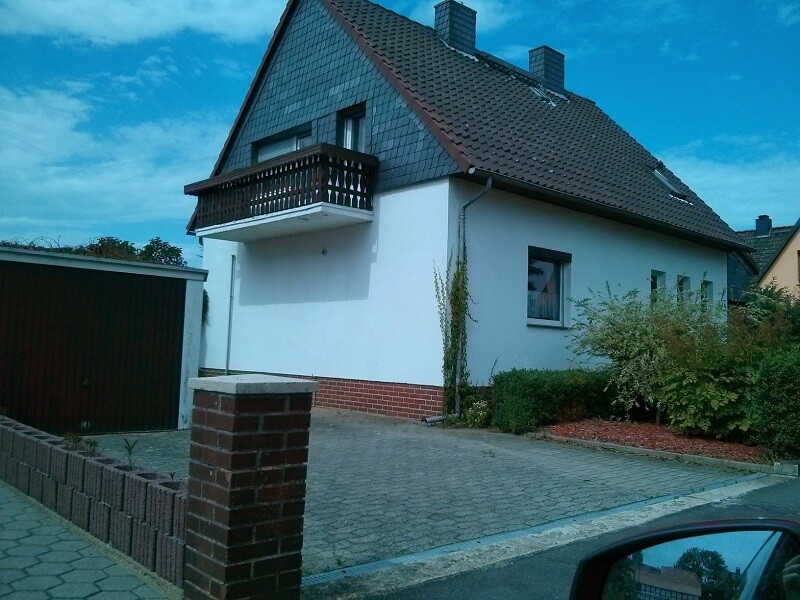
For renovations, it’s best to provide a comparison of before and after the remodeling.
Before March 2014:
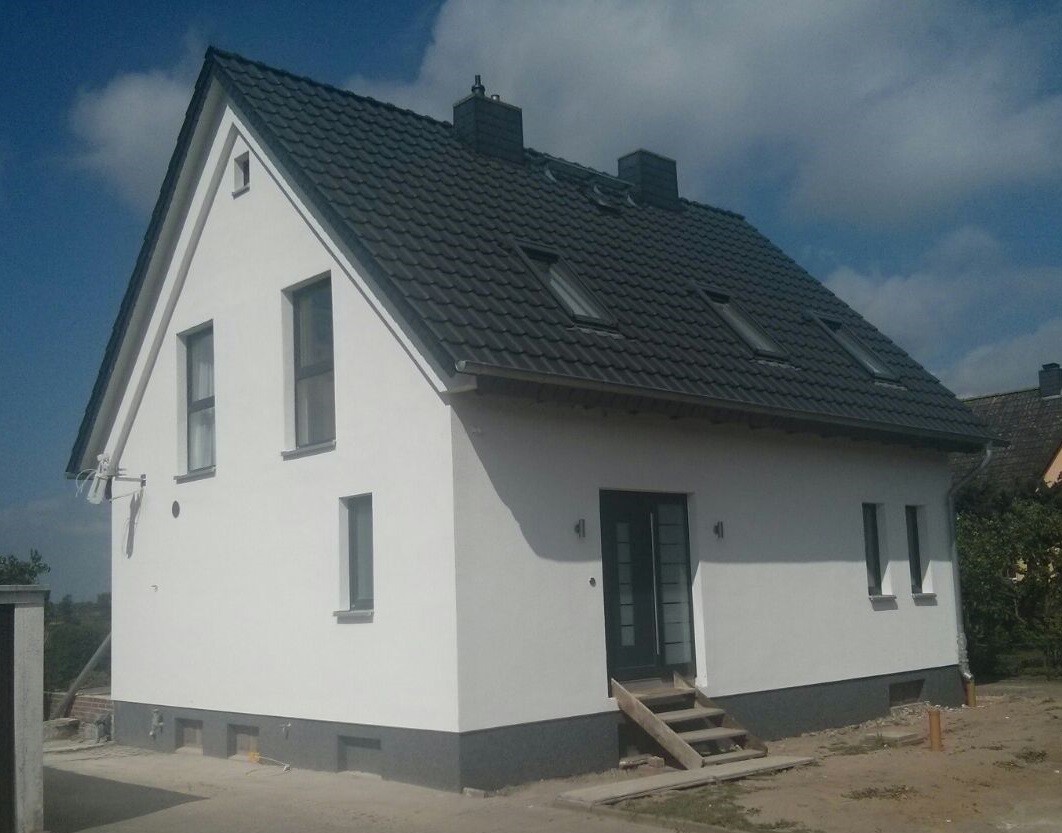
After May 2015:
It would be really great if everyone here could just post one or a few pictures showing the current state of their house.
I'll start right away.
For renovations, it’s best to provide a comparison of before and after the remodeling.
Before March 2014:
After May 2015:

Tom1607 schrieb:
Hello,
from what I could see in the pictures, the electrician used underground cable, not NYM cable, so it is acceptable that he did not use conduit. Using NYM cable on the raw subfloor would not be allowed. Regarding installation zones on vertical edges, it is 10cm (4 inches) from the edge extending 30cm (12 inches) inward (a 20cm (8 inches) zone). On horizontal surfaces, from below 15cm (6 inches) to 45cm (18 inches) (30cm (12 inches)) and similarly from above 15cm (6 inches) to 45cm (18 inches) under the ceiling. All measurements refer to finished floor height, not the raw subfloor. You need to add the floor structure buildup to that!Hello Tom1607,
thank you very much for your explanation, which I find very helpful! So, based on the photos, did my electrician do everything correctly?
Best regards
Axel
I just checked my collection of DIN standards again regarding NYM cables on an unfinished floor. Why does everyone always argue about this...
But in a shell construction, this is impossible since people are constantly walking over the cables. So NYM cables on an unfinished floor should be ruled out, even if it’s not explicitly stated. I don’t want to say anything incorrect here...
According to DIN 18015 Part 3 and DIN VDE 0100 Part 520, cables may be laid on the floor along the shortest route. Cable and wiring systems must be selected and installed so that damage to the sheath and insulation of cables and wires, as well as their connections, is avoided during installation, operation, or maintenance (DIN VDE 0100 Part 520).
But in a shell construction, this is impossible since people are constantly walking over the cables. So NYM cables on an unfinished floor should be ruled out, even if it’s not explicitly stated. I don’t want to say anything incorrect here...
AxelH. schrieb:
Hello Tom1607,
thank you very much for the explanations, which I find very helpful!
So, judging by the pictures, did my electrician do everything correctly?
Hello Axel,
The bend next to the outlet box and the cable running upwards seem borderline to me. Just check whether the 10cm (4 inches) from the edge or the 30cm (12 inches) from the edge (20cm (8 inches) installation zone vertically) have been respected, because if so, the cables are within the installation zone. If not, someone could drill into them since they might assume there are no cables there. Personally, I always run the cables below the outlets. It only takes a little extra effort, but if I see an outlet, I’m cautious above and below it—not 20cm (8 inches) to the left or right of it.
B
Bieber081512 Jun 2018 09:38As far as I can understand from #2953 and #2955, the cables are located inside the insulation layer. According to my interpretation of the DIN standard, this is not permitted.
M
Matthew0312 Jun 2018 10:55daniels87 schrieb:
5x4m (5x13 ft)In the real photo, you have two posts, but in the 3D version, there is a third post in the middle... with the suppliers I've contacted so far, a third post was always required for widths over 4 meters (13 feet)... how come you only have two? I actually prefer that and would like it that way too.
D
daniels8712 Jun 2018 11:33Which snow load zone do you live in? Aluminum tends to sag slightly under weight. If there is currently 40cm (16 inches) of snow on the roof, obviously even more weight is added. There are cross beams with a steel reinforcement core that can span more than 5 meters (16 feet).
The first supplier (and also the most expensive) had a third post in the middle. At that time, I created the 3D model and have not changed it since.
In winter, when snow was on the roof and got soaked through with sleet, you could see the deflection. However, this is only temporary. It was not enough to jam the sliding doors. In an extreme winter, I would either clear the roof as a precaution or place a temporary support post in the middle at the front.
The first supplier (and also the most expensive) had a third post in the middle. At that time, I created the 3D model and have not changed it since.
In winter, when snow was on the roof and got soaked through with sleet, you could see the deflection. However, this is only temporary. It was not enough to jam the sliding doors. In an extreme winter, I would either clear the roof as a precaution or place a temporary support post in the middle at the front.
Similar topics