
Development Plan / Restrictions
Plot size: 774 m² (8,330 ft²)
Slope: 13%, as shown on the site plan
Floor area ratio (FAR): 0.4
Building coverage ratio: 0.5
Building envelope, setback lines, and property boundary: 11 x 15 m (36 x 49 ft), as shown on the site plan
Number of floors: 2 full stories
Roof type: Gable roof, 30° pitch
Orientation: Ridge running NE-SW
Requirements of the Homeowners
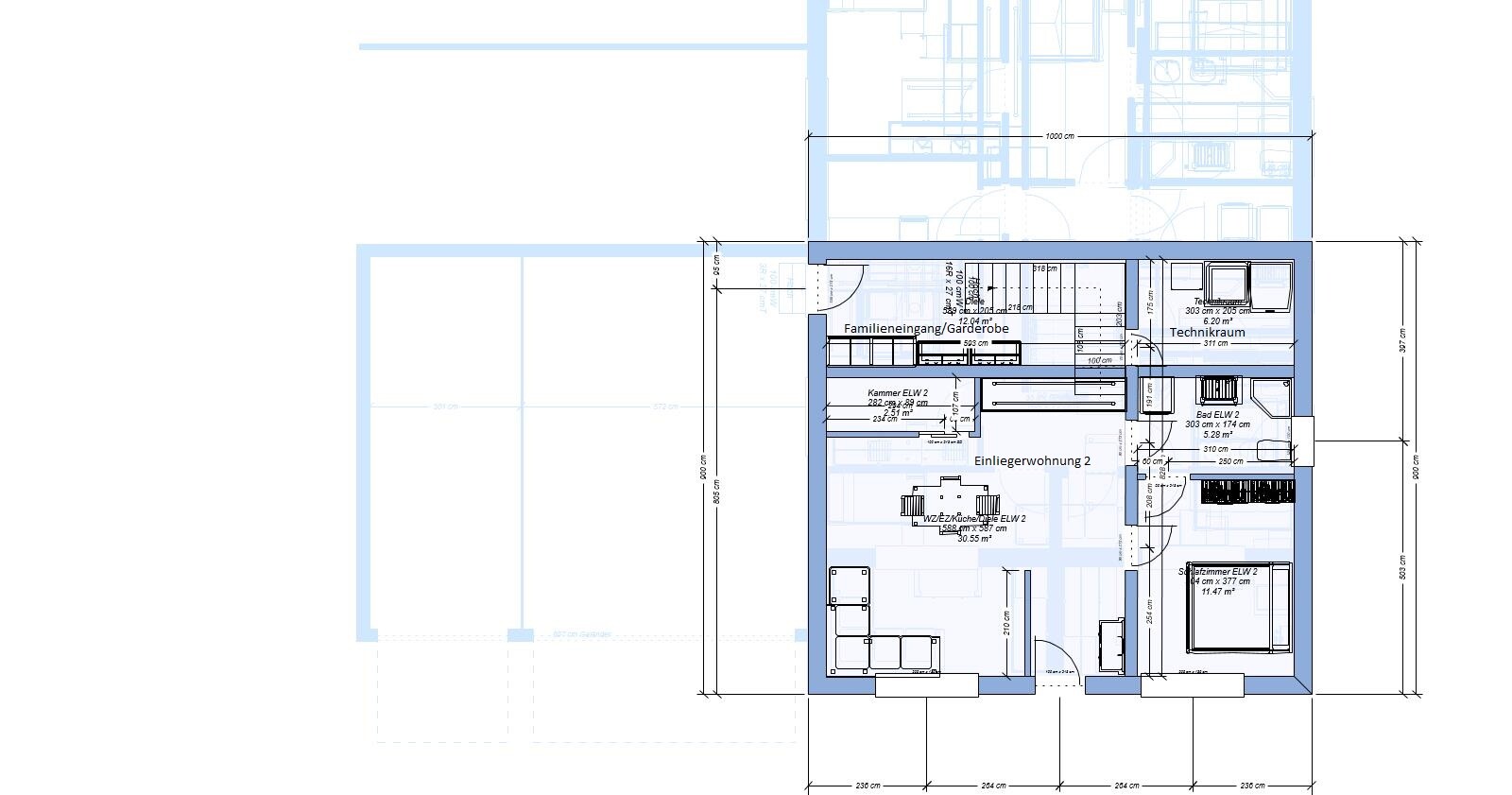
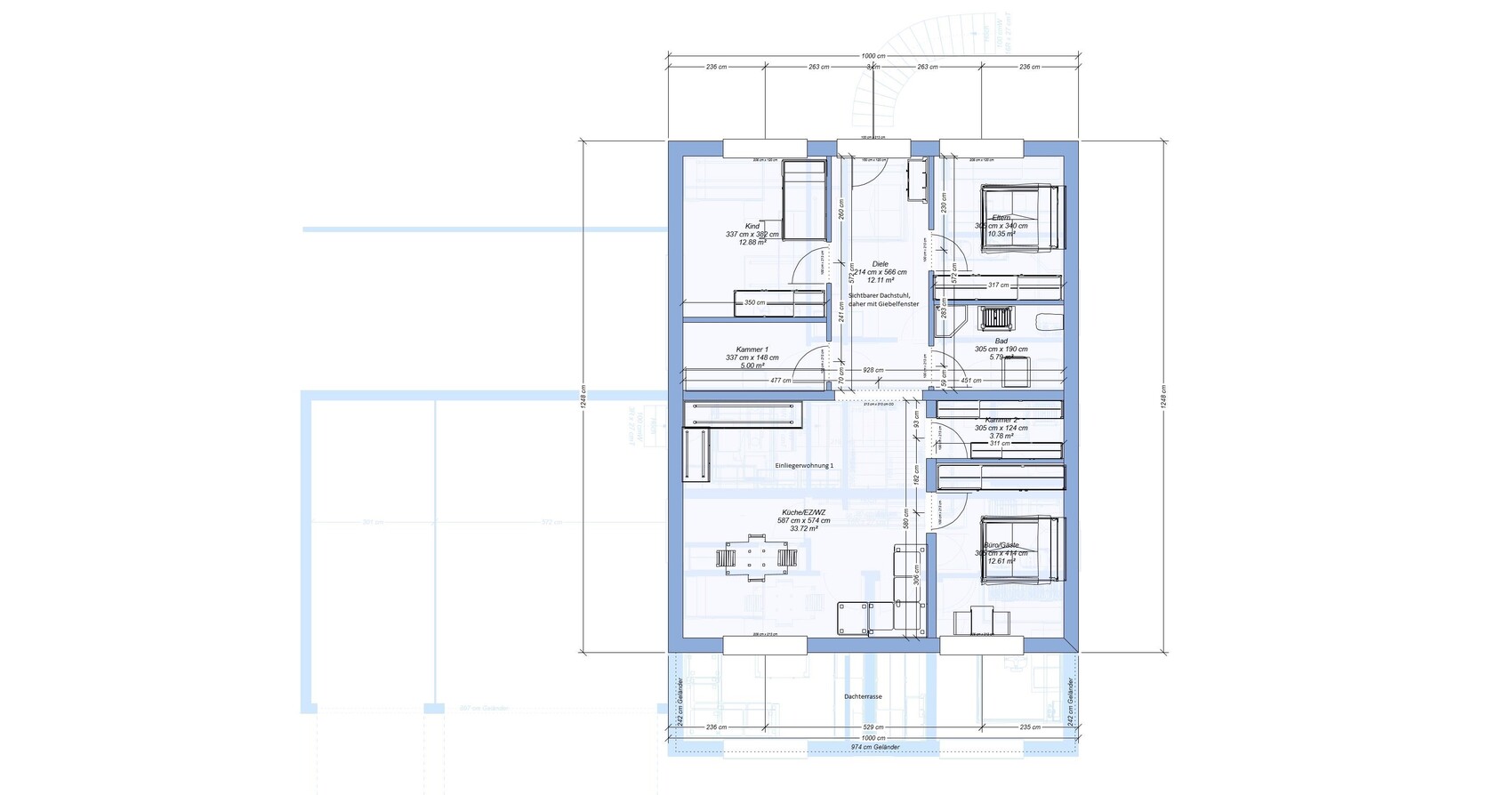
Style, roof type, building type: Main residence with 2 accessory apartments (one in the attic, one smaller in the basement)
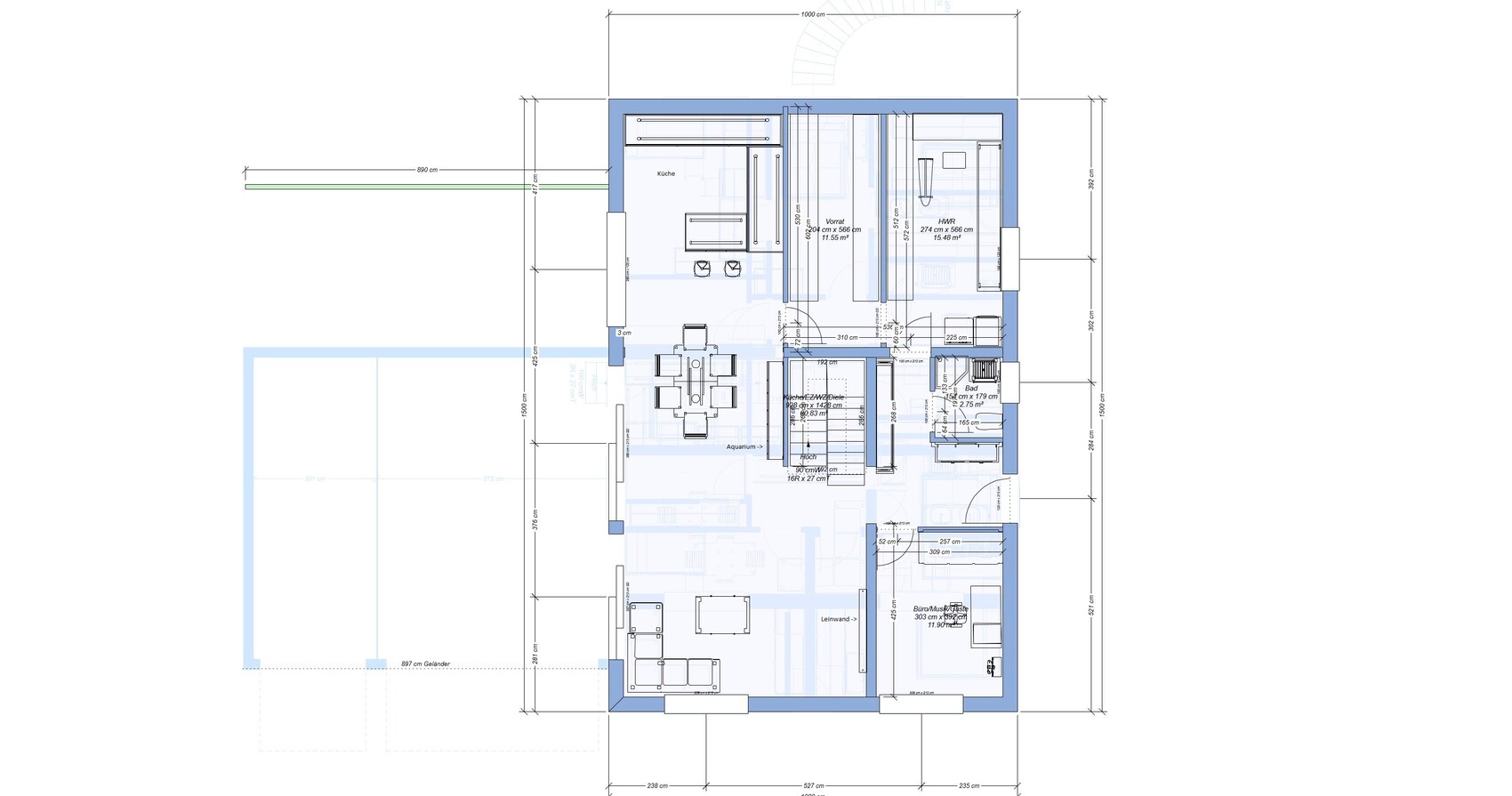
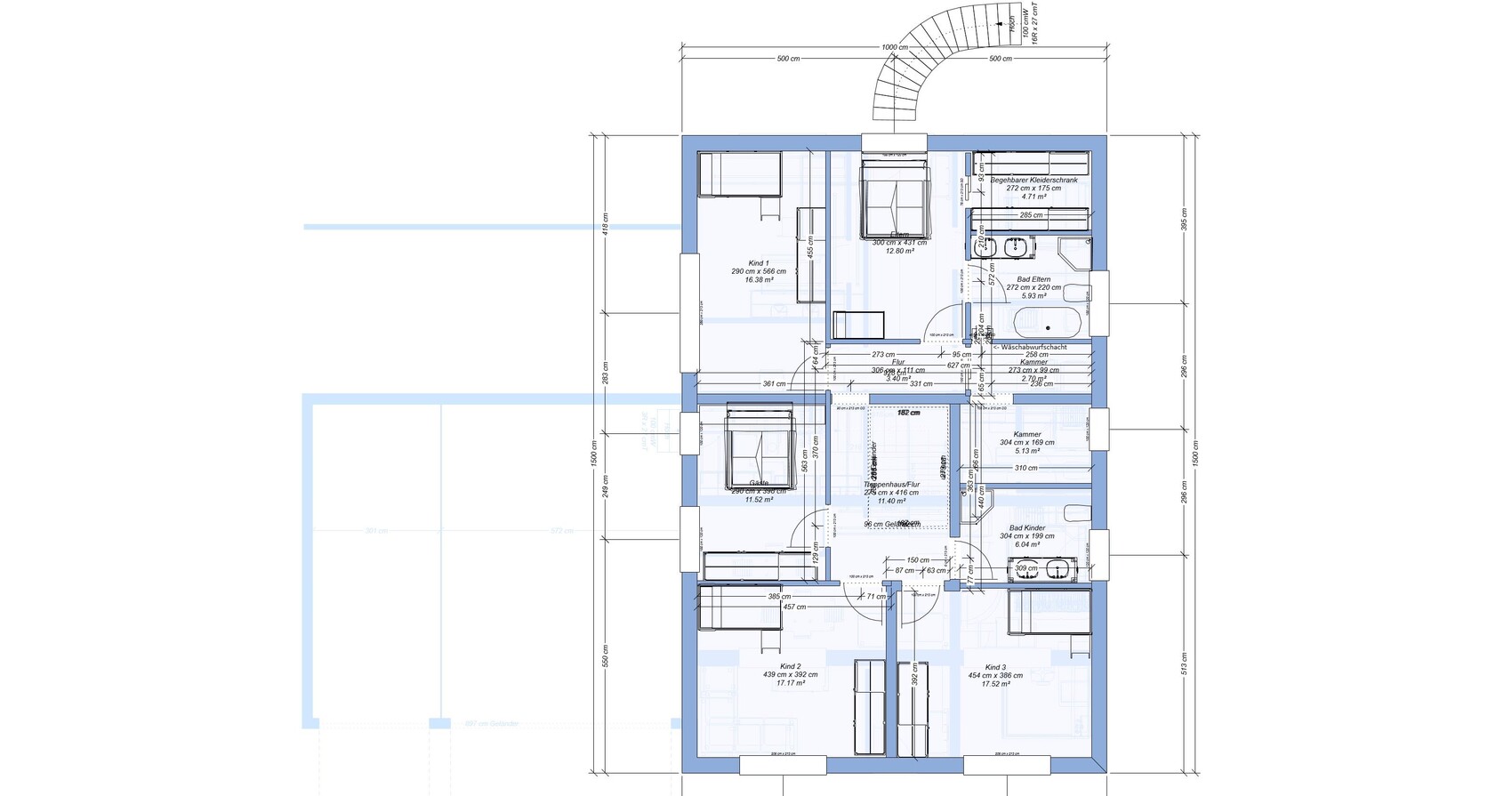
Basement, floors: Basement (UG), ground floor (EG), upper floor (OG), attic (DG)
Number of occupants, ages: 1975m, 1980f, 2007m (mostly lives with partner from previous marriage), 2009f, 2019m, (expected 2020m/f)
Space requirement on ground and upper floor: from 200 m² (2,150 ft²)
Office: Family use
Guests per year: Apart from resident born 2007 (male), about 6
Open or closed architecture: open plan
Traditional or contemporary design: modern
Open kitchen, kitchen island: yes
Number of dining seats: 6
Fireplace: no
Music/stereo wall: Home theater system in the living room
Balcony, roof terrace: Roof terrace in the attic for accessory apartment 1
Garage, carport: 3 garages, 2 parking spaces
Utility garden, greenhouse: A level garden is planned on top of the garages, with lawn and some bushes around.
Other wishes / special features / daily routine, including reasons for preferences:
House Design
Designer: Do-it-yourself
What do you especially like? Why? Plot with significant slope but still a level garden on top of the garages. Accessory apartment 1 with separate entrance from above.
Personal budget for the house, including outfitting: 1 million EUR in a major city in Bavaria
Preferred heating technology: Heat pump with photovoltaic system on the roof facing southwest
If you have to make compromises, which details/features can you do without: Gable window in the attic
Why is the design the way it is? We want to use the (expensive) plot as efficiently as possible.
What is the key/basic question about the floor plan in 130 characters? Where are the mistakes? Suggestions for improvement? Is the plumbing for bathrooms and kitchens sufficient or should I redesign it?
Unfortunately, I can’t accurately represent the terrain in the design software. If needed, I can scan a section drawing to make it clearer. The garden to the left of the house and above the external staircase will certainly be designed differently later. So far, there is no lawn area marked yet.
Many thanks in advance for lots of inspiring ideas

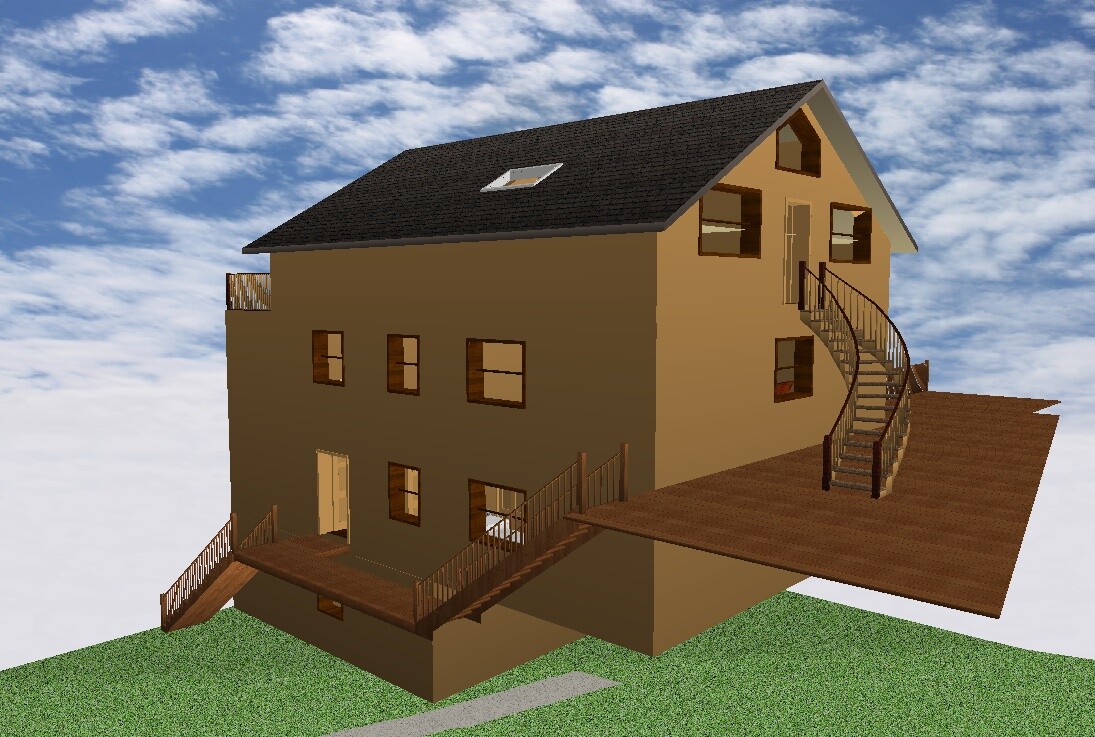
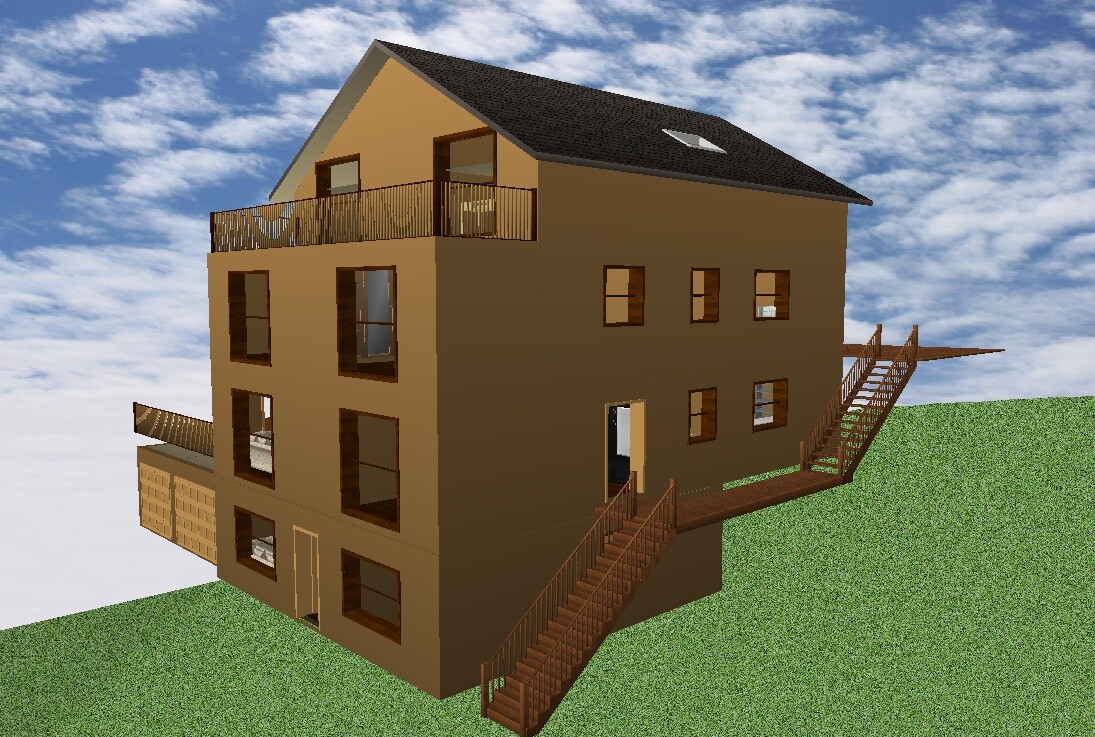

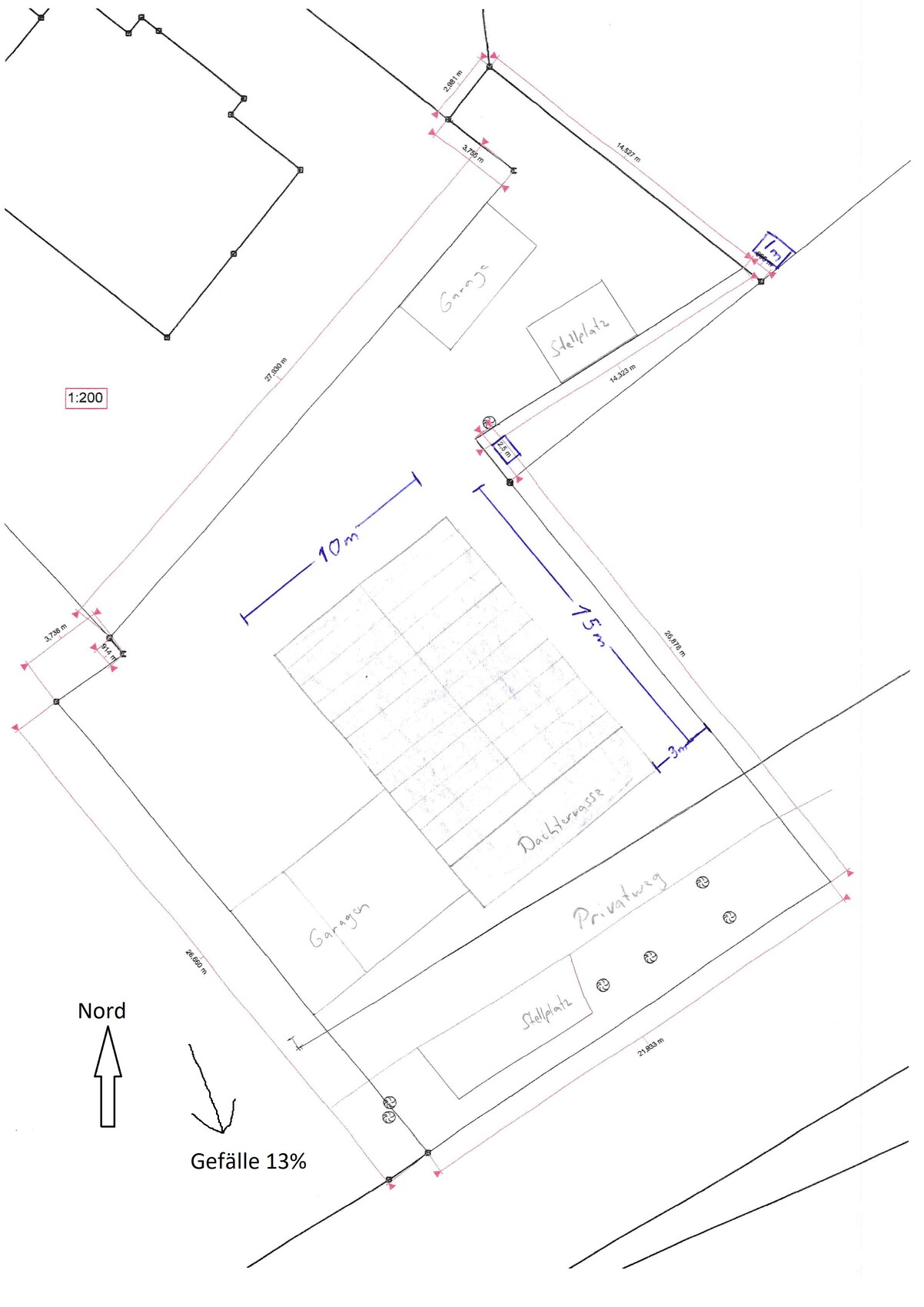
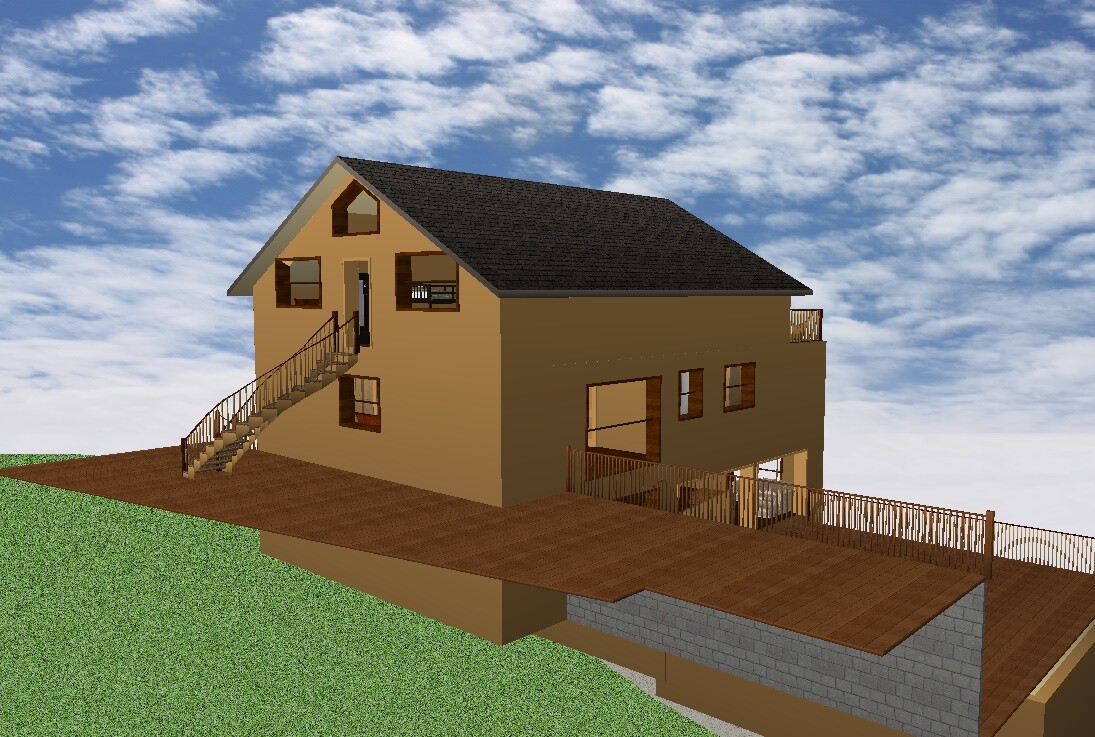
Plot size: 774 m² (8,330 ft²)
Slope: 13%, as shown on the site plan
Floor area ratio (FAR): 0.4
Building coverage ratio: 0.5
Building envelope, setback lines, and property boundary: 11 x 15 m (36 x 49 ft), as shown on the site plan
Number of floors: 2 full stories
Roof type: Gable roof, 30° pitch
Orientation: Ridge running NE-SW
Requirements of the Homeowners
Style, roof type, building type: Main residence with 2 accessory apartments (one in the attic, one smaller in the basement)
Basement, floors: Basement (UG), ground floor (EG), upper floor (OG), attic (DG)
Number of occupants, ages: 1975m, 1980f, 2007m (mostly lives with partner from previous marriage), 2009f, 2019m, (expected 2020m/f)
Space requirement on ground and upper floor: from 200 m² (2,150 ft²)
Office: Family use
Guests per year: Apart from resident born 2007 (male), about 6
Open or closed architecture: open plan
Traditional or contemporary design: modern
Open kitchen, kitchen island: yes
Number of dining seats: 6
Fireplace: no
Music/stereo wall: Home theater system in the living room
Balcony, roof terrace: Roof terrace in the attic for accessory apartment 1
Garage, carport: 3 garages, 2 parking spaces
Utility garden, greenhouse: A level garden is planned on top of the garages, with lawn and some bushes around.
Other wishes / special features / daily routine, including reasons for preferences:
- Ground-level family access via garage and ramp into the basement. Guest entrance on the right side into the ground floor.
- Separate external staircase leads directly to accessory apartment 1 in the attic. This unit also has a private entrance from above (north side) with garage and parking space (see site plan).
- Accessory apartment 2 has direct access from the private driveway to the basement and the garage at the left property boundary.
- Since we are a large family, laundry is often left in the living room. This should change, so we want a generous utility room (with marked ironing board) on the ground floor and possibly an additional ventilation system.
- The private driveway is used only by us and one other neighboring property behind us. The surroundings have many trees, so there is no real view.
- Large sliding glass doors from the dining room to the terrace/garden.
- Good soundproofing between attic / upper floor and ground floor / basement.
House Design
Designer: Do-it-yourself
What do you especially like? Why? Plot with significant slope but still a level garden on top of the garages. Accessory apartment 1 with separate entrance from above.
Personal budget for the house, including outfitting: 1 million EUR in a major city in Bavaria
Preferred heating technology: Heat pump with photovoltaic system on the roof facing southwest
If you have to make compromises, which details/features can you do without: Gable window in the attic
Why is the design the way it is? We want to use the (expensive) plot as efficiently as possible.
What is the key/basic question about the floor plan in 130 characters? Where are the mistakes? Suggestions for improvement? Is the plumbing for bathrooms and kitchens sufficient or should I redesign it?
Unfortunately, I can’t accurately represent the terrain in the design software. If needed, I can scan a section drawing to make it clearer. The garden to the left of the house and above the external staircase will certainly be designed differently later. So far, there is no lawn area marked yet.
Many thanks in advance for lots of inspiring ideas
When developing from below, you can also do more than just add a garage underneath; for example, you can elevate the house with a basement, either for storage space or an accessory apartment.
I am thankful every day to my ancestors who painstakingly excavated the mountain step by step. Otherwise, we would face the same issues as with exposed concrete. It all adds up: some areas need to be excavated, others filled in, some parts require retaining structures. Everything is a bit more complicated and expensive (structural engineering) to make the site usable as if it were nearly level ground.
I would build the house without an accessory apartment.
Basement: entrance, cloakroom, home office, building services, storage room
Ground floor: kitchen, dining, living, 1 children’s bedroom
Direct garden access opening the summer living and dining area with a small play corner for toddlers.
Upper floor: remaining bedrooms, with hallway access to the garden
At the garden, develop the slope with a shaded play area.
Next garden level with a south-facing terrace for transitional seasons (too hot in summer). It should be high enough and not shaded by the house.
Garage and house can switch places.
If possible, I would plan 2 children’s bedrooms in the basement and accommodate the two older children there.
I am thankful every day to my ancestors who painstakingly excavated the mountain step by step. Otherwise, we would face the same issues as with exposed concrete. It all adds up: some areas need to be excavated, others filled in, some parts require retaining structures. Everything is a bit more complicated and expensive (structural engineering) to make the site usable as if it were nearly level ground.
I would build the house without an accessory apartment.
Basement: entrance, cloakroom, home office, building services, storage room
Ground floor: kitchen, dining, living, 1 children’s bedroom
Direct garden access opening the summer living and dining area with a small play corner for toddlers.
Upper floor: remaining bedrooms, with hallway access to the garden
At the garden, develop the slope with a shaded play area.
Next garden level with a south-facing terrace for transitional seasons (too hot in summer). It should be high enough and not shaded by the house.
Garage and house can switch places.
If possible, I would plan 2 children’s bedrooms in the basement and accommodate the two older children there.

haydee schrieb:
When developing from below, you can also insert more than just a garage underneath, or raise the house with a basement, either for storage space or as an apartment. For the so-called "Eureka moment" of creating a terrace on top of a double garage, see here: https://www.hausbau-forum.de/threads/grundrissplanung-Einfamilienhaus-an-suedhanglage.30386/
https://www.instagram.com/11antgmxde/
https://www.linkedin.com/company/bauen-jetzt/
kbt09 schrieb:
You haven’t addressed the fundamental design flaws of the floor plan at all. The hallway in the children’s/parents’ area is 275 cm (108 inches) wide... for both the corridor and the staircase landing... that’s already a problem, so it’s pointless. Hello kbt09, I just tried to understand that again, but unfortunately I have no idea what you mean... oops: Could you please explain it once more?
kbt09 schrieb:
With a 200 cm (79 inches) knee wall, the windows, which are also supposed to have roller shutters, end at a maximum height of 160 cm (63 inches), meaning the glass reaches up to about 150 cm (59 inches). So when you enter the rooms, your view mostly faces the wall. You are absolutely right about that. Therefore, I increased the knee wall height to 260 cm (102 inches). The question is: is that allowed?
kaho674 schrieb:
To me, this all looks like a "novice with heavy machinery."
I see a huge box that seems to be driven by the mistaken belief that the plot must be built to the maximum. Why, however, is unclear. Is the goal to avoid any lawn or bushes at all costs? Is the million-dollar budget meant to be spent no matter what? Is a representative hut needed to boost self-esteem? Or are they building two granny flats for a nanny and butler as well? What exactly? Novice is absolutely correct. That’s exactly why I’m here—to gather information. Of course, I will continue planning this with an architect. The rest of your comment is incredibly annoying and just sounds like jealousy! I can do without that. Or was there really a serious question in there?
kaho674 schrieb:
The slope only adds to the original poster’s confusion, since as a layperson, they naturally lack ideas for appropriate use. Well then, why don’t you share your ideas? What constructive input do you have, please?
11ant schrieb:
Such knee walls don’t appear in the dream homes of football referees – they know what "offside" means.Okay, if I understood the information correctly, tall knee walls are rather out of fashion.
This morning we visited the building authority, which informed us there is an issue with the setback area. We recalculated several times and concluded that the double garage needs to be narrower so the house can be shifted slightly to the left. We tested this with 1.50 m (5 feet), resulting in a critical corner distance of 441 cm (14 feet 5 inches) to the neighboring property (see draft 7.0). Of course, the terrace and the garden on the south side of the plot will also become narrower.
There are two options for calculating the setback area:
1. We make the upper floor a full storey without a knee wall and add an attic with a 50 cm (20 inch) knee wall. Since in setback calculations a storey with sloping roof is counted as one-third, this approach is unfavorable (see attached drawing "Setback Calculation") with a distance of 4.99 m (16 feet 4 inches). We would be missing 58 cm (23 inches), which we would have to take, for example, from the garage again.
2. We increase the knee wall height on the upper floor from 200 cm (6 feet 7 inches) to 260 cm (8 feet 6 inches), which results in a distance of 3.91 m (12 feet 10 inches). That would of course be much preferred, allowing us to make the garage about half a meter wider again. The question is: is that allowed? And does it make sense? You said that such high knee walls are out of style. Is there a maximum knee wall height allowed to apply the one-third calculation?
11ant schrieb:
And after that, a look at @sichtbeton82 is recommended – in his thread https://www.hausbau-forum.de/threads/grundrissplanung-für-zfh-im-Hang.24435/ you can not only commiserate about current budget overruns, but also see an example of how to group dark rooms on the uphill side in challenging hillside building conditions. Here, too, there is (only one) self-contained flat upstairs, but the access is also from the uphill side – which requires a different approach.I will check that out, thank you very much.

Ikearegal schrieb:
A layperson is absolutely right. That’s why I’m here—to gather information. Then remember the most important fact: being an architect is not your job.
Ikearegal schrieb:
Of course, I will continue planning everything with an architect. You’ll get much better results if you let them handle it entirely. You can always add your own ideas later.
Ikearegal schrieb:
...sounds like jealousy!... Or was that really a serious question? My house is already built—so, no thanks. But clearly, there was a question. Why do you need two granny flats? You can say it openly. It’s anonymous here, so even if one of them is meant to be a torture chamber, no one here cares.
Ikearegal schrieb:
Then go ahead and share your ideas! What constructive suggestions do you have? Look, I’ll take the liberty to claim that I’m probably the one offering the most floor plan proposals here. But I’m now sorting out when it makes sense and when it would be a waste of time. There’s still way too much nonsense mixed in.
Similar topics