
L
Lulu2411824 May 2017 16:44Hello everyone,
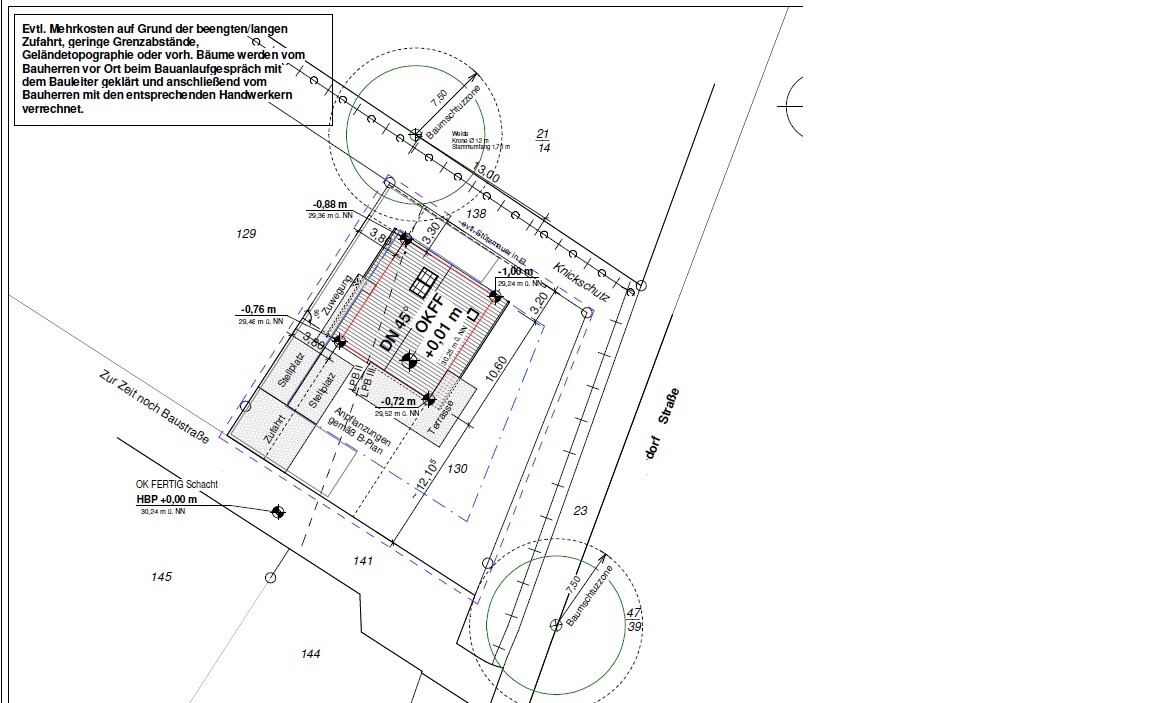
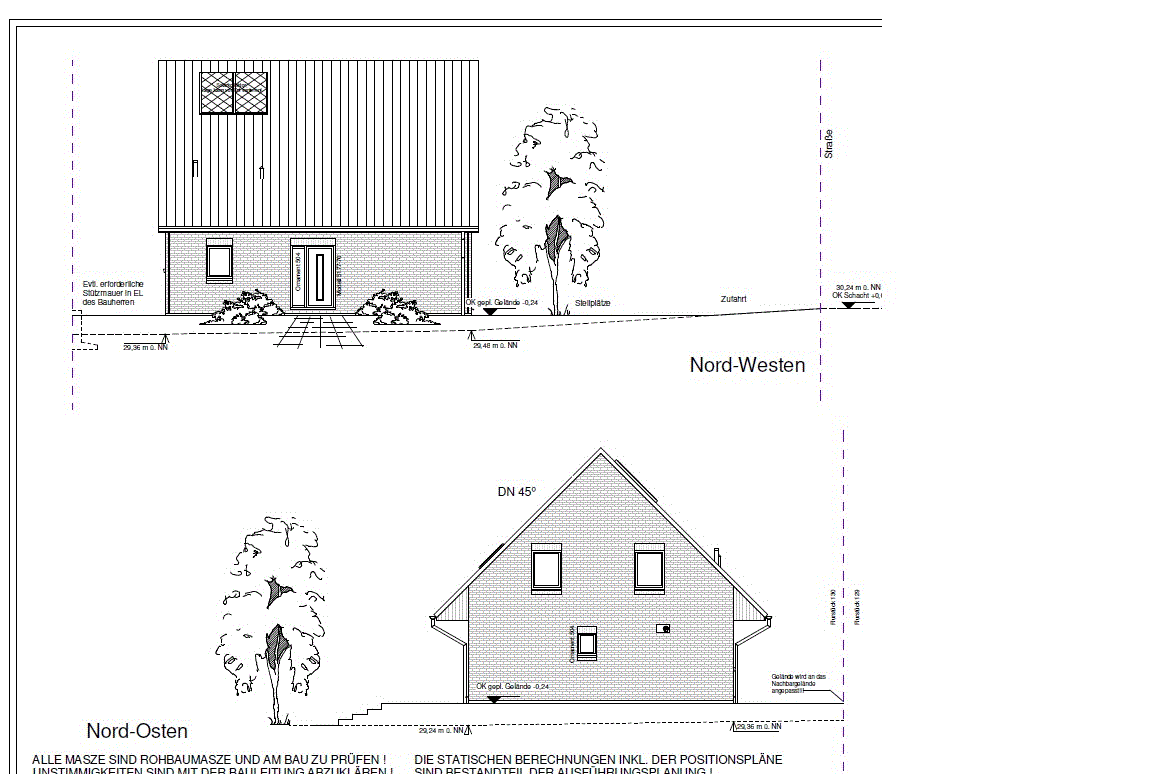
We submitted the building notification on Monday and only at that time did we receive the final height specifications.
Here is what resulted:
- 30.24 m above sea level (99.21 ft) top edge of finished shaft
- 30.00 m above sea level (98.43 ft) top edge of planned ground (-0.24 m)
- 30.25 m above sea level (99.21 ft) top edge of finished floor (+0.01 m)
We need to fill about 1 m (3.3 ft) at the lowest point.
The top edge of the finished floor is therefore just 1 cm (0.4 inches) above street level, and the planned ground is just below (-0.24 m / -9.4 inches). What do you think of the values above? Am I maybe too low? Of course, I would like to avoid a lifting station or any kind of backwater protection.
We submitted the building notification on Monday and only at that time did we receive the final height specifications.
Here is what resulted:
- 30.24 m above sea level (99.21 ft) top edge of finished shaft
- 30.00 m above sea level (98.43 ft) top edge of planned ground (-0.24 m)
- 30.25 m above sea level (99.21 ft) top edge of finished floor (+0.01 m)
We need to fill about 1 m (3.3 ft) at the lowest point.
The top edge of the finished floor is therefore just 1 cm (0.4 inches) above street level, and the planned ground is just below (-0.24 m / -9.4 inches). What do you think of the values above? Am I maybe too low? Of course, I would like to avoid a lifting station or any kind of backwater protection.

Hello,
the base of the inspection chamber is very important; you need to be clearly above it to ensure that water can flow into the sewer by gravity.
If you have a basement, it's almost impossible to avoid a backwater valve or a lifting station.
Without a basement, you generally don’t need these, except for a walk-in shower on the ground floor. Every drain must be higher than the top edge of the finished inspection chamber.
Keep in mind that the top edge of the finished inspection chamber is sometimes specified without the final asphalt layer (this is the case for us), and house construction is not always perfectly precise. (For example, our house is 3 cm (1.2 inches) too low.) What starts as a +1 cm (0.4 inches) difference in height can quickly turn into -5 cm (-2 inches).
So, don’t plan too tightly.
Best regards,
Andreas
the base of the inspection chamber is very important; you need to be clearly above it to ensure that water can flow into the sewer by gravity.
If you have a basement, it's almost impossible to avoid a backwater valve or a lifting station.
Without a basement, you generally don’t need these, except for a walk-in shower on the ground floor. Every drain must be higher than the top edge of the finished inspection chamber.
Keep in mind that the top edge of the finished inspection chamber is sometimes specified without the final asphalt layer (this is the case for us), and house construction is not always perfectly precise. (For example, our house is 3 cm (1.2 inches) too low.) What starts as a +1 cm (0.4 inches) difference in height can quickly turn into -5 cm (-2 inches).
So, don’t plan too tightly.
Best regards,
Andreas
Similar topics